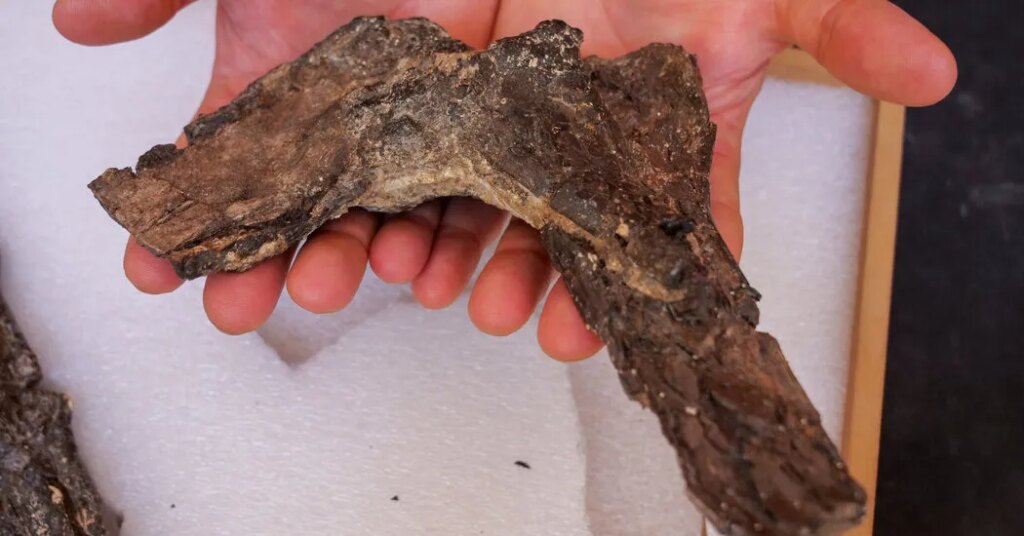
Dinosaurs have always felt far removed from mankind, their presence known only from dusty bones and fossils, perhaps an ancient trail of footprints. Now, for the first time, researchers claim to have discovered traces of red blood cells in a 115-million-year-old bone from the species Aratasaurus museunacionali, a meat eater from the early Cretaceous Period.
“We’re not suggesting that we have intact blood, like you would find in a vial,” said Kliti Grice, a geochemist at Curtin University in Perth, Australia, and the lead researcher of the study. It was published on Monday in the journal Proceedings of the National Academy of Sciences.
That is to say, the scientists haven’t found dried dinosaur blood but rather the chemical fingerprints of heme, the iron-rich molecule in hemoglobin, which is the protein that gives blood its deep-red color.
“The chemical signals associated with the original biology that have undergone complex fossilization and mineralization — that’s what we’re looking at,” Dr. Grice said.
Unlike bones and teeth, soft tissues like muscles and skin decay rapidly. Only in rare and specialized environmental conditions can they be preserved in fossils. Cells from bodily fluids are even more rare.
The news of the discovery has excited the paleontology community. But some are hesitant to celebrate.
“The data are intriguing but not utterly convincing,” said Mary Schweitzer, who three decades ago became the first paleontologist to discover fossilized blood vessels and soft tissue in ancient bone.
Dr. Schweitzer questioned the discovery, reasoning that the cells found by Dr. Grice did not display evidence of a “nuclear bulge,” characteristic of vertebrate red blood cells (except those of mammals and certain salamanders and fish).
In 1997, the paleontologists David Martill and David Unwin set forth four criteria needed to establish evidence of red blood cells in fossil bones: The structures found must bear strong likeness to red blood cells of the given organism, if known; be a similar size to cells in existing relatives; be in high abundance; and contain biomarkers, like heme compounds.
To Dr. Schweitzer, the cells described in the study meet none of these criteria.
“The morphology of these structures is challenging,” Dr. Grice said in response. “They have been mineralized, and mineralization does change the shape and structure of what was originally there.”
The absence of a reference point is perhaps the biggest challenge. No one knows what a dinosaur’s blood cells looked like.
The scientists could compare their newly discovered structures to the cells of living relatives of dinosaurs, like birds and crocodiles. But those cells haven’t been weathered by millions of years’ worth of organic and chemical processes.
The chemistry tells the story, Dr. Grice said. The structures were in the right location, in the Haversian canal, which acts as a tunnel within the bone to deliver blood cells.
“How can we say this is not a mineralized blood cell of a dinosaur?” Dr. Grice asked.
She and Dr. Schweitzer agree on one thing: Dinosaur blood matters.
“Dinosaurs have an awful lot to teach us,” Dr. Schweitzer said. They roamed Earth as the dominant terrestrial species on every continent for about 180 million years. Humans have been around a minuscule fraction of that time, about 300,000 years.
And dinosaurs thrived in an environment high in carbon dioxide, at least twice as much as any human has lived in.
Museums around the world have many specimens collecting dust, Dr. Grice said. She said she thought that if we were to take a closer look at these fossils, “we would find extraordinary molecules and start to unravel evolution and history.”
Studying ancient organisms can also give us insight into medicinal practices today. In the case of mineralization of organic material, these processes can inform our efforts to preserve soft tissue for research.
“Their red blood cells can tell us a lot about their physiology,” Dr. Schweitzer said. “It might behoove us to look at the molecular makeup of dinosaurs and figure out, is there some insight there?”
The post Did These Scientists Find Evidence of Blood in a Dinosaur Bone? appeared first on New York Times.