Send questions about the office, money, careers and work-life balance to [email protected]. Include your name and location, or a request to remain anonymous. Letters may be edited.
Dear Work Friend,
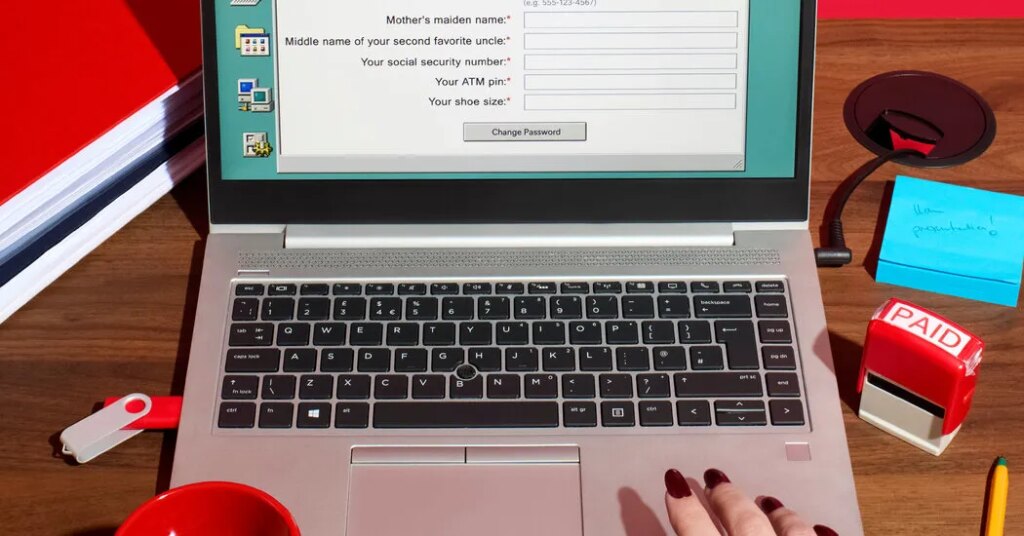
The company where I’ve been working for five years has decided that in order to reset or get help with our passwords, we have to prove who we are. This means we have to give them our personal phone numbers, and our personal email addresses.
I find that demand incredibly invasive, and so far I have not given them that information. I haven’t had to reset my password, so I haven’t had any need to contact I.T.
Here’s my question: Is this legal? Can they demand that we give them our personal information, and deny our request to reset our passwords if we refuse?
Thanks,
Anonymous
I have to say I’m a little taken aback: I didn’t know it was still possible to have the kind of job where you have a password that might need resetting and an employer who doesn’t already have your personal phone number or email address on file somewhere. Every white-collar job I’ve ever had has tended to involve an increasingly elaborate and detailed on-boarding process, during which I willingly hand over all kinds of personal information just in the hopes it will end soon. After all, they already have my Social Security number — what’s an email address or a phone number besides? I’ll give them my blood type if payroll processing depends on it.
The truth is, I respect your strong commitment to privacy, both as a philosophical matter and because it feels like a great comedy bit. But to answer your question, at least in the United States, it’s almost certainly legal for your employer to make access to its systems conditional on your personal contact information. And in its defense, it’s trying to prevent phishers from impersonating you as a means of infiltration. This seems like a fair enough reason to know your phone number.
The good news is that you don’t really need to die on this hill. It’s extremely easy to set up a single-use email address specifically for the purpose of mollifying I.T., and if you sign up through Google’s Gmail, you can get yourself a phone number through Google Voice. You can provide this dummy email address and phone number to your employer, and either set them up to forward messages and calls to your real contacts or just check them in the event you need to reset your password. I.T. will be happy, and you’ll remain a mystery to your bosses.
Can I Ghost My Mentee?
Dear Work Friend,
I have been working in my professional services field in my city for several decades. After a beloved colleague died, a younger woman he had mentored asked me to fill his shoes. I was a bit surprised, as I did not know her very well, but I agreed to meet with her periodically.
After spending time with her over the last year or so, I have come to the conclusion that she is not particularly talented in our field. Her knowledge and expertise are below what I would expect given her years of experience. She makes significant mistakes. She sometimes does not seem to understand the applicable rules and principles and is prone to act in an immature manner. Moreover, she has unrealistic expectations of her job prospects given her level of experience and expertise. I would have difficulty recommending her for a job.
What are my obligations in this circumstance? She has not asked for an assessment of her skills or qualifications; rather, she is seeking advice on how to apply for other positions. Do I gradually become less available? Ghosting seems excessive and rude, but I don’t have unlimited time. There are several other professionals I am enthusiastically mentoring or sponsoring at the moment.
Anonymous
Given that the woman asked you herself to be her mentor, and you didn’t make any deathbed promises of guidance and protection to your departed colleague, I think your only obligation is honesty. I’m not saying you need to tell her that she’s “not particularly talented,” or that her mistakes are “significant,” or that she’s “immature” and has “unrealistic expectations.” But if she’s looking for help in applying to other positions you need to communicate to her that she is not ready for these jobs, and tell her specifically how and where to improve, even if that’s not what she’s explicitly asking for.
In doing so, though, you also need to hold your contempt for her in abeyance. It’s quite clear from your letter that you don’t like this woman very much, and that fact, more than her lack of skills or knowledge, is the reason to end your relationship with her. She asked you to be her mentor, presumably because she believed you could help her, and you have decided that she is beyond help. If you can’t or won’t help her, no one is getting anything out of the relationship as it currently exists.
I agree that ghosting is excessive and rude. So, too, would be telling her that she’s a dummy who will never get a good job, even if it’s what you believe. Instead, dump her gently, as you might a person you’d been dating for a short time. (This is ultimately a fairly casual relationship — as you note, you’re not exclusive.) Tell her that you don’t think you can help get her the kinds of jobs she’s looking for, that you’re too busy with your work to make yourself available and that you don’t think the two of you are a good match for a mentorship relationship. If you let her down easy enough, she might even thank you, and you can return your attention to the mentees you like.
A Mother’s Work
Dear Work Friend,
I supervise a four-person team, and May is our crunch time. One of our veteran team members, who had her first child last year, came to tell me in April that she didn’t think she could finish her final reports on time. She said she was too busy during the workday because our workload has increased somewhat this year. (The rest of the team is coping well with the increased workload.) Completing these detailed reports is the crux of the job and one of the reasons our team is paid more than other teams at our company.
I know that in previous years, she, like the rest of us, had worked on some weekends during the months of April and May to finish the reports on time, so I asked her if she had been working on the weekends. She said she was offended by the question because she needed to spend every possible minute bonding with her baby and therefore she wasn’t going to work outside of office hours. She told me I was being insensitive and then asked if she could offload some of her other work onto her colleagues in order to make time to complete her reports during the workday. Her job description mentions working on evenings and weekends, as needed. How would you respond to this situation?
Anonymous
For better or worse, the first thing you should do is consult your H.R. department. While in some locations caregivers specifically have protected status, in others treating mothers differently can run afoul of federal sex-discrimination laws. And though it sounds like the expectation that your team work nights and weekends is documented and uniform, you’ll want to at least have some guidelines from human resources before you pick up the conversation.
Beyond that, I think you should do your best to respond with compassion. People adjust to parenthood at different speeds, and a first child especially can radically reorient your life and change your ability to maintain a healthy work-life balance. The additional strain (and sleep deprivation) can make anyone sensitive and quick to anger.
But parents do, generally, want to work, too, so you probably want to have a gentle conversation with your employee about whether this is a one-year adaptation or a new expectation. If it’s the former, you as a manager will have to decide whether, and how, to accommodate her with a reduced workload, in consultation with H.R. and, of course, the other members of your team, who deserve compassion and consideration around their schedules, too. (Though perhaps they’d be eager to help alleviate their co-worker’s burden.)
If she’s confident that working nights and weekends is no longer an option for her, then the most respectful and helpful thing you can do is communicate plainly that the role as she currently inhabits it is no longer a good fit. Perhaps a different team would work better for her, if that is a possibility — or perhaps she would like a grace period to find a new position elsewhere that would give her the kind of work-life balance she seeks.
The post Can My Company Force Me to Reveal My Personal Email? appeared first on New York Times.