Lower Lake, CA — Two years after The Times found that cannabis sold at California dispensaries contained alarming levels of pesticides, the safety of the state’s legal weed remains a crapshoot, as government regulators fail to keep up with an ever-evolving slate of hazardous chemicals or crack down on the growers using them.
A new round of tests commissioned by The Times shows that even as many major cannabis brands have cleaned up their products, others are using pesticides off the state’s radar.
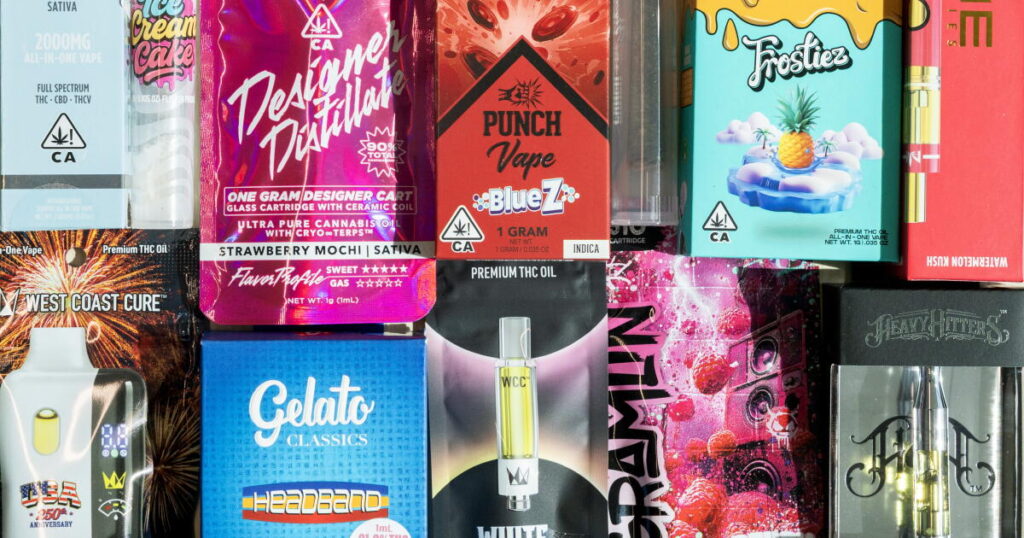
Brands, including Stiiizy and West Coast Cure, that were contaminated two years ago came up largely clean in the latest testing — a change that industry leaders attribute to pressure from consumers outraged by The Times’ 2024 reporting.
But three other brands, all from the same manufacturer, contained significant quantities of a pesticide, pymetrozine, that was widespread in the 2024 testing. And previously unseen chemicals hazardous to human health were detected in a quarter of the 49 inhalable products tested by The Times.
One product contained the soil fungicide etridiazole, a likely carcinogen not widely known to cannabis safety professionals, in amounts 125 times higher than what would trigger safety testing under federal tobacco standards.
About 17% of Americans smoke cannabis products, including nearly a quarter of people under age 29, according to an August Gallup poll. When cannabis is inhaled — whether by vape, bong or joint — chemical contaminants travel directly from the lungs into the bloodstream and to the brain and internal organs. Even low levels can cause harm over time, contributing to nerve damage, brain cell death, genetic deformities, organ failure and cancers.
Eight years after legalization was sold to voters as a way to protect cannabis consumers, the weed supply is policed by an under-resourced state agency, the Department of Cannabis Control, that can do much better in enforcing laws and inspecting California’s more than 2,500 licensed cultivators, according to local regulators, cannabis labs and law enforcement officials. These critics point to the agency’s track record of failing to shut down violators for months or even years, allowing contaminated products to be sold to consumers.
Legal weed is a $5.5-billion industry in California, according to market intelligence firm Grand View Research. But profit margins are low for growers who pay high taxes while competing with illegal products. Battling the constant threat of pest and mold infestations, farmers have a financial incentive to turn to off-list pesticides that state regulators don’t test for.
What’s more, about half of the cannabis products Californians consume, and almost all of what the state exports to the world, are part of an unregulated illegal market.
DCC spokesperson Jordan Traverso said in a written statement that “California takes cannabis product safety seriously” and has a “comprehensive system for testing, surveillance, recalls, investigations, and enforcement.”
The Department of Cannabis Control declined to make any officials available for interviews, nor would it respond to detailed questions.
After a public “listening session” in San Diego last month, DCC Director Clint Kellum pointed to the challenge of catching growers who can escape detection by turning to hundreds of easily accessible toxic chemicals to increase their cannabis yields and profits.
“There’s probably always a natural incentive for people to be trying to game the system,” he said.
In a regulatory filing last November, the DCC noted: “It is not possible for the Department to test cannabis or cannabis products for every potential substance, as the number of potential chemical substances numbers in the thousands.” Some of these chemicals are “so exotic or new” that no tests exist to detect them, the DCC wrote.
But even when confronted with known pesticide threats, the agency can take years to act, according to enforcement case files as well as confidential records shared with The Times. Despite The Times’ findings about pymetrozine in 2024, the reproductive toxin won’t make the state’s screening list until April 2028.
“These pesticide lists in particular need to be living lists, so that people aren’t incentivized to choose non-listed pesticides,” said Zachary Eisenberg, president of Anresco Laboratories, which tested cannabis samples for The Times in 2024 and this year.
Since 2024, the DCC has suspended, revoked or denied the licenses of just eight cultivators, manufacturers and distributors in connection with pesticide-adulterated products. It has yet to shut down seven others, some of which have continued operating for nearly two years since inspectors found illegal pesticides.
In multiple instances, the DCC did not revoke licenses of grows where highly toxic Chinese-labeled pesticides were found, in some cases even granting new licenses to those operators. Nor does it frequently inspect growing operations.
“The public has a right to know they’re being poisoned by California’s licensees,” a federal cannabis enforcement official, Hasti Javid, wrote in August to county and state officials objecting to the DCC’s continued licensing of farms contaminated by toxic foreign pesticides.
In August, a woman working at a massive cannabis farm in Lake County died from suspected pesticide poisoning. A state inspector described greenhouses containing cockroach spray and other insecticides illegal to use on cannabis. Though local inspectors found numerous violations a month earlier, the post-death inspection was the DCC’s first visit to the farm in the two years it had been licensed.
To check on the safety of California cannabis, The Times purchased 49 weed products — pre-rolls, vapes and flower — from legal dispensaries and asked three state-licensed laboratories to screen for a combined total of 376 pesticides, based on each lab’s capabilities.
Some products selected for testing came from brands that were highly contaminated in The Times’ testing two years ago, while others were picked at random. The 49 products, some of which were tested by more than one lab, were sold under more than two dozen brands.
Labels were obscured so that participating labs — Anresco Laboratories in San Francisco, Infinite Chemical Analysis Labs in San Diego and Excelbis Labs in Santa Ana — were not aware of which products they were testing.
The survey, conducted from August through October, is smaller than the 538 weed tests published by The Times in 2024 and represents a tiny fraction of what’s sold on California’s legal market.
But it is still more comprehensive, in size and scope, than the state’s monitoring of the weed supply. The DCC’s lab in Richmond is able to screen for fewer than half the pesticides detected in this year’s Times testing. This year, through late August, the agency had tested only 35 products pulled from store shelves statewide.
California instead mostly relies on the industry to police itself. Producers must pay private labs to test a sample from each batch of 50 pounds or less. Weed that exceeds the state’s pesticide limits is destroyed, diluted or converted into products with higher pesticide allowances, such as edibles. There are 66 pesticides on the screening list, and in April 2028, the state will add 14 more.
By comparison, California monitors more than 500 chemicals on food, which in turn is a small slice of the thousands of agricultural pesticides sold legally in the U.S. or smuggled from abroad.
The Times’ 2024 revelations that legal weed products, which were heavily advertised by the state as safe, contained harmful pesticides had a profound impact, with cannabis users voicing concern and anger.
“It changed the cannabis industry,” Eisenberg said of The Times investigation.
State regulators, who had issued only a single pesticide-related recall prior to 2024, pulled 266 cannabis products from shelves in the five months after The Times’ reports. Some brands shown by The Times to be contaminated, such as Cru, left the California market. Or, like the suppliers for adulterated lines of Backpack Boyz and Flav vapes, the state shut them down.
Cannabis oil producers developed a premium-grade product that would pass screening for the chemicals on The Times’ list. And at least three major dispensary chains began their own testing of what they were selling.
A group of testing labs and manufacturers formed a safety certification nonprofit, ECCO, with more than 30 brands now screening for a changing list of 140 pesticides, as well as submitting to surprise tests of their products on store shelves.
Among ECCO’s members is West Coast Cure. In The Times’ testing two years ago, a majority of its products exceeded state safety limits for eight chemicals. This year, all were well within permitted levels. Co-founder Logan Wasserman declined to comment on the turnaround.
Even cleaner were Stiiizy vapes, which in 2024 contained off-list pesticides not monitored by the DCC. This year, no pesticides at all were detected in five of eight products tested. Stiiizy does not participate in ECCO, but company president Tak Soto said his company made internal changes, “from seed to sale,” to improve product sourcing and quality-control steps.
“Ultimately, consumers should be able to trust the safety and quality of every product sold in California’s legal market,” Soto said in a statement. “We’re proud to have moved early — and to see stronger standards now being applied industry-wide.”
Citing The Times’ reports, state lawmakers passed legislation this August requiring retailers to provide consumers with safety certifications for cannabis products and permitting regulators to spot check the accuracy of cannabis testing labs. Gov. Gavin Newsom signed it into law the next month.
Some changes were not lasting or complete. This year, the DCC recalled only a single product for pesticide contamination. And internal agency reports, including enforcement case files and lab records viewed by The Times, show that the DCC’s pesticide testing remains hampered by significant delays — typically three to five months for lab results — as well as mishandling of samples.
Kellum defended the time it takes for the DCC to complete testing and act on the findings, citing the need to follow administrative rules and protect the rights of licensed growers. He said the agency has spent the last year trying to build up capacity to test for a broader range of pesticides, though those plans are still in the works.
This year, The Times found high levels of pymetrozine in five products made by Green Vibe Inc., including “Super Boof” Quiet Kings flower, which had twice the amount of pymetrozine that California will allow in 2028; “Chocolatina” Wave Rider pre-rolls, which were three times over that limit; and “Blood Orange” Chico Verde vapes, which exceeded the limit by more than six times.
“We’re not using any of those products,” Green Vibe head grower and co-founder Aldo Juarez said when asked about insecticides containing pymetrozine. He said he suspected the chemical wafted from neighboring farms into Green Vibe’s greenhouses in the Salinas Valley.
At least 52 other licensed cannabis growing operations are clustered in that pesticide hot spot in the heart of California’s food production belt, where farms growing arugula, celery, cauliflower, broccoli, endive, lettuce and spinach dropped 710 pounds of pymetrozine on their crops this year and last, Monterey County agricultural records show.
Of the five brands containing etridiazole in this year’s Times testing, the highest levels, by far, were found in pungent cannabis flower from KushCompany, a brand owned by One Up Montebello, which grows weed indoors at a nondescript industrial park in Montebello.
Anresco found that KushCompany products also contained another novel chemical, the growth regulator chlormequat chloride, at levels over the tobacco threshold.
One Up Montebello’s officers and lawyer, named on state and local licenses, did not respond to repeated calls and emails. A security guard turned away a Times reporter and videographer attempting to speak with company officers at the Montebello operation.
In this year’s testing, The Times found three other novel pesticides — dinotefuran, fenazaquin and oxamyl — in two brands, with one brand containing traces of two of the pesticides and the other containing one of them. State regulators test for only one of the pesticides, highly toxic oxamyl.
The smell of pesticides in Flower Room 8 was so strong that even in protective gear, state inspectors refused to enter.
It was only one of the signs that Zanna USA, which advertised itself as a purveyor of affordable “luxury cannabis,” was dealing in contaminated weed.
State inspectors visiting the licensed indoor farm in San Bernardino County in January found cans of Pylon TR, a bug killer illegal to use on cannabis. Batches of flower that had failed testing for another illegal pesticide, dichlorvos, were mixed in among the 27-gallon plastic tote containers and boxes headed to market, according to a DCC inspection report.
Zanna’s cultivation manager told inspectors that he had hung “Hot Shot” strips containing dichlorvos near fans in grow rooms to spread the dangerous chemical, which is linked to tremors, weakness and convulsions and gives off toxic phosgene gas when burned.
It wasn’t the first time Zanna had been accused of violating pesticide safety rules. A DCC civil enforcement complaint noted that the company was cited in 2023 for using pesticides not on its management plan, and in 2024 for “cherry picking” the samples picked up by labs for testing.
This time, the DCC ordered Zanna to destroy its entire crop and pay a $35,000 fine. But the company was allowed to keep its license and more than 5,000 young plants.
A month later, state enforcement officers returned and discovered that Zanna was drying plants harvested from three of the contaminated grow rooms. A day later, two more Zanna products, sold under the “Whoopi & Maya” label launched by actor Whoopi Goldberg, failed state-required testing for dichlorvos.
The DCC in May asked the state Department of Justice to revoke or suspend Zanna’s license but did not recall Zanna products. Six months later, the case remains pending, and the company’s spaceship-themed hash joints, jars of “premium” flower, vapes and therapeutic balms were still in stores.
The Times last month purchased Zanna’s Purple Cadillac hash-infused pre-rolls from a ZZFlux dispensary in South Los Angeles, with a label stating that it was packaged 100 days after the state moved to revoke the company’s license. A lab test detected no pesticides.
An attorney representing Zanna did not respond to a request for comment.
The January inspection at Zanna was one of at least seven instances over the last year where the DCC found illegal pesticides at growing operations but failed to swiftly revoke operators’ licenses or pull products from sale, according to interviews, emails and enforcement case files. One of those cases, against an Alameda County warehouse grow, has remained pending for nearly two years despite state lab tests confirming the toxicity of chemicals found on the site, where three DCC inspectors became ill.
The DCC has no set schedule for its unannounced inspections and hasn’t visited some operations in years. Kellum said the agency has made a concerted push and is on track to surpass by 30% the number of inspections it performed last year. The agency would not provide the number of inspections in either year.
Chinese-labeled pesticides, once largely isolated to illegal operations, have now been found at licensed growing operations in Alameda, Inyo, Los Angeles, Monterey, Trinity and Santa Cruz counties.
In August, the FBI issued a law enforcement bulletin calling the increase in Chinese-labeled pesticides on cannabis farms a “nationwide threat.” The bulletin cited the discovery of the pesticides on farms in California, Washington, Oklahoma and New Mexico, as well as a May 2025 raid on an illegal farm in Siskiyou County that left sheriff’s deputies with chest pains, uncontrollable sweating and nosebleeds.
Chinese-labeled pesticides were among the illegal chemicals found in a raid of a massive greenhouse operation in Monterey County in July 2025 that Newsom’s office called “one of the most significant cannabis enforcement efforts in state history.”
Yet the DCC did not recall any products and allowed the three licenses associated with the property to lapse without sanction seven months later. Though the DCC obtained test results showing that cannabis from the property was contaminated, its licensing division invited one operator to renew her license, state records show, and awarded two new licenses to company personnel to grow cannabis in Santa Cruz County, over that county’s objections.
“It is good to see DCC is consistent in their policy of not revoking licenses when requested by local jurisdictions,” Santa Cruz County cannabis licensing manager Sam LoForti sarcastically emailed the agency in July. He told The Times it was the second instance where DCC failed to revoke a license he had yanked.
After LoForti’s complaints circulated within a widening circle of county and state officials, Kellum responded.
“I am sorry it had to reach this point to get the attention it deserves,” Kellum wrote in early August. “We’re looking into the issue now, including what process changes we can make to prevent situations like this going forward.”
On Aug. 21, a driver pulled up to a hospital in Lake County with an unconscious woman in cardiac arrest. She died seven days later, of what is now being investigated as potential pesticide poisoning.
Yufang Lan, 46, worked at a gigantic licensed cannabis operation of 112 greenhouses stretching three deep across a hillside outside Lower Lake.
A month earlier, a Lake County planning inspector found numerous licensing violations there during a scheduled inspection. The inspector, Max Stockton, told The Times that it was up to the county code enforcement office to issue citations.
The county has not released public records related to the farm that were requested by The Times, including code enforcement files.
Arriving after Lan’s death, DCC Special Investigator Jaime Masuda found that living conditions were crowded and unsanitary and that none of the farm’s dozen workers, who spoke only Mandarin, had been paid, according to an affidavit supporting the state’s suspension of the farm’s cannabis license.
Masuda wrote in the affidavit that in 20 of the greenhouses, she found cans of Real-Kill Indoor cockroach fogger in quantities sufficient to douse the space with cypermethrin, an insecticide that can cause nausea, vomiting, headaches and breathing difficulties.
Outside were buckets and bottles of gopher killer and commercial pesticides such as Eagle 20, Sanmite SC and Altus — all illegal to use on cannabis — as well as “different bottles of illicit foreign labeled products,” Masuda wrote.
The 503-acre property, owned by a New York management company, operated under a state cannabis license held by The Joel Michaely Grow LLC. State and county records identified the “responsible party” as a Las Vegas businessman, Joshua Michaely, who the site manager said was last seen at the farm the day before Lan was hospitalized. (In late September, The Joel Michaely Grow LLC changed its name to Spruce Grove Grow LLC.)
In a phone interview, Joshua Michaely denied knowledge of pesticides on the farm. He said he rented his license to three men, who in turn rented out greenhouses to others.
Lan “paid rent for the right to conduct her own cultivation activity,” Michaely said. He emphasized that all of the renters had signed agreements not to use illegal pesticides.
After Lan’s death, the DCC immediately suspended the farm’s license. The agency also quarantined or recalled every cannabis product remotely connected to the farm, including material harvested in previous years or infused with oils made from plants grown on the property.
The broad action was only possible because the DCC, contending it was “hampered by the near impossibility of confirmatory testing,” updated its sanitation regulations in July. Under the new rules, the mere presence of a pesticide with a label written in a foreign language makes everything grown on that farm “unsanitary” and subject to destruction.
Growers had strongly objected, fearing that the state could easily put a farm out of business without actual proof of contamination.
And there’s an apparent loophole — unscrupulous growers have been stripping the labels off foreign pesticides for some time, according to law enforcement sources.
State and county officials would not provide an update on the investigation into Lan’s Aug. 28 death. Sources told The Times that the federal Environmental Protection Agency is assisting in the toxicology investigation, while state labs are testing weed from the farm. The federal Occupational Safety and Health Administration opened its own investigation on Sept. 2.
Viewed by drone recently, the farm appeared abandoned. Greenhouse tarps had begun to tatter, and the brown husks of uprooted cannabis were strewn across the ground. Bright blue fertilizer bottles lay between greenhouses beside large open mixing vats.
The property is for sale, for an asking price of $10 million.
The post California’s losing quest for clean weed appeared first on Los Angeles Times.