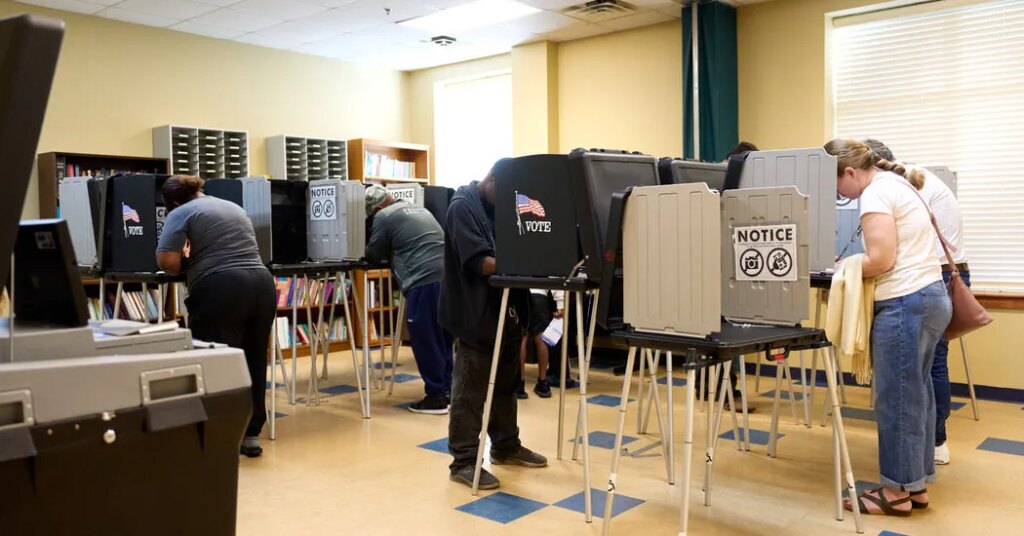
A sheriff known for his anti-immigration views lost to a pastor promising to rebuild trust with immigrants. A Black man was elected sheriff in a largely white, rural and conservative county.
A candidate who previously lost two federal races defeated the powerful chairman of the House Republican campaign arm. And the State House, in Republican hands since 2011, shifted into Democratic near-supermajority control.
All of this happened in North Carolina, a state known in recent years for breaking Democrats’ hearts. On Tuesday, it became ground zero of the Republican Party’s implosion. Perhaps in no other state was the Democratic drubbing quite so complete, from the U.S. Senate and House to a small county commission race.
“What we saw at the lower levels downballot is not purely a reflection of the national mood,” said Andrew Dunn, a conservative columnist and author in the state. “I think you also have to interpret it as a repudiation of the Republican Party in North Carolina.”
The swing state had long been viewed as a Republican firewall, especially for federal races. No Democratic presidential or Senate candidate had won in the state since 2008.
Since reclaiming control of Raleigh 15 years ago, conservatives had an easy time governing. The era was shepherded by Senator Thom Tillis, the former speaker of the State House, and Phil Berger, the longstanding leader of the State Senate and most powerful politician in North Carolina. They lowered taxes, encouraged business growth and brushed off Democratic lawmakers like dust bunnies.
To preserve that power, they passed some of the most gerrymandered maps in the nation, ignoring Democratic scorn because they had been guilty of doing the same decades ago.
On Tuesday, Democrats shattered the gerrymander. And with Mr. Tillis retiring, and Mr. Berger losing an explosive primary this year to a small-town sheriff, Sam Page, a rudderless Republican Party in North Carolina is questioning how things went so wrong.
The State Senate, which operates under heavily gerrymandered maps, appears to have come within a few hundred votes in one race from losing the chamber to Democrats.
Days before the election, the speaker of the State House, Destin Hall, privately told Republicans that they would keep the majority in their chamber if turnout was strong, even as some officials raised concerns about their chances in traditionally safe districts, according to people briefed on those conversations who were not authorized to speak publicly.
A spokesperson for the State House Republican Caucus said that since 2025, they had warned this year’s midterms could threaten the majority, adding that Mr. Hall was clear about the risk once early voting started.
State Representative Donny Lambeth, a seven-term Republican, said the caucus had repeatedly told him that he was in a “safe” district and that he did not need to spend “any money” but rather give as much as he could to the caucus.
“Unfortunately, I took their advice,” Mr. Lambeth said. “Mistake on my part.”
He lost by about eight percentage points in a district he had won by nearly 14 points in 2024.
Mr. Lambeth noted he should have done his usual work to get re-elected, but he believed he was affected by missteps from the Trump administration, as well as hustle from Democrats. “I will help my opponent in any way I can,” he said.
After Tuesday’s landslide, Mr. Hall conveyed a different message, the people said: Nothing more could have been done.
Some beg to differ.
More than a dozen Republican officials, strategists and party leaders argued in interviews that while the Trump-fueled maelstrom of an unpopular war and high gas prices largely caused the results, opportunities were still missed to save lawmakers who lost in razor-thin margins across North Carolina.
Congressional incumbents perked up to poor poll numbers much too late in the game, resulting in some of the unlikeliest of upsets that have captured national attention.
Lakesha Womack, a Democratic newcomer with a felony warrant for failing to return a rental car years ago, defeated Representative Tim Moore, who as State House speaker helped craft the gerrymandered U.S. House district he ran in.
Representative Virginia Foxx, an 11-term Republican and chairwoman of the powerful House Rules Committee, is trailing Chuck Hubbard, a new moderate darling of the internet who said he ran to protect his gay daughter.
And Representative Richard Hudson, chairman of the National Republican Congressional Committee, the House G.O.P.’s campaign arm, lost to Richard Ojeda, who previously lost a House race in West Virginia and then a Senate primary there, before bolting to North Carolina. Mr. Ojeda got to tell his bedridden father, battling Parkinson’s disease, that he finally won an election before the father died on Friday.
Those results were so surprising, they overshadowed a blowout victory in the mountains of western North Carolina, where Jamie Ager, a Democratic farmer, defeated his opponent in the heavily conservative district by 16 points.
Elsewhere in the state, Sheriff Terry Johnson of Alamance County, who is known for incendiary remarks and anti-immigration rhetoric, lost to Shannon Long, a pastor and unaffiliated candidate who spoke of making his county “Second Chance Alamance.” Anderson Clayton, the chairwoman of the state Democratic Party, said she cried happy tears when a Black Democrat, Dennis Allen, won the sheriff’s office in conservative-leaning Person County.
“The lack of structure of the North Carolina Republican Party was incredibly evident,” said Michele Woodhouse, a former Republican chairwoman for the 11th Congressional District. “Elected Republicans and party organizations were caught completely and totally flat-footed.”
Some raised flares. Conrad Pogorzelski III, a Republican consultant, posted data on X that predicted an incoming Democratic meteor. “Election Day doesn’t save Republicans,” he wrote.
Leadership in the State House had confidence. As late as October, Mr. Hall and his team continued to direct thousands of dollars to candidates in swing districts that some considered lost causes and believed would be better spent on embattled bases, according to two Republicans who were not authorized to speak publicly.
The House Republican Caucus also booked ads for candidates who had won by large margins in past elections, according to campaign advertising disclosures. A spokesperson for the caucus said it had spent a majority of funding on seats that it believed would make or break the majority.
President Trump’s handpicked Senate candidate, Michael Whatley, did not help in his failed campaign against former Gov. Roy Cooper, who won by an astounding 20 percentage points. Mr. Whatley’s campaign messaging — tarring Mr. Cooper as weak on crime and a career politician — never seemed to stick. A get-out-the-vote rally scheduled for Halloween night was canceled.
But fissures in the party were brewing long before the midterms. The Republican-controlled Legislature became an arena for intraparty bickering, sometimes over issues that turned off parts of the base, including a proposed shrimp trawl ban or a casino. There were also laws that Democrats derided as blatantly partisan and rushed, such as when Gov. Josh Stein was stripped of State Board of Elections appointment powers.
And there was a protracted battle over an overdue state budget this year.
“What I heard at the polls is that people were upset that we had been in control of the House and Senate for so long, and we could not get along and not get a budget,” said State Senator Jim Burgin, a Republican vying to be the leader of his chamber next year. “Things were stalled not because of us and Democrats but because of Republicans.”
Mr. Burgin said his leadership candidacy is premised on working across the aisle because “we can’t do stuff that people perceive as highly partisan politics, like redistricting for no reason.”
The post From Powerhouse to Punchline: The North Carolina G.O.P. Implosion appeared first on New York Times.