On election night, as Republicans lost both chambers of Congress, President Donald Trump finally acknowledged the war in Iran had played a role. In a Fox News interview, he said the public was unwilling to tolerate high gas prices. That night, he also told the New York Times he knew voters were unhappy about gas prices all along.
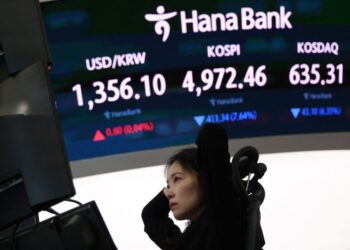
What voters wanted was simple: to afford a burger on the grill and a full tank of gas. Both had gotten more expensive. Ground beef cost $6.79 a pound in September, up 22% since Trump returned to office. Gas prices rose 40% since the Iran war began in February. His Liberation Day tariffs will cost the typical household more than $1,000 a year. And inflation climbed to 3.7% over the year through September, with energy driving roughly 40% of the increase.
In 2024, Democrats largely lost after what many regarded as the end of an era of cultural politics. In his second term, Trump built his presidency around fights that defined his own political identity— deportations and military force—seemingly not heeding the lesson Democrats did and all the while as voters were watching what they paid at the pump and the grocery store. On Tuesday, they didn’t vote identity: They voted on the prices.
‘You can’t call it a hoax and suggest that people are going to believe it‘
For two years, Trump and his party treated affordability as a Democratic talking point.
“The word ‘affordability’ is a con job by the Democrats,” Trump said at a Cabinet meeting last December. At the G7 summit in June, he called it a “fake word made up by the Democrats.” At the Republican convention in September, he said it again: “They use the word affordability, right? It’s fake.”
When the war sent oil prices up in March, Trump wrote that prices would drop once the Iran threat was over, and that “ONLY FOOLS” would not see higher costs as a small price to pay. A Republican National Committee spokeswoman then later accused Democrats of “fearmongering” about gas prices.
Though it could have been contained as a talking point for Trump, it didn’t stay that way for long: In what is now the still hotly-contested, razor-thin Senate race in Mississippi, Sen. Cindy Hyde-Smith, a cattle rancher, answered a question about beef prices by noting that voters have “so many proteins to choose from.” In Ohio, Sen. Jon Husted said one way to make things more affordable was to “earn more.” Last week, when asked by a young voter how her generation could afford to start a family, Vice President JD Vance opened with a joke about Husted’s backside before admitting Republicans haven’t addressed the cost of living crisis adequately, and Husted lost on Tuesday.
The inability to take affordability seriously didn’t just rest with the White House or with candidates. When former President Barack Obama hit the administration over prices on the campaign trail, Treasury Secretary Scott Bessent responded by eating at a Cheesecake Factory near the White House and mocking Obama, who responded that the administration focused on his joke instead of the prices.
“These are not serious people,” he said.
Nearly three-quarters of Trump’s voters rated the cost of living bad or the worst ever last December. In an October survey, 96% of Republicans said the U.S. was in an affordability “crisis.” Some in the party had warned about the gap.
“You can’t call it a hoax and suggest that people are going to believe it,” Sen. Lisa Murkowski (R-Alaska) said last December.
Bringing back kitchen table economics
Voters worried about the economy broke for Trump by 2 to 1 in 2024, fretting about the cost of everything from food in their pantries to gas in their trucks to their medications. In 2020, Joe Biden won voters with a negative view of the economy by 63 points, but four years later, Kamala Harris lost them by 40.
This go-around, it appears as if Democrats learned from that loss. The party’s winners this year were mostly moderates who ran on costs, and the cultural politics that peaked in 2020 and 2021 continues to recede.
Trump, meanwhile, made his own version of the mistake. He staked his second term on mass deportations, an immigration crackdown, and a war in Iran, while the problem families named in 2024 hadn’t gone away. By this fall, a record 43% of Americans viewed socialism positively, and Vance warned his party not to blame young people for that when housing costs kept them from buying homes. Even billionaires like PayPal cofounder Peter Thiel and Amazon founder Jeff Bezos said they understood why socialism was surging.
Here’s the issue: Trump took office in 2025 with an economy that had recovered from the pandemic and an AI investment boom underway. He could have kept blaming Biden for inflation. Instead, he spent his political capital abroad. On Jan. 3, U.S. forces captured Venezuelan President Nicolás Maduro, an operation that gave Trump considerable sway over the country’s oil reserves without extended U.S. military action. Just because he got lucky in Venezuela didn’t inherently mean he would in Iran, and aides struggled to convince Trump that Iran was unlikely to unfold like the Venezuela raid. Nonetheless, eight weeks later, the U.S. and Israel went to war with Iran.
Trump could have maintained the idyllic economic prosperity that he touted when running for reelection. Instead, in the national exit poll, 89% of voters called the cost of living crucial or a major factor in their vote, second only to government corruption, at 90%. NBC’s exit poll found Republicans had lost their advantage on the economy, the issue that helped return Trump to the White House.
Following the Blue Tsunami on Tuesday, Senate Minority Leader Chuck Schumer said Democrats intend to end the war and bring down costs, promising “relief is on the way.” But the relief may be slow: Gas still averages $4.12 a gallon, about $1 higher than a year ago, and even in the most optimistic scenario, prices could take three months after a ceasefire to return to prewar levels.
The post Trump admitted the Iran war and gas prices hurt Republicans. It was his version of the identity politics that cost Democrats 2024 appeared first on Fortune.