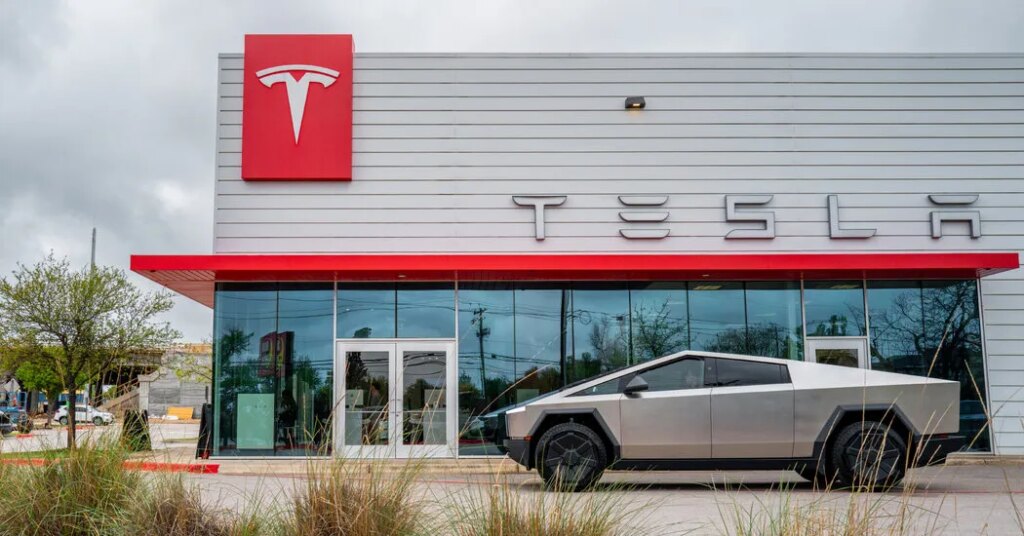
Tesla is winding down production of its polarizing Cybertrucks, Elon Musk, the company’s chief executive, said in a social media post on Friday, suggesting an end to the model.
Production of the electric trucks at the company’s factory in Austin, Texas, will end around the middle of next year to make room for increased production of the Cybercab, an autonomous ride-share vehicle, Mr. Musk wrote in a post on X.
It has not been a smooth road for the Cybertruck. Its hard-edge geometric design proved to be a love-it-or-hate-it proposition, and production has been hampered by several recalls because of software glitches and hardware issues. Last March, the company recalled nearly all its Cybertrucks, about 46,000 vehicles, after it found that an exterior trim panel was falling off.
The parents of two young adults who died in a crash also sued the company last year, claiming that the design of the doors made it impossible for their children to escape the Cybertruck after it crashed, trapping them in the burning vehicle.
The announcement to end Cybertruck production was expected, and Tesla’s stock rose around 5 percent after the news on Friday morning.
Mr. Musk first unveiled a prototype of the electric truck in 2019. “It’s not going to be for everyone,” he said at the time.
Tesla began production at its factory near Austin in 2023, selling them for about $80,000 to $100,000, depending on customization. Before its launch, Mr. Musk said that he expected annual sales of 250,000 units. But the company sold only a little over 20,000 Cybertrucks in the United States last year, down about 48 percent from U.S. sales in 2024, according to data from Kelley Blue Book, an automotive research company.
Tesla said it began producing the Cybercab, an autonomous vehicle with no steering wheel or pedal, at its factory in Austin in July. In September, the company began demonstrations.
The model embodies Mr. Musk’s longtime ambition to create fully autonomous vehicles.
Tesla has said on its website that people will be able to hail a Cybercab and “use it for errands, commuting and more.” It will fit only two passengers but still have room for things like luggage, golf clubs or scooters. The Cybercab is intended to compete with Waymo, a subsidiary of Alphabet, the parent company of Google, which already has 4,000 autonomous vehicles offering paid rides in 14 U.S. cities.
The post Tesla Is Ending Production of Its Cybertruck and Refocusing on the Cybercab appeared first on New York Times.