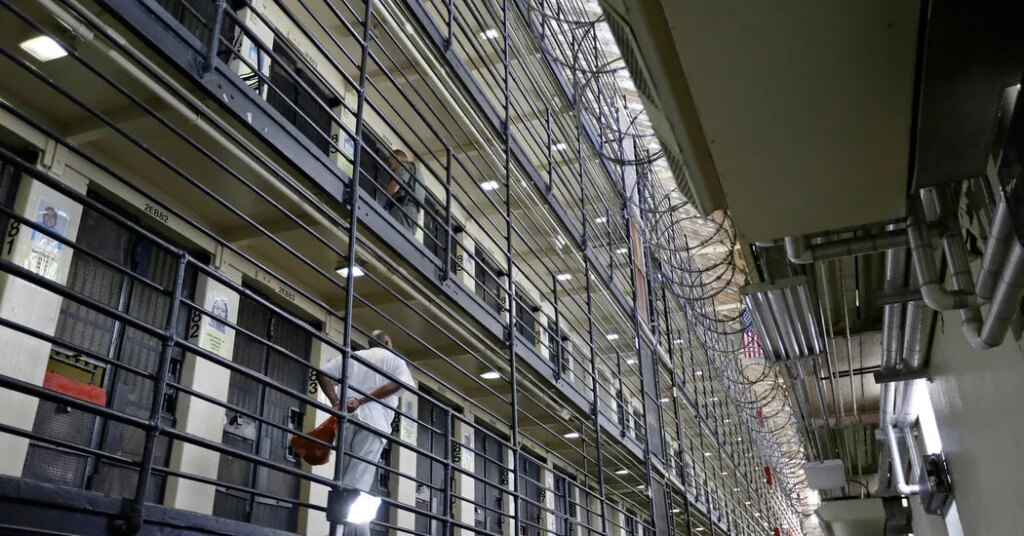
In moving to spare the lives of California’s 548 death row inmates, Gov. Gavin Newsom of California left unaddressed one question:
What happens when the next person in California is sentenced to death?
After Mr. Newsom announced on Thursday that he was issuing mass commutations for death row prisoners, some prosecutors vowed to continue seeking the death penalty in new cases in which they believe the severity of the crimes justify the ultimate punishment.
That means that as long as capital punishment is legal in California, the state’s death row is likely to be slowly repopulated in the coming years as prosecutors pursue the death penalty.
“I’m going to continue to seek it when appropriate,” said Michael A. Hestrin, the district attorney of Riverside County, calling the commutations “an abuse of power.”
In recent years, Riverside has sent more inmates to death row than any other county and currently has 20 cases in which prosecutors are seeking capital punishment.
Mr. Hestrin said that the first person added to death row following the commutations might be a defendant from his own county: Saul Arevalo, who was recently convicted in a triple murder case. The jury voted for the death penalty, and Mr. Arevalo is waiting to see if the judge will affirm that decision.
Mr. Hestrin, as well as several other prosecutors in California, said on Friday that they were weighing a legal strategy to challenge the mass commutations, even though some acknowledged that it was a long shot given the seemingly clear authority the governor has to use his clemency powers.
“We are meeting,” said Cynthia Zimmer, the district attorney of Kern County. “We are Zooming. We are examining all of our legal options.”
The state Supreme Court must approve more than half of the commutations because the inmates have multiple felony convictions. It’s unclear how long that process will take. Legal challenges could slow the process, and if the Supreme Court has not approved the commutations by the time Mr. Newsom leaves office in January, they would expire, leaving the death sentences in place.
If they go through, however, Mr. Newsom will have emptied the largest death row in the nation in one fell swoop.
“Mass commutation, is that something that was ever even contemplated by the people who wrote our Constitution?” Mr. Hestrin asked. “That is going to have to be tested in the courts.”
Mr. Newsom said in an open letter to Californians on Thursday that he felt morally obligated to commute the sentences and that he believed the state should end capital punishment. California has not executed a prisoner since 2006, when Gov. Arnold Schwarzenegger, a Republican, was in office.
Mr. Newsom, who is considering a Democratic presidential run, had already imposed a moratorium on executions in California when he took office in 2019. He then dismantled the physical death row at the San Quentin state prison and transferred the inmates to other facilities around the state, where they live among the general population.
Mr. Newsom’s successor, Xavier Becerra, a Democrat who was elected on Tuesday, has vowed to keep the moratorium in place. But he has not said if he would commute any future death row inmates, and his campaign did not respond to a request for a comment on Friday.
In addition to the case of Mr. Arevalo, the prisoner in Riverside, there are three other pending cases, all in San Bernardino County, in which a jury has recently decided to impose the death penalty. Each case is awaiting the final word from a judge in the coming weeks, according to Natasha Minsker, the director of the California Anti-Death Penalty Coalition.
Any of those men, Ms. Minsker said, could be the first person to repopulate death row if Mr. Newsom’s mass commutation becomes final. At the same time, she said, there are 70 other open death penalty cases across California moving through the courts.
A spokesman for Mr. Newsom said that the commutations only applied to “the list as it is right now,” and that the fate of future death row inmates will be in the hands of Mr. Becerra.
Ms. Minsker said that the death penalty was giving victims a false promise of punishment because California has stopped executing prisoners. She said it was wrong for prosecutors to keep pursuing a resolution that they knew the state would never impose.
“They would really be mistreating victims if they continue to do this,” Ms. Minsker said of the prosecutors.
The governor spoke last month with two sisters of Polly Klaas, a 12-year-old whose 1993 kidnapping and murder prompted an era of tough-on-crime policies in California. They encouraged him to go through with the commutations; Jess Nichol, a stepsister of Polly, said in an interview that she did not want to be “haunted by the hungry ghost of vengeance.”
But Mr. Newsom did not reach out to Polly’s father, Marc Klaas, who was furious at the move and said it left him “feeling raw and angry.”
Ms. Zimmer, along with other prosecutors, said on Friday that teams of victims advocates from county district attorney offices were reaching out to the families of the victims who were killed by the inmates on Mr. Newsom’s commutation list.
“We are doing our best efforts to call them today, to let them know we are fighting to keep this in place,” Ms. Zimmer said.
She said her office in Kern County has 13 open cases for which they are seeking the death penalty. Nine of them involve murders inside prison — Kern County has several state prisons — in which an inmate serving life without the possibility of parole is accused of killing another inmate.
“If we don’t pursue the death penalty for them, they can get as many free murders as they wish,” she said.
Ron Freitas, the district attorney in San Joaquin County, has two current cases in which it is seeking the death penalty: one against a man accused of a spate of serial killings in 2021 and 2022; and another against a man accused of killing three people during a home invasion.
Ten years ago, California voters rejected a ballot measure to repeal the death penalty and approved one to speed up executions. Mr. Freitas said he believes that voters still support the death penalty for the most heinous crimes.
“My obligation is to do the right thing,” Mr. Freitas said. “And right now the state of California, my voters, my constituents have been very, very clear that they want the death penalty.”
The post Prosecutors Vow to Keep Pursuing Death Penalty in California appeared first on New York Times.