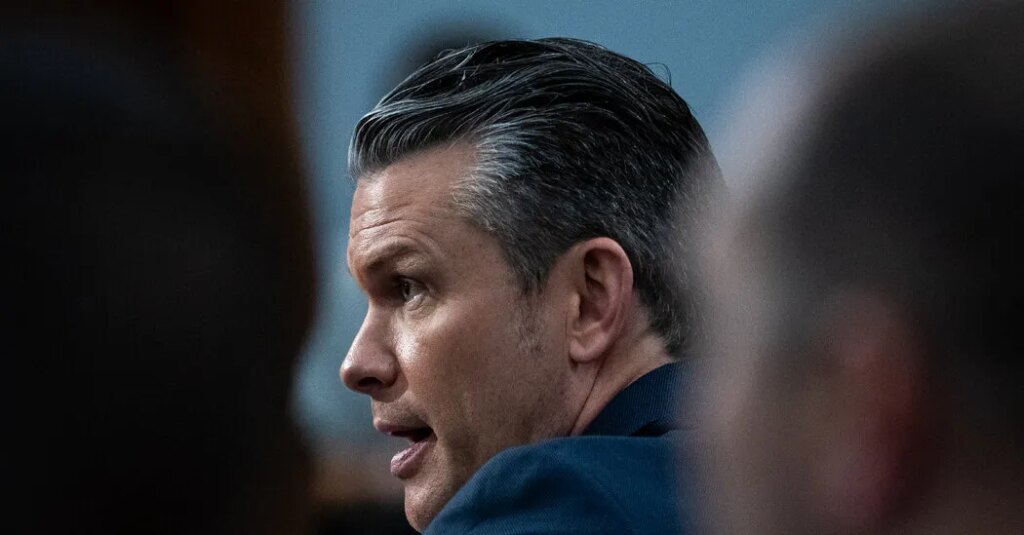
Defense Secretary Pete Hegseth disclosed war plans in a chat on a commercial app that accidentally included a journalist, faced allegations of war crimes in the Caribbean and frustrations over his purge of top generals, and survived it all.
But now his fate is one of the biggest questions in the aftermath of the midterms. Even his own bosses acknowledge that the war against Iran, championed by the self-proclaimed “secretary of war,” was a major contributor to the Republican blood bath in the elections.
Mr. Hegseth was already battling hostile bipartisan forces in Congress, including an impeachment effort introduced by a Republican — Representative Thomas Massie of Kentucky.
Congress still has not passed the Pentagon’s $1.5 trillion overall budget request, with lawmakers in both parties pointing to the combative defense secretary as among the reasons it has not moved forward.
A part of this defense funding measure, the National Defense Authorization Act, would fund salaries for troops, weapons production and everything in between. But it also remained stalled after months as lawmakers complained that the Pentagon had not consulted or communicated with them on a host of issues, including the war in Iran.
And President Trump’s efforts to push through another aspect of the funding, some $350 billion in military spending using a special budget bill that could not be filibustered, had not advanced either.
This was before the Democratic victories on Tuesday night.
Mr. Trump has stuck with his defense secretary, who has made amplifying the president on culture-war issues the center of his tenure at the Pentagon.
Mr. Trump told Fox News on election night that he did not intend to make any changes to his cabinet, and on Wednesday, when asked specifically about Mr. Hegseth, he told reporters, “I think he’s doing a very good job.”
Pentagon officials also say Mr. Hegseth is not going anywhere.
After Republican losses in the 2006 midterms, the first cabinet member to fall in President George W. Bush’s administration was Defense Secretary Donald H. Rumsfeld, a magnet for criticism for his management of the war in Iraq.
Mr. Bush had said he was keeping Mr. Rumsfeld, just days before he announced that his defense secretary was leaving.
“Donald Rumsfeld was gone the day after the Bush administration was repudiated by the American people in the 2006 midterm election,” Representative Hakeem Jeffries, the New York Democrat expected to be the next speaker of the House, said in an interview. “Why is Pete Hegseth still around?”
Mr. Hegseth posted a defiant video on social media Thursday. “We don’t back down, and that especially applies now,” he said. In the video, he bragged about tearing down Democratic “sacred cows,” like diversity, equity and inclusion and repeated his oft-proclaimed aversion to transgender troops in the military.
“We will continue to drive President Trump’s agenda at the Department of War — despite threats of sham witch hunts from Democrats — and Secretary Hegseth is 100 percent committed to leading the department until the end of President Trump’s term in office,” Sean Parnell, the Pentagon’s chief spokesman, said in a statement.
Mr. Hegseth has been among the loudest champions of the eight-month-old war against Iran, which early on he declared the U.S. military was carrying out with “brutal efficiency.”
But in the aftermath of the election, the narrative has solidified that the G.O.P. thumping this week was largely because of the war, which led to higher prices at gas stations and grocery stores across the country. The conflict has also depleted the U.S. military’s global stockpiles of weapons.
Vice President JD Vance said in a social media post on Wednesday that “the reason we lost is the war,” a statement that several Pentagon officials viewed as a direct shot across the bow at Mr. Hegseth.
Lawmakers and aides believe that the impeachment charges brought by Mr. Massie have a solid chance of passing the House with the support of several Republicans. G.O.P. leaders could delay an impeachment trial, and it would be exceedingly difficult to get two-thirds of the Senate to vote to convict him.
But the House vote alone was likely to constitute a bipartisan vote of no confidence in Mr. Hegseth by Congress at a critical time, as the administration was laboring to win approval of a Pentagon spending package and a substantial increase in the military budget.
On Wednesday night, Mr. Massie doubled down on his vow to press for impeachment. “There is one contingency in which I won’t reintroduce the articles of impeachment: Hegseth resigns,” he wrote on social media.
Mr. Massie has accused Mr. Hegseth of using his office to conduct political retaliation against his critics, including Senator Mark Kelly, Democrat of Arizona, and of failing to get congressional authorization before the war in Iran.
In private conversations since Tuesday, Mr. Trump has laid much of the blame for his party’s midterm losses on his political team, according to two people who have spoken with him, and who described private conversations on the condition of anonymity. So far he has not appeared to blame Mr. Hegseth or Adm. Brad Cooper, the head of U.S. Central Command, despite polls showing that the Iran war soured the public on the Trump administration.
People close to the president say he has indicated he wants to stand by his defense secretary, though some allies caution that the situation could change given how many Republican lawmakers have been complaining about Mr. Hegseth to the White House.
On Friday, Representative James R. Comer of Kentucky, the Republican chairman of the House Oversight Committee, told NewsNation that the decision was up to Mr. Trump. But, he added, “I can tell you with a high level of confidence that there’s a lot of questions about Hegseth.”
Some of Mr. Hegseth’s allies have quietly been talking about a way out: Senator Marsha Blackburn of Tennessee, who was elected governor on Tuesday, needs to pick her successor. To Mr. Hegseth’s allies, the seat would let the defense secretary leave the Pentagon on his own terms instead of being forced out.
But that would mean putting a divisive figure in another red-state Senate seat that Republicans would have to defend in 2028; several Republican congressional aides and Republican political operatives in Tennessee said such a move was unlikely.
If he stays, Mr. Hegseth will face headwinds on Capitol Hill.
Senator Jack Reed, the top Democrat on the Senate Armed Services Committee, said it was critical to stop Mr. Hegseth’s purge at the Pentagon.
“We can certainly stop it bleeding, and that probably means the departure of Hegseth one way or the other,” Mr. Reed, who is expected to be the committee’s next chairman, said in an interview.
He said Mr. Hegseth had created a “toxic” climate, adding: “He’s weakened the mutual respect and trust that you must have for a military organization.”
Inside the Pentagon, some senior officers were already rethinking their retirement plans, said senior defense officials, who discussed sensitive personnel matters on the condition of anonymity. In the last year, Mr. Hegseth has blocked the promotions of more than 50 officers selected for general or admiral rank, often without a stated reason.
The officers had been chosen by boards made up of more senior military leaders. The nomination are good for 18 months, even though Mr. Hegseth declined to send them to the White House and Congress for final approval.
Many of those officers had planned to submit their retirement papers in the coming weeks, if not sooner. On Wednesday, senior military leaders had begun telling some of them to wait. Mr. Hegseth’s interventions are highly unusual and unpopular with military leaders and Congress.
A new secretary of defense could reverse Mr. Hegseth’s decisions on the officers, clearing their path for promotion and allowing them to continue their military careers.
If Mr. Hegseth survives the looming impeachment effort, he will also face scrutiny over other issues, congressional officials said.
They said Democrats would mount a robust oversight campaign on military spending that could include riders that force the Pentagon to comply with various congressional directives.
Democrats plan to hold hearings on the boat strikes, which have killed dozens of people in the Caribbean and Eastern Pacific who the administration says were drug traffickers since the strikes began last year. They also intend to demand more information about the U.S. bases across the Middle East that were damaged in the war.
Representative Adam Smith, the Washington State Democrat who is poised to reclaim the chairmanship of the House Armed Services Committee, outlined his priorities in a letter to Democratic colleagues on Wednesday. He called for establishing an oversight subcommittee that would investigate “the illegal war against Iran, unauthorized military strikes in the Caribbean and Latin America, and the deployment of the military to U.S. cities.”
But some analysts warn that Democrats will have to walk a fine line between demanding accountability and appearing as if they are targeting American troops.
“The new Congress has a choice — it can opt for made-for-social-media-outrage show-trial hearings,” said Peter Feaver, a political science professor at Duke University. “Or it can try to repair the low-information environment surrounding defense policy with substance-focused oversight and engagement.”
Annie Karni, Jonathan Swan and Maggie Haberman contributed reporting.
The post Hegseth Faces Scrutiny From Both Parties in Aftermath of Midterms appeared first on New York Times.