A word or two on how, at the age of 28, I came to share a bottle of Cutty Sark with the leader of the free world.
In the spring of 1965, I was sitting in The New York Times’s Washington bureau minding my own business and placing phone calls to the small-bore federal agencies I was covering when our White House correspondent, Charles Mohr, burst in and declared that he needed help.
President Johnson, he said, had already talked to reporters twice that day, and was planning his third trip to Texas in as many months, one result being that he, Mohr, needed a rest — his marriage, his sanity, etc., etc., were all teetering on the edge. At which point Tom Wicker, then the bureau chief, looked at me and said, in so many words, “I don’t suppose you can do a lot of damage as the No. 2.”
Which I nearly did. The next day the press corps flew to Texas for the Memorial Day weekend, first to Austin, and then, in a thunderstorm, to Waco, where the president delivered the commencement address at Baylor University’s Heart O’ Texas Coliseum. Johnson spoke from a raised platform, with reporters typing furiously away on plywood tables set up below him and in front of the graduating seniors, their proud parents and the faculty. Not one for the usual commencement platitudes, Johnson delivered a policy address applauding the hemispheric response to what appeared to be a flowering communist insurgency in the Dominican Republic.
This was serious stuff, but just as the president reached an oratorical high point, the doors at one end of the coliseum blew open, sending the paper on the press tables fluttering out across the graduating seniors. In a trice I saw not only my news story but also quite possibly my career disappearing like confetti in a windstorm. As I scrambled through the rows of bemused members of the class of 1965 to retrieve my prose, I briefly caught sight of the president, the height advantage he always enjoyed greatly magnified by the raised platform, peering down with a look of profound annoyance, one I associate with every president as the moment they realize that among the crosses they have to bear are the Fourth Estate and its pesky practitioners.
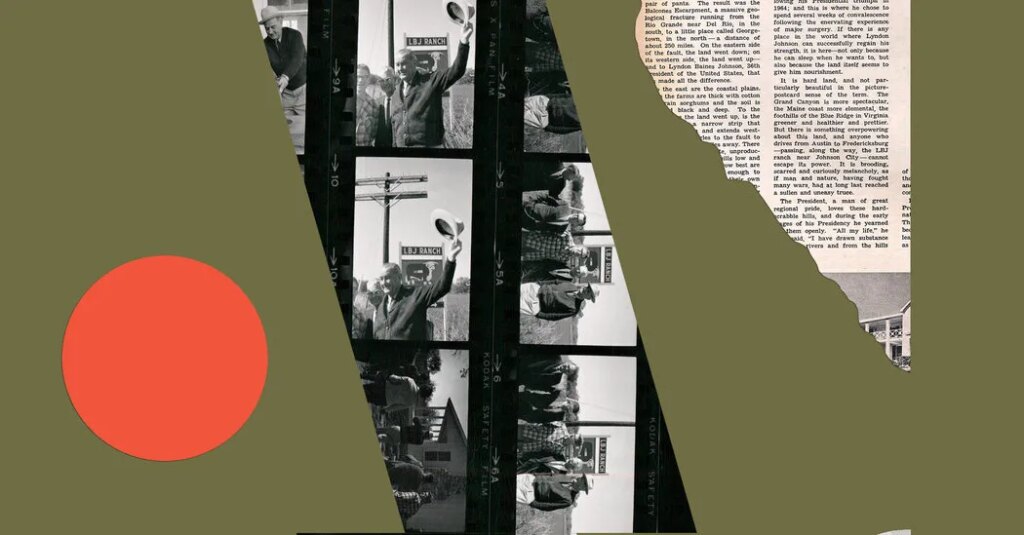
My story made the paper, the weekend went off without further drama and, most important to me, I survived. Even better: When The New York Times Magazine then asked me to write a piece on the LBJ Ranch, there was no pushback from the White House, as long as I agreed to withhold embarrassing personal details — of which, Johnson being an incorrigibly earthy man, there were bound to be a few. In due course came an invitation to visit the ranch and take what was advertised as a brief tour. I ended up staying for the day and the better part of an evening, with a couple of tours, a swim, lunch and dinner thrown in.
What remains most vivid in my mind, apart from the president himself, is the landscape, unlike any I had seen before. The LBJ Ranch is part of what’s called the Hill Country, which angles westward from Austin for more than 100 miles. It is where Johnson was born, schooled and tested; where he won his first race for Congress in 1937; where he sketched out plans for the Great Society after succeeding a slain President Kennedy in 1963 and beating Barry Goldwater the next year; where he recovered after major surgery; where he reliably sought refuge and renewal from whatever he was doing in Washington; and where he died.
The Hill Country is not conventionally pretty. It is hard land, thin and unproductive in many places, but there is something almost overpowering about it, and anyone who completes the drive from Austin to the ranch in Stonewall cannot escape its brooding presence. Johnson revered these hardscrabble hills. “All my life,” he once said, “I have drawn sustenance from the rivers and from the hills of my native state.”
The Johnsons could not have been more welcoming, especially Lady Bird Johnson, whose adroit management of the family TV and radio station in Austin accounted for much of the family wealth. She showed us around the house, including the living room with its huge easy chair and Johnson’s pine-paneled office with a massive walnut desk that once belonged to Arthur Vandenberg, a Senate luminary. Then she led us to the pool, just outside the president’s bedroom, and in which Johnson himself was immersed in the shallow end, chatting with a secretary perched on the edge and reading what appeared to be cables about the war in Vietnam.
Next came lunch at a cherry table in the bright and lively dining room — hamburgers well done, an immense salad topped off with a big helping of peach slices — with me at one end, the president at the other and Lady Bird and other guests in between. The chatter was polite and local — however threadbare the soil, Lady Bird said at one point, “this is good peach country.” One moment has stuck: the president eating peach slices with his fingers, the slices falling on the plate in front of him, his wife sharply remonstrating: “Lyndon! Guests are here. Do not eat peaches with your fingers!” — and a president briefly chastened.
Then followed the principal business of the day: an inspection of Johnson’s holdings, in two parts, first with him at the wheel of a Chrysler station wagon buzzing around the ranch, and later with his great friend Judge A.W. Moursund driving at a more leisurely pace through some of the thousands of nearby Hill Country acres Johnson had bought or leased over the years and intended to bequeath to his daughters.
At 438 acres, the LBJ Ranch itself was not much more than what the House speaker and fellow Texan Sam Rayburn once called “a little old farm,” but the president was immensely proud to show it off. Bought for a measly $20,000, the land, by the time I saw it, was rich with alfalfa and oats, thanks to irrigation from the nearby Pedernales River, and supported 400 cows, 100 calves, four bulls and some sheep, goats and pigs. It also featured a spacious hangar, several enormous communications towers rising above the cattle pens, trailers for Secret Service agents and support staff, and a landing strip where every morning a courier jet would touch down bearing 10 different newspapers, The Times among them, as well as intelligence data and stacks of reports.
Little escaped the president’s attention as he wheeled the car up and down various farm roads, from time to time swerving into pastures where unsuspecting cattle were grazing, honking his horn until the red and white Herefords were practically eyeball to eyeball with their strange proprietor, this big man in a Stetson hat. Johnson was in constant touch via the car’s Motorola radiophone with his foreman, Dale Malechek, barking orders. Spotting a coil of barbed wire near the base of a tree, he said, “A cow could get tangled up in that,” and ordered it moved. Another time, driving by the small cabin in which he was born, he noticed with annoyance that the sprinklers were turning the front yard into mud: “I told that boy to water the lawn but not all day when the sun is high.”
The ranch tour over, the president relinquished the wheel to Judge Moursund, a local rancher and former county judge. There were four of us in the car, with Secret Service agents fore and aft, the judge and the president up front, and me and another reporter in the back. There was the usual Johnson paraphernalia in the car, including, as I recall, a rifle under the front seat.
There was also a bottle of Cutty Sark, which the president passed back and forth as we drove through the woods and scrubland, and from which everyone except the judge took an occasional swig — not terribly hygienic, but who was I to argue with a president and a bottle of good Scotch?
Then, seemingly out of nowhere, there appeared up ahead a couple of small dwellings and some people standing by the side of the road. The president said quietly, “Hide the bottle.” It disappeared under my feet. The car stopped. Never one to ignore a constituent, Johnson reached out the window and shook hands, the people smiling and wishing him best of luck, and then we moved on.
The Lyndon Johnson I saw that day is the way I like to remember him — comfortable, even a bit carefree and at peace in his own Texas world. Things were not that way back in Washington, especially not in 1965, a year that brought him great and lasting domestic triumphs, among them the Voting Rights Act and the Medicare and Medicaid Act, as well as the gigantic missteps in Vietnam — the Rolling Thunder bombing campaign and the first wave of American combat troops on the ground — that eventually brought him down.
I never learned what exactly was in those cables he was reading in the swimming pool. I was not there to discuss policy. But I do remember the look on his face, frowning and frustrated.
I also remember that in fairly short order came a pronounced lifting of the presidential spirits. All it took was a bowl of peaches and a few restorative hours connecting with friends and the rocky soil he had brought to heel and, through friends and soil, with his ancestors who had done battle in these same hills.
The post Day Drinking With the President appeared first on New York Times.