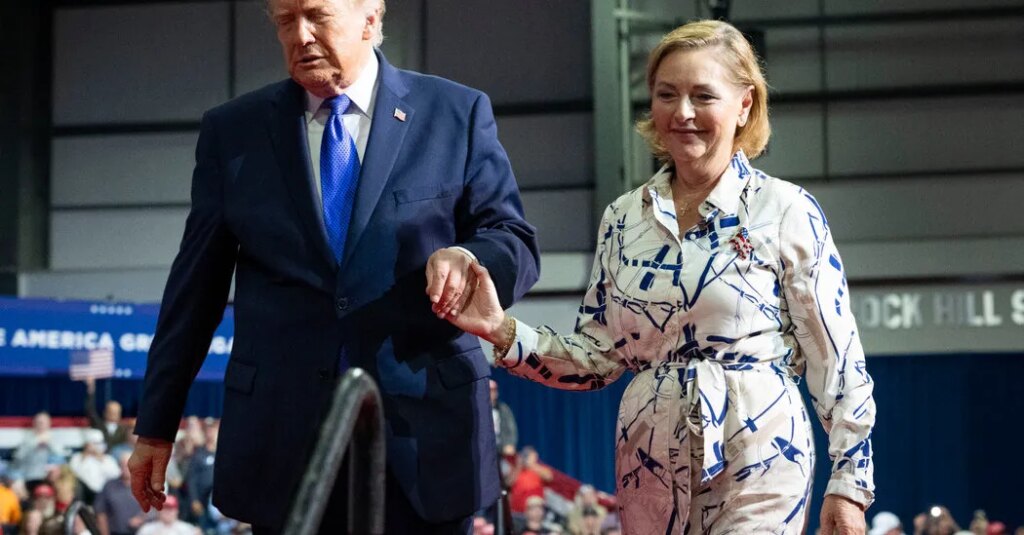
President Trump used to gloat about his near-perfect endorsement record, reveling in the control he exerted over the Republican nomination process during this year’s primary season. Voters overwhelmingly rewarded the candidates he backed and punished those who displeased him, muscling numerous less loyal candidates out of contention.
“If you pushed back” on Mr. Trump, said Justin Evans, a Republican strategist in South Carolina, “you’d get your head chopped off.”
Mr. Trump has little to brag about this week. Senate candidates he had helped elevate, including Darline Graham in South Carolina, Michael Whatley in North Carolina and Ken Paxton in Texas, lost by margins previously unimagined by even the most optimistic Democrats. Those high-profile defeats contributed to what Gov. Ron DeSantis of Florida, a one-time Trump rival for the presidential nomination, called as “close to an extinction-level event for Republicans” as the country has seen in a century.
“The people who did the best last night were the people who distanced themselves from the president,” Mr. Evans said, calling the results “a universal repudiation of the bullying that’s been taking place during this primary” by Mr. Trump.
Here’s a look at what happened to some of the candidates who tied their fortunes most closely to Mr. Trump.
Darline Graham
After Senator Lindsey Graham, a Republican, died in July, Mr. Trump threw his weight behind Mr. Graham’s sister, Darline Graham, in a snap primary election. While many Republican insiders objected, primary voters listened, narrowly nominating Ms. Graham over Representative Ralph Norman, despite her self-described lack of experience or policy expertise.
On Tuesday, the wider South Carolina electorate rejected Ms. Graham, choosing to send a Democrat to Washington for the first time in nearly 30 years.
“It wasn’t that voters rebuked Trump,” Mr. Evans said, noting that the Republican nominee for governor had earned at least 90,000 more votes than Ms. Graham. “It was that the entire Washington machine pushed this woman on South Carolina, and South Carolina resoundingly pushed back.”
Ken Paxton
Senate Republicans begged Mr. Trump to endorse Senator John Cornyn over Ken Paxton, the Texas attorney general, in the state’s Republican Senate primary. Many argued that Mr. Paxton’s scandal-ridden past would make it significantly more difficult, and more costly, to win in a general election. They also said a contentious intraparty battle would waste resources needed in more competitive states. Mr. Trump ignored them, waiting until days before a May primary runoff to back Mr. Paxton.
On Tuesday, despite dramatically outspending Democrats, Republicans lost the Senate seat, the governor’s mansion, and every other statewide race in Texas, breaking a more than three-decade-long streak of G.O.P. dominance.
Some Texas Republicans speculated that Mr. Paxton would have won the primary regardless of Mr. Trump’s choice. It is also not clear that Mr. Cornyn could have defied the tsunami of voter anger that propelled Democrats to victory up and down the ballot. But some blamed Mr. Paxton, and Mr. Trump, for the extent of the losses.
“You stand by Trump at your own peril at this point,” said Dade Phelan, the former Republican speaker of the State House. He recalled how Mr. Trump asked voters in Texas and elsewhere to “pretend I’m on the ballot.”
“Well, voters imagined he was on the ballot,” Mr. Phelan said. “And it was an absolute apocalypse for Republicans.”
Michael Whatley
Mr. Trump’s fingerprints were all over North Carolina’s Senate race. First, Senator Thom Tillis, a Republican who has served in North Carolina for more than a decade, announced he would retire rather than run for re-election after the president threatened to back a primary opponent against him.
Then, Mr. Trump handpicked Michael Whatley, a former Republican National Committee chairman, and Mr. Whatley spent millions touting Mr. Trump’s endorsement ahead of his victory in the Republican Senate primary. On Tuesday night, Mr. Whatley fell to former North Carolina Gov. Roy Cooper, a Democrat, by around 20 points, a stunning leftward shift for a state that Mr. Trump won in 2024.
Meghan McMichael, 33, a voter in Canton, N.C., said on Tuesday that she had voted for Mr. Cooper and other Democrats in order to hold the Trump administration accountable for its treatment of immigrants, and the state of the economy.
“I’m just hopeful that certain people will be held accountable for things that have happened over the last two years,” she said.
Jon Husted
Senator Jon Husted, Ohio’s Republican Senate nominee and a former professional football player, was little known nationally until President Trump started talking about his rear end while on the campaign trail. Mr. Husted also joined Mr. Trump at several Ohio rallies in the final weeks of the campaign, tying himself to the president.
Mr. Husted lost to former Senator Sherrod Brown on Tuesday, making Ohio one of seven states that Democrats had flipped as of Wednesday evening.
The president’s comments about Mr. Husted’s backside may also have backfired, with voters across the country telling The New York Times they had disapproved of his remarks that Mr. Husted had a “great ass” and a “pile of muscle.”
In Lincoln, Neb., on Tuesday, Deondre Webster, 36, said he didn’t believe Mr. Trump is a good role model for his three daughters.
“We don’t want to see the leader of the country talking about male behinds or stuff like that onstage,” he said. “When he’s supposed to be the leader, and that’s not what we’re teaching our kids.”
Mark Barrett in North Carolina and Justin Diep in Nebraska contributed reporting.
The post These Republicans Bet Big on Trump. It Didn’t Pay Off. appeared first on New York Times.