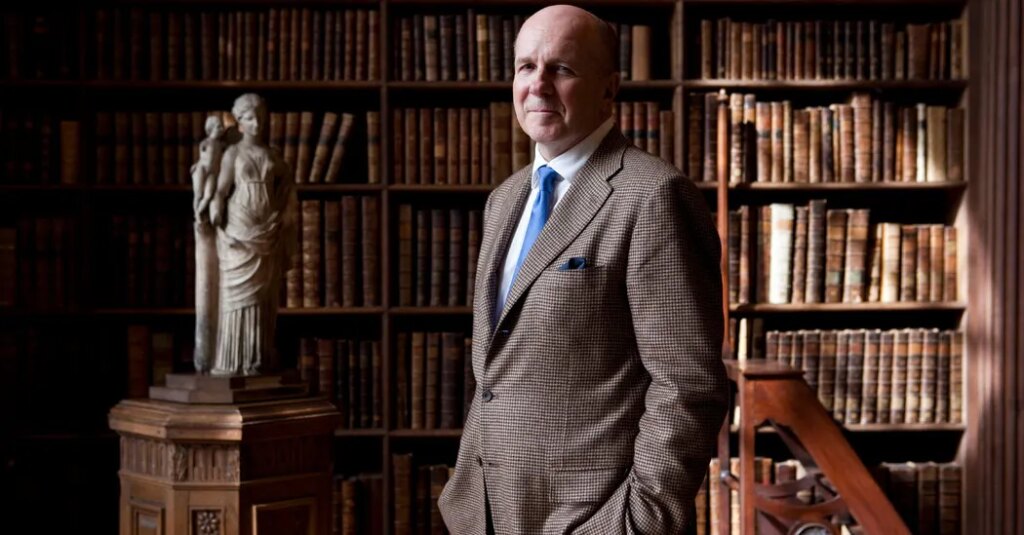
Simon Winchester, a British-American journalist, author and broadcaster, who traded an early career as a geologist exploring East Africa for an even more peripatetic résumé covering stories from Northern Ireland’s bloodstained Troubles to Watergate-era Washington, the Falklands war and China, died on Tuesday on his farm in Sandisfield, Mass., according to his wife, Setsuko Sato. He was 82.
The cause of death was a heart attack, she said.
His reporting days were studded with adventure and peril. During the Argentine invasion of the Falkland Islands and Britain’s reconquest of the remote, Atlantic territory in 1982, he achieved twin distinctions of being on the islands when they were first occupied, then being arrested in southern Patagonia, mistaken for a spy, and imprisoned for three months, according to a biography on his website.
Mr. Winchester made the switch from geology to journalism after reading “Coronation Everest,” a book about the 1953 first ascent of Mount Everest, by Jan Morris, then known as James Morris, who had covered the momentous expedition.
Mr. Winchester read the book while encamped in Uganda’s Rwenzori Mountains and resolved to become a reporter himself, writing to Ms. Morris to seek advice. She replied that, if he wanted to join the ranks of traveling writers, his best course would be to return to England and work on a newspaper. He duly began his own ascent on the profession’s heights not in the Himalayas but in Newcastle-upon-Tyne in northeast England.
According to his website, he joined Britain’s liberal The Guardian newspaper in Newcastle in 1969 and soon moved on to Northern Ireland at the height of its 30-year sectarian conflict between Protestants and Roman Catholics that drew in the British Army in a bloody war with the Irish Republican Army.
Much later, in 2001, he acknowledged suspicions that he had been manipulated in his reporting by the British Army, in particular an officer who routinely briefed him — anonymously — on the background to various killings of civilians. In an article in The Guardian he described how a brigadier would explain why the victims had been combatants in the I.R.A., and how he would then broadcast those details in an interview with the BBC.
Yet, he said, “it turned out later that the army’s intelligence was so rudimentary in those days — and may yet be so — that most of what I gaily rebroadcast was, if not a pure figment of the imagination of some superheated British army intelligence officer, then to a very large degree, wishful thinking.”
The motives of the British military may have been to choose Mr. Winchester as a relatively untainted reporter to be a mouthpiece for disinformation. Yet, he wrote, “by appearing so regularly on the radio, and offering a message that in fact was the message of the British army, I was for a brief while, very tainted indeed.”
A year later, in 1972, he was posted to Washington D.C., and during a four-year assignment, covered the fall of President Richard Nixon and the election of Jimmy Carter. Apart from The Guardian he wrote over many years for The Sunday Times and Condé Nast and as a freelancer.
During his time in Washington he published his first book, “In Holy Terror,” based on his years as a reporter in Northern Ireland. His breakthrough work as an author, however, came later, in 1998 when he was living in New York, with the publication of “The Professor and the Madman,” about the making of the Oxford English Dictionary.
The story was based on the relationship between James Murray, the editor of the dictionary, and a contributor, William C. Minor, who had been incarcerated at an institution for the criminally insane. The book was on The New York Times’s best-seller list and in 2019 was made into a movie starring Mel Gibson and Sean Penn.
Mr. Winchester went on to write or contribute to some 30 books on themes as varied as the origins of geology and the impact of the wind.
In 2025, a review in The Times of “The Breath of the Gods,” Mr. Winchester’s most recent book, said: “A peripatetic polymath who has written books about everything from the Oxford English Dictionary to the San Francisco earthquake to a journey up the Yangtze River, Winchester weaves geology, meteorology, etymology and history into a jaunty survey of wind’s incarnations and permutations.”
Simon Winchester was born in London on Sept. 28, 1944. He was the only child of Bernard and Andrée Winchester (de Wael.) By some accounts, his father, a British soldier, was imprisoned in Nazi Germany at the time of his son’s birth. In interviews, Mr. Winchester has frequently suggested that, when he returned from captivity, his father was not enthusiastic about his young son and sent him to boarding school in England at around the age of 5. He studied geology at Oxford University, graduating in 1966.
In 2006, he married Ms. Sato, a former producer for NPR, and he lived in New York and on a small farm in the Berkshires. He became a naturalized American citizen in 2011.
In addition to Ms. Sato, his survivors include three sons, Rupert, Angus and Alex.
After graduating from Oxford, he worked for a Canadian mining company looking for copper in western Uganda — the job he was doing when he wrote to Ms. Morris. The exchange of letters was the beginning of a long and nuanced friendship.
“I’m sure Simon would forgive me for saying that he’s a charming rogue, who’s fond of women,” Ms. Morris said in 1997. “I know his current and his ex-wife. Although I often don’t approve of the way Simon has sometimes behaved, I’m constantly amused by him and the way he always seems to get out of trouble.”
The post Simon Winchester, Author of ‘The Professor and the Madman,’ Has Died appeared first on New York Times.