The 2026 midterm election has dealt the country a political realignment beyond even the rosiest hopes that had been building for Democrats in the pre-election polls.
President Donald Trump’s unpopular policies, erraticism and misalignment with the priorities of the voters have brought a return of divided government in Washington, where Democrats will have bigger-than-expected majorities in the House and Senate.
The election carried lessons for Democrats in how to win and laid bare the stakes— and risks, particularly for Republicans — in the 2028 presidential race, which effectively will get underway almost immediately.
It opens possibilities for newly empowered Democrats to investigate the Trump administration and take action at both the state and federal level on unpopular GOP policies, from housing to health care to energy to the Iran war.
Ballots are still being counted, and two Senate races had yet to be called as of midmorning Wednesday. But Democrats have picked up seven seats in that chamber, giving them at least 54. In the House, their numbers grew by more than two dozen, to reach upward of the 225 that party leaders had said they considered their most optimistic scenario.
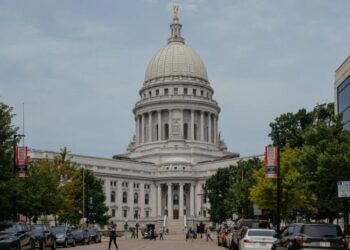
For the first time since 2010, Democrats will also hold most of the nation’s governorships. And the party picked up hundreds of seats in state legislatures across the map, flipping some — including both houses in the critical swing state of Wisconsin, where Democrats will have full control of the government for the first time in nearly two decades.
Those significant Democratic gains came in what had been deep-red territory, which also saw a shattering of the 2024 coalition that carried Trump into the White House for a second time. Groups that had moved rightward two years ago — among them, rural voters, Latinos, Black men, younger Americans — went the other direction. Where Trump won voters without college degrees and men by double digits, they narrowly sided with Democrats this year.
With the starting gun for the 2028 presidential contest about to go off, those are auspicious signs for Democrats. The result could also be read as a sign — albeit a tentative one — that the intense polarization that has defined the nation’s politics for more than a decade is loosening its grip.
“Investments in swing states like North Carolina, as exurban and rural as it is, go a long way,” said Jeff Allen, campaign manager for former governor and Sen.-elect Roy Cooper (D), who won by nearly 20 percentage points in a state where no Democrat has been elected to statewide federal office in nearly two decades. “You can’t just run up the score in urban areas and hope turnout carries the day.”
In North Carolina’s General Assembly, Democrats gained control of the House and narrowed the GOP majority in the 50-member state Senate from 10 to just two.
There remain significant obstacles as to how much newly empowered Washington Democrats can get done during Trump’s remaining two years in office. In the Senate, Democrats still have fewer than the 60 votes needed to break a filibuster. And in neither chamber will they have the two-thirds supermajority needed to overcome Trump’s veto, which he has said he will be aggressive about using.
No doubt, after an election in which voters cited corruption as a top concern, congressional Democrats will use their new subpoena power to launch investigations of Trump, his family and his administration. “LAWYER UP,” Rep. Robert Garcia (D-California), who is expected to become chairman of the House Oversight Committee, wrote on social media.
But they also will be called upon to do something about the cost of living, which more than any other issue drove the election result, and the unpopular Iran war, to which Trump has remained committed, despite its having sent fuel prices soaring.
Speaker-in-waiting Hakeem Jeffries (D-New York) has appointed task forces to look at various aspects of the affordability conundrum.
In the near term, Democrats expect to take up a number of measures that have already passed the House. Among them: extending expired tax credits that made coverage under the Affordable Care Act more affordable, revoking tariffs that Trump placed on Canada, restoring temporary protected status for Haitian migrants, and wiping out the president’s executive order terminating collective bargaining for federal employees.
The comfortable size of Jeffries’s Democratic caucus will be such that he will have more room than the current speaker, Rep. Mike Johnson (R-Louisiana), does to negotiate the ideological divisions and competing agendas within the GOP’s paper-thin majority.
Trump had told voters to pretend he was on the ballot, and they apparently did. Nonetheless, he tried to deflect blame for his party’s punishment by the electorate.
“I wasn’t on the Ballot and if I was, we would have won IN A LANDSLIDE!” he posted on his Truth Social account late Tuesday.
But Trump, using his outsize influence in his party, had personally cleared the way and taken credit for many of what turned out to be the party’s weakest nominees — among them, Ken Paxton in Texas, Darline Graham in South Carolina, Vivek Ramaswamy in Ohio, Michael Whatley in North Carolina.
So will there be a Republican reckoning? Not likely, said GOP pollster Whit Ayres: “Trump is going to maintain a stranglehold on a significant part of the party, no matter how you cut it.”
Ayres also noted that in modern history, an unpopular president’s party has always been thrown out of the White House in the next election. “Maybe you just let JD Vance have it and be the sacrificial lamb,” he said of the 2028 GOP nomination.
While the battle over Congress has consumed most of the nation’s attention, some of the most profound change is likely to take place on the state level. “Last night was the most significant night for state legislatures since the seismic GOP wave in 2010,” said Mandara Meyers, executive director of the States Project, a progressive organization.
Governors and legislators will preside over the reapportionment that will take place after the 2030 Census — and probably sooner in some states, should they choose to repeat this year’s arms race of mid-decade redistricting. With the Sun Belt population growing, the census is expected to allocate more congressional and electoral votes to states such as Texas, which flipped to blue after three decades in which Democrats did not win a single statewide office.
In other words, over the longer run, the road to the White House will take a new turn, into territory that no longer looks uninhabitable for Democrats.
The post Midterms offer a road map for Democrats and highlight risks for Republicans appeared first on Washington Post.