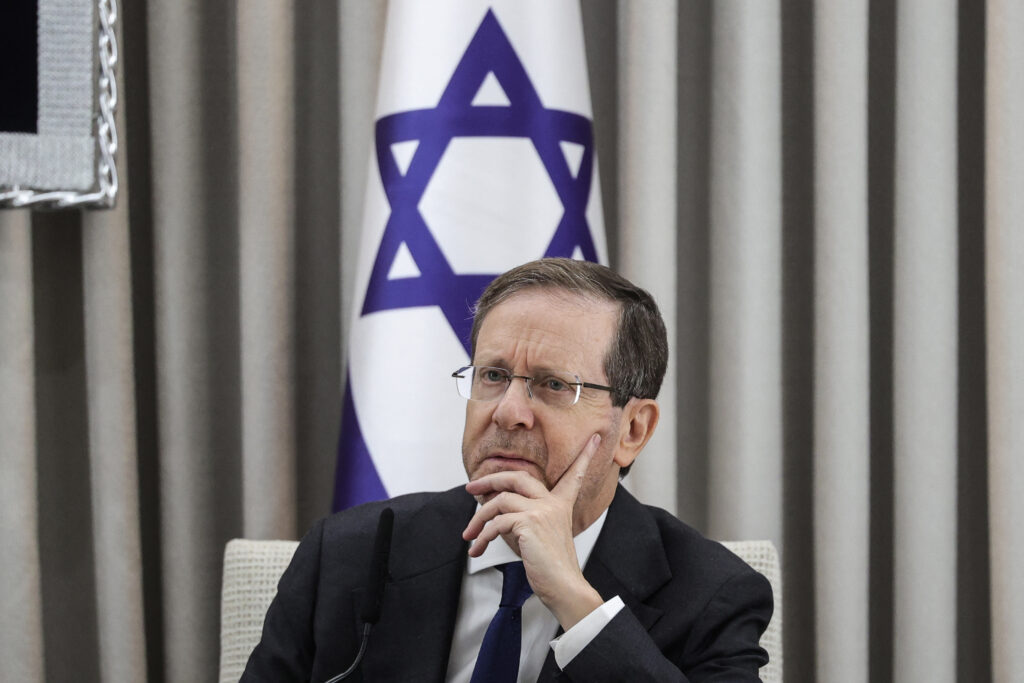
Israeli President Isaac Herzog’s largely ceremonial position comes with one key role. And it starts now.
The job of the nonexecutive president, as opposed to that of the prime minister, is mostly symbolic: signing laws (that he can’t veto), swearing in judges and greeting visiting heads of state.
But Herzog is once again about to fulfill the president’s main duty, one that could alter Israel’s course of history: He will grant one of the party leaders elected last week to the Knesset, Israel’s parliament, the coveted “mandate” — an exclusive 28-day window to negotiate with other parties and form a governing coalition.
Even that task is a formality when the election produces a clear winner. This year — with the outcome leaving each of the battling factions short of a majority and Prime Minister Benjamin Netanyahu and his main opposition all warning of societal collapse if the other takes power — the decision is anything but routine.
Herzog, 66 — a lawyer, former member of parliament and ex-government minister whose father also served as president from 1983 to 1993 — is caught in the middle. By law, he is an objective referee, but under the circumstances, he could become a broker.
“He is supposed to maintain political neutrality, but he is also supposed to be a sort of guardian of democracy,” said Ofer Kenig, a research fellow and political scientist at the Israel Democracy Institute and Ashkelon Academic College. “I don’t envy Herzog in this situation.”
Whom he picks — and it will almost certainly be one of the leaders of the two biggest blocs, Netanyahu or former military chief Gadi Eisenkot — will help decide who leads Israel at a perilous crossroads: at war with Iran, still fighting in Gaza and Lebanon, and split at home by deep political and societal divisions.
Granting someone the mandate merely starts the process. It could also start a clock that sends Israelis back to the polls within months, for the seventh time since 2019.
The Joint List, one of the growing parties representing Israel’s Palestinian citizens, on Thursday called for Eisenkot to get the nod from Herzog.
That doesn’t mean Eisenkot and the Arab parties, which represent a large share of Israel’s Palestinian citizens, would ultimately form a partnership, analysts said, but it does give the retired general the most endorsements from other party leaders to take charge of the coalition-building efforts, a key factor in Herzog’s assessment.
Israeli law empowers Herzog to anoint with a mandate the leader he thinks has the best chance of forming a workable government, but it doesn’t tell him how. The first time Herzog executed this duty, following the 2022 election, Netanyahu’s bloc won an outright majority and the choice was easy. Presidents generally choose the party with the most seats.
This time, it will be more subjective.
The puzzle Herzog faces: A party or coalition of parties needs 61 seats to control a majority in the 120-seat parliament. Netanyahu’s current coalition of parties lost its majority in the election, falling to 53 seats. The main bloc of opposition parties, led by Eisenkot, controls 48 seats.
Neither side can form a government on its own, unless they poach parties (or individual lawmakers, which also happens) from another contingent or join forces in a power-sharing “unity” government where they split the top jobs (including possibly taking turns as prime minister) or by turning to a third group: the bloc of Arab parties that won a record 19 seats.
None of those options is within reach in a parliament where joining with one party will often lose you another. Some factions have sworn never to serve with Netanyahu; some have sworn to keep the Arab parties out of government; some have sworn both.
One of the ultra-Orthodox parties, United Torah Judaism, has signaled willingness to join the opposition, but its key demand — exempting religious school students, a large share of the ultra-Orthodox male population, from the military draft that requires service of most other Israeli Jews — has already been ruled out by Eisenkot, a former military chief of staff.
“The president is left with some really difficult maths,” said Jason Pearlman, a onetime aide to Herzog and his predecessor, former president Reuven Rivlin. “There is no clear certainty in this case. It will be his qualified opinion at best.”
Herzog began his process, as is customary, by bringing the leader of each of the 12 parties that were elected on Oct. 27, to the presidential residence in Jerusalem to ask who they want him to pick. He started with the smallest parties and was to finish Thursday with the biggest, Netanyahu’s Likud, which took 27 Knesset seats.
The meetings are televised, but off-camera they are also a chance for Herzog to test how far the parties are willing to go to partner with other factions, and to assess which promises are fixed and which are negotiable.
“What you see on the screens is a nice little democratic dance,” Pearlman said. “But the real conversations take place behind closed doors.”
Herzog himself beseeched party leaders to “stop climbing trees and face the reality” of the split results. He called for them to enter the coalition-building phase with “originality and creativity, courage and goodwill.”
The rules are simpler than the politics. The person Herzog anoints gets 28 days to assemble a coalition, plus up to 14 more. If they fail, the president can try a second candidate, who gets 28 days and no extension.
After that, any 61 of the Knesset’s 120 members can petition for a candidate of their own. If that fails too, the Knesset dissolves and a new election is scheduled.
That prospect might demoralize an already exhausted electorate, but it would not bother Netanyahu, many analysts say. His coalition remains in power as the head of a “caretaker” government until the next leadership takes shape, whether that is in months or years. Israel’s longest-serving prime minister stays in the top job, as do his ministers, with a restricted, provisional budget in place, putting time on their side.
“I don’t think Bibi’s camp care at all if we have to go back to elections,” said an Israeli official familiar with coalition talks, speaking on the condition of anonymity to discuss internal deliberations. “They are kind of like, whatever, we can do this again. We are still in power.”
The man trying to push the system along, Herzog, comes from something close to Israeli political royalty. His father, Chaim, was the country’s sixth president. His grandfather was chief rabbi of Ireland and later of Israel. His brother Michael Herzog is a retired brigadier general and former ambassador to the United States.
A former head of Israel’s defunct Labor party, Herzog lost to Netanyahu in 2015 and later ran the Jewish Agency, the quasi-governmental body that promotes immigration to Israel. In 2021, the Knesset elected him president, considered a capstone honor for Israeli public figures.
He spent his term in the crossfire of Israel’s warring factions. He tentatively pushed back on Netanyahu’s plans to restrict the power of the courts over government actions, saying the moves threatened Israel’s moral integrity. But he signed some of the legislation, sparking protests outside his residence.
Liberals call him too cautious. Many on the right still see him as a man from Labor.
Then there’s Netanyahu’s corruption case. The prime minister made a formal request to Herzog a year ago for a pardon before his ongoing trial reached any verdict on charges of bribery, fraud and breach of trust. President Donald Trump pushed Herzog to grant it.
Trump called the prosecution a “witch hunt.” Netanyahu said it was a distraction at a time of national emergency. Opponents have wondered if a pardon, or a plea bargain, could be part of a deal that pushes Netanyahu toward a power-sharing deal or, in liberal dreams, out of power entirely.
Herzog’s office says the pardon and the mandate remain separate issues. Kenig expects them to stay apart, at least at first. If Eisenkot fails and another election looms, he said, there is speculation that Herzog might use the pardon “as part of his tools to try to force an agreement.”
Israeli social media has filled in the rest. One theory says Herzog owes Likud for votes in his 2021 election. Another has Trump brokering a deal: Netanyahu governs for a year or so, then takes a pardon and retires. Neither has any evidence behind it.
Who will next lead Israel is far from clear. But Herzog is about to start the machinery that decides.
The post Israel’s largely ceremonial president faces choice that could shape its future appeared first on Washington Post.