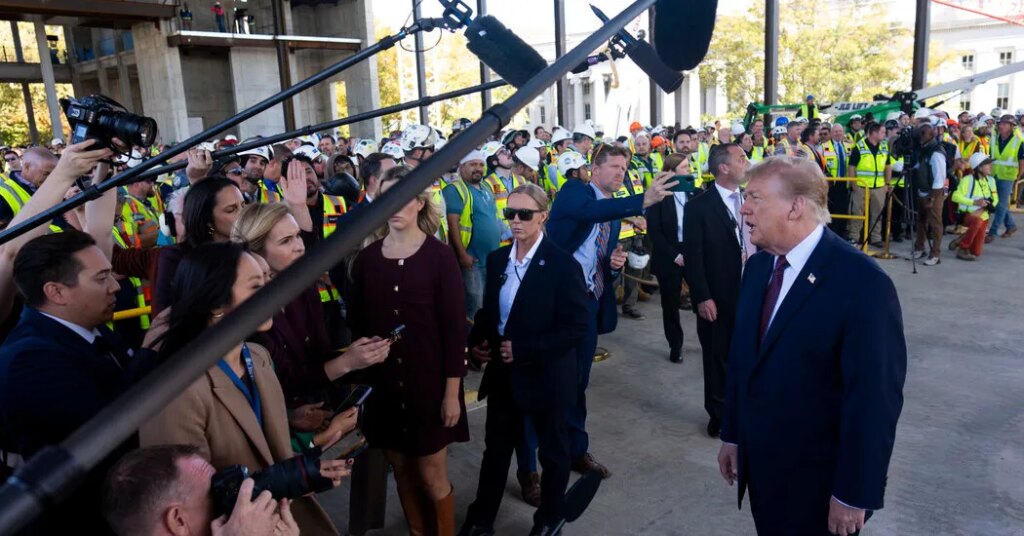
In the final months of a bitterly fought midterm campaign, President Trump frequently shrugged off affordability as a “hoax,” bragging to voters that the economy was stronger than it had ever been.
In the end, Americans resoundingly disagreed.
Furious over high prices at the grocery store, at the gas pump and beyond, a broad swath of the electorate delivered an unmistakable repudiation of Mr. Trump’s agenda on Tuesday, one that may serve to curtail his economic policies and ambitions over the final two years of his term.
The depth of the public’s dissatisfaction with Mr. Trump was evident in the breadth of the Democratic victories. The party flipped dozens of states and congressional districts by channeling the public’s anger over inflation and the costs of the president’s policies, including the war with Iran.
The outcome denied Mr. Trump the potent advantage of another congressional majority, which he had wielded over the last two years to cut taxes, slash welfare programs, delete federal regulations and wage a bruising global trade war. By Wednesday, some Democrats began openly plotting how to roll back some of the president’s prized accomplishments.
“What is our assignment?” asked Senator Chuck Schumer, Democrat of New York, who could soon become the majority leader. “First, Americans want Washington to bring down the cost of living.”
The work to deliver on that pledge could prove difficult for Democrats, whose majorities are robust but still insufficient to override Mr. Trump, who said this week that he could become “Mr. Veto.” Adding to the challenge, Democrats probably cannot directly turn back the clock on high prices, though they can certainly curb the political and economic sources — including the war with Iran — that have exacerbated inflation.
But there was an early sense in Washington on Wednesday that the midterms could institute some constraints on a president who had grown accustomed to operating without any. The outcome also reinforced the standard by which Mr. Trump and the incoming Democratic majorities may soon be judged: If they can actually fulfill long-unmet demands to combat the rising costs of living.
“People want relief on the affordability squeeze,” said Lael Brainard, who led the White House National Economic Council under President Joseph R. Biden Jr. “That is the clear economic message voters are sending.”
In a statement, Matthew Middleton, a White House spokesman, promoted the president’s tax and trade policies, adding that Mr. Trump would “work with anyone willing to advance solutions that strengthen our economy.”
But Mr. Trump otherwise responded to his party’s shellacking by trying to distance himself, claiming on Wednesday that Republicans “would have won” if he had been on the ballot. His vice president, meanwhile, blamed the war with Iran, a conflict that has caused energy prices worldwide to soar.
As Americans cast their ballots on Tuesday, gas prices averaged about $4.15 per gallon nationally, according to AAA. That was more than a dollar higher than one year ago, amounting to a political albatross for Mr. Trump, who spent the final weeks of the race claiming that costs were declining, even when they were not.
Wilbur Ross, who served as the commerce secretary in Mr. Trump’s first term, said there was truth to Mr. Trump’s optimism in the closing days of the election. He pointed to the nation’s continued economic growth. But Mr. Ross also acknowledged that inflation in general and gas prices in particular were probably the “determinative factor” for voters.
“I think people very much vote their pocket book,” he said.
In other words, the same economic forces that had propelled Mr. Trump back to the White House in 2024 contributed to his party’s electoral demise two years later. Seizing on that shift, Democratic leaders set out on Wednesday to demonstrate that they had heard voters’ message on the economy.
“We’ve promised to fight for an affordable America, and that’s exactly what we will do,” said Representative Hakeem Jeffries of New York, the potential next House speaker.
At a celebratory news conference, Mr. Jeffries and his Democratic colleagues promised several moves that they said would alleviate some economic pain. That included ending the war with Iran and taking steps to lower health insurance premiums, after a key tax subsidy lapsed under Republican leadership.
Other Democrats said the party could roll back portions of the president’s signature tax cuts, enacted last year, which critics see as too friendly to the wealthy and big businesses. Incoming Democratic leaders also proposed unwinding elements of the same law that slashed benefits to low-income Americans enrolled in Medicaid, and to those receiving food stamps.
“The American people who are struggling to afford gas, health care and groceries overwhelmingly voted for change,” said Senator Ron Wyden, Democrat of Oregon, who is expected to become the chairman of the chamber’s top tax committee.
Mr. Wyden also pledged in a statement Wednesday that his panel would try to “end Trump’s disastrous and corrupt tariffs,” and limit his authority to impose similar duties. Some of those taxes on imports have already been invalidated by federal courts; others representing billions of dollars in collected revenue are awaiting a verdict.
For Democrats, the initial wave of promises illustrated the scope of their ambition and the complicated political forces they may encounter in trying to address the economic anxieties of voters.
Lawmakers in both parties had recently banded together for a handful of failed yet symbolic attempts to roll back Mr. Trump’s policies. That included efforts this year to cancel out some tariffs seen as legally or economically excessive, and to end the war with Iran.
But reducing costs quickly and legislatively is never easy, and it may prove to be even harder with Mr. Trump in control of the White House. On Wednesday, the president reiterated his threat to scuttle what he described as “destructive” ideas put forward by a new Democratic-led Congress “if we don’t like what they’re doing.”
Mr. Trump has also proved willing throughout his second term to stretch the limits of executive power to achieve his economic goals, even when Congress and the courts have tried to restrict him. Stephen Moore, a conservative economist who previously advised Mr. Trump, said he expected the president to continue wielding this authority, especially in pursuit of deregulation.
“You can do a lot of things administratively without Congress,” he said.
Still, many Democrats this week dismissed Mr. Trump’s rhetoric, arguing that they did not think his threats alone should deter them from trying.
“Make the president veto — if that’s what he’s going to do — clear steps that would address affordability,” argued Heather Boushey, who served on the Council of Economic Advisers under Mr. Biden.
Ms. Boushey pointed to what she described as “low-hanging fruit” for Democrats if they wanted to show they were serious about addressing affordability. That included efforts to lower health care costs and unwind cuts to the federal safety net, she said.
At minimum, added Ms. Boushey, the attempt to rein in prices could improve Democrats’ standing among voters, while “setting the scene for what you’re running on in 2028.”
The post In Victory, Democrats See Economic Mandate to Cut Costs and Curtail Trump appeared first on New York Times.