Six days before the election, more than two dozen of President Trump’s top strategists logged onto a private video call.
The mood was grim. The discussion began with talk of cyanide.
“Do you want the white pill first, or the black pill first?” asked Tony Fabrizio, the president’s chief pollster.
Tim Saler, one of the Republican Party’s top data consultants, laid out two scenarios. In the first, the $400 million MAGA Inc. super PAC was reaching the voters that it had wanted and expected to vote. “That’s the optimistic scenario,” he said.
The other was a wipeout.
“I’m getting my affairs in order,” James Blair, who left the White House to oversee the president’s midterm strategy, said to laughter, according to four people on the call. “I suggest everybody else do the same.”
For roughly 30 minutes, the call ran on gallows humor: funeral arrangements, prison food, presidential pardons, even a brief riff on fleeing the country.
“At least Bibi won. He’ll protect us,” Mr. Blair said sarcastically of the Israeli prime minister, Benjamin Netanyahu, whose country had voted the day before. (Mr. Netanyahu’s bloc fell short of a majority, and his party soon claimed the election had been stolen.)
“Maybe we could get asylum in Israel,” Mr. Fabrizio said.
Collapse at the Polls
The scope of the Republican wreckage would become clear a week later.
Democrats stormed to a huge House majority and won control of the Senate, a remarkable feat powered by victories in Republican strongholds — Kansas, South Carolina, Texas — that few could have imagined a year ago.
This account of the Republican Party’s collapse is based on interviews with more than 70 people — among them lawmakers, political strategists, party leaders, pollsters, White House officials and congressional aides — who were directly involved in the midterm elections, many of whom were granted anonymity to describe private conversations and decisions.
The scale of the defeat was far from inevitable.
Republicans had record fund-raising, the world’s richest man, a favorable Supreme Court ruling on campaign finance and a demoralized, unpopular opposition.
In the Senate, they had a map that required Democrats to compete in states they hadn’t won in decades.
And in the House, the Trump team demolished the tradition of redrawing congressional lines only once a decade in order to carve up new districts to help the G.O.P. bolster its narrow majority.
What Republicans could not overcome was a president who lost the public’s trust on the economy and so much more. And what they had not counted on was an unpopular war in the Middle East — one that would close the Strait of Hormuz and push gas prices past $4 a gallon — that would rage all the way through the election.
And Democrats were ready, this time, to seize on the G.O.P. stumbles.
A Stark Warning on the Iran War
The slide deck that Mr. Blair had circulated over the summer to officials in the West Wing was stark.
One slide linked Republicans’ polling numbers to an Iran war timeline.
It showed how the Democratic advantage had ballooned during active hostilities, shrunk during talks over a “memorandum of understanding” and then spiked again when the cease-fire collapsed.
By the end of July, Democrats had a 10-point edge on the congressional ballot.
The “bottom line” was hard to miss. It was in highlighter yellow: Republicans could still conceivably win the House if Democrats had only a four-point edge. “But that won’t happen without an extended cease-fire, Hormuz open & gas prices falling,” the slide warned.
“A final result approaching D+10 would likely cost us the Senate.”
The results on Tuesday were even worse: Mr. Trump’s party is on track to lose the national popular congressional vote by about 13 points, according to estimates by The New York Times. It is shaping up to be the worst loss in a half-century, since the aftermath of the Watergate scandal.
Even before the polls had closed, Mr. Trump had begun to ruminate on what might have been.
“If we never went into Iran, what do you think would happen in the midterms?” the president had asked privately, according to a person who spoke to him.
An Unchecked Second Term
What made the war such a potent force is that it told a simple story for voters.
As a candidate, Mr. Trump had promised no new wars. He started a new war.
He promised lower prices. Gas prices soared and inflation rose.
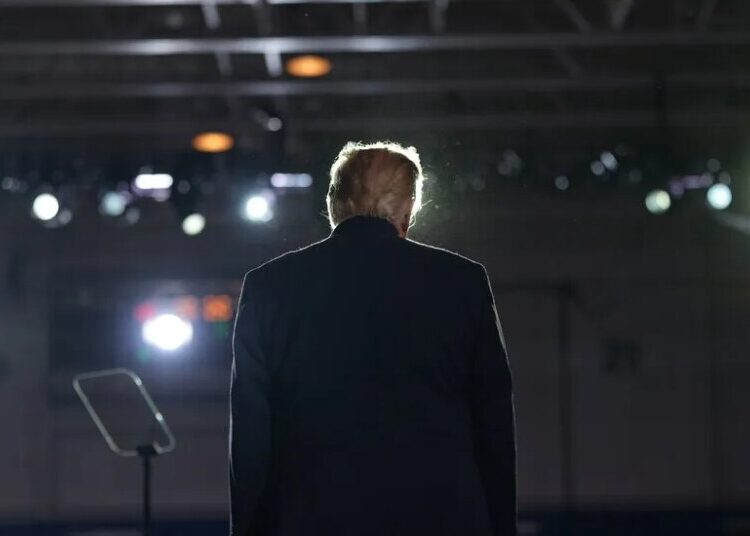
The story of the G.O.P. midterm implosion was not only a story of broken promises; it was also a story of radical overreach. After Mr. Trump came back from pariah status after Jan. 6, 2021, some advisers believed he had convinced himself that the rules of politics had been suspended for him alone. That illusion was obliterated on Tuesday night.
Over nearly two years, hubris had become the governing philosophy of Mr. Trump’s second presidency.
There was a seemingly endless string of investigative pieces revealing that Mr. Trump, his family and their close associates had used the presidency to enrich themselves brazenly. Those reports began to resonate with voters; an early October poll from Fox News showed corruption as the top voter concern. (Anna Kelly, a White House spokeswoman, said: “The President only acts in the best interest of the American people. There are no conflicts of interest.”)
In 2025, Mr. Trump began a trade war with the entire world — the pain of which was still being felt more than a year later on farms all over the suddenly competitive states of Kansas, Texas and Iowa.
Throughout it all, the president flashed indifference to the struggles of Americans that his policies had exacerbated.
Soaring gas prices? “A small price to pay,” Mr. Trump insisted.
Some members of his team grew exasperated as Mr. Trump spoke seemingly more about his new ballroom than the border, golf courses than grocery prices, interior decorations than inflation.
On the eve of the midterms, he focused his closing pitch on his refurbishment of the Reflecting Pool on the National Mall, joking that he was considering renaming it for himself rather than Abraham Lincoln.
Unlike in the past, Democrats mostly ignored the daily Trump distractions and sought to connect corruption to costs. They also told a story of a government focused on elites while average people struggled — from Jeffrey Epstein’s protected associates to the president’s $2.2 billion in personal profits.
In the House, Democrats quickly and unexpectedly countered Mr. Trump’s redistricting push and pursued strong candidates deep into red territory to spread the map. In the Senate, they found a series of blue-chip recruits who put once unthinkable states into play. In the final, frenzied weeks of the campaign, Republicans were redirecting cash from the usual swing states of North Carolina and Georgia to try to shore up traditional strongholds in South Carolina and even Mississippi.
The war in Iran, said Representative Hakeem Jeffries of New York, the Democratic leader and now the speaker-in-waiting, helped “supercharge” the contrast between the two parties.
Republicans had tried to frame the midterms as a choice between “common sense and crazy,” relentlessly attacking the rising democratic socialist wing of the left.
Yet Mr. Trump’s own pollster’s final survey, taken two weeks before the election, showed that while both the MAGA Republican brand and democratic socialists were unpopular with voters, MAGA carried more baggage. When Republicans who were planning to cast ballots were asked what it would take to earn back their vote, their top two answers were ending the war and addressing inflation.
On that final call before Election Day, Mr. Trump’s advisers were both clear-eyed and cynical about the state of the race, referring at one point to a Trump ally who ran for governor of Minnesota and demanded a recount in his primary despite losing in a landslide.
“Look, it’s fine,” Mr. Blair told the group sarcastically. “I think we’ll just pull a Mike Lindell and demand a recount regardless of how many points we’re down.”
Alex Pfeiffer, a spokesman for the MAGA Inc. super PAC, said that the group’s “sober and clear-eyed view of the political environment,” led to investing in House races Republicans are leading in, in Maine, Florida, Tennessee, New York and Texas.
“The people peddling these made up quotes and false gossip not only demean and belittle the historic and generous investment by the president into the party’s midterm effort, but they also slander the hard work of the many who contributed to this effort,” he said in a statement. “They are cowards and losers.”
A White House official, who declined to speak on the record, said in response to the reporting for this article: “President Trump was not on the ballot, and it’s proven that Trump voters show up when he is on the ballot. Candidate quality matters, and President Trump did a better job promoting many of the candidates on the ballot than the candidates did themselves.”
The official repeated that the president, who acknowledged earlier on Wednesday that the war affected the midterms, had over and over again said Iran can’t procure a nuclear weapon.
The Anti-Recruiter
While Senator Chuck Schumer of New York, the Democratic leader, painstakingly recruited top-tier Senate candidates, Mr. Trump took a series of steps that endangered the Republican majority.
After Senator Joni Ernst of Iowa flirted with opposing Mr. Trump’s most controversial nominees and Senator Thom Tillis of North Carolina voted against his signature tax-and-spending bill, Mr. Trump’s allies threatened to end their careers. Both decided to retire, creating vulnerable open seats that had been held by Republicans.
In North Carolina, Mr. Trump cleared the field for Michael Whatley, a former lobbyist and Republican National Committee chairman, who proved a lackluster candidate and lost to Roy Cooper, the state’s popular Democratic former governor.
After Senator Lindsey Graham of South Carolina died in July, Mr. Trump supported tapping his sister, Darline, to not just replace him temporarily but also to run for a full six-year term. In doing so, he elevated an inexperienced candidate with no fund-raising base, and she went on to lose in a state that had not elected a Democrat to the Senate since 1998.
But no candidate proved more costly to the party than Ken Paxton, the scandal-ridden Texas attorney general. Mr. Trump endorsed him over Senator John Cornyn, the Republican incumbent, ignoring a year of warnings that Mr. Paxton would put the seat in jeopardy. Republicans were ultimately forced to spend close to $300 million in Texas — money that could have gone to shore up candidates in other states. Mr. Paxton lost by 12 points.
On another recent call, the Trump team mocked the haplessness of some of the Republicans they were trying to elect.
“I have seen the enemy,” Mr. Blair told the group a week earlier. “And it is us.”
Mr. Fabrizio replied: “In many places.”
The Democrats’ Playbook
In May 2025, Mr. Schumer arrived at Wildflower Farms, an upscale resort in New York’s Hudson Valley, for a secretive retreat with donors and party officials. He desperately needed to expand the Senate map.
To win control of the Senate, Democrats needed to hold all of their seats and flip at least four, including in states that Mr. Trump won handily in 2024.
Mr. Schumer spent months wooing Mr. Cooper and took at least three trips to Ohio to coax former Senator Sherrod Brown, who had lost in 2024 but had a populist brand that matched the country’s mood.
“If you retire and we lose the majority by one vote, you won’t enjoy your retirement,” Mr. Schumer recalled telling Mr. Brown, 73.
Both ran and won.
In the House, where Democrats had fallen three seats short in 2024, recruiters went hunting in districts Mr. Trump had carried by 10 points or more, betting early that the emboldened president would overreach.
An election post-mortem by the Democratic House Majority PAC circulated in April 2025 found two factors stood out among the party’s stronger 2024 candidates: being “perceived as moderate” and focusing on the economy.
“If we wanted to compete deeper in red districts, we needed to find candidates who are not immediately off-putting,” said Mike Smith, the PAC’s president.
They set about recruiting candidates with distinctive biographies: military veterans, doctors, farmers, a smokejumper, a Tejano music star — just about anyone who didn’t scream professional politician.
Redistricting Wars
Mr. Trump, meanwhile, was trying to redraw the House battlefield itself.
In the spring of 2025, Mr. Blair, then his deputy chief of staff, brought the president a plan to redraw congressional maps mid-decade to make seats safer for Republicans. The gerrymandering push started in Texas and soon spread to other Republican-led states.
When Mr. Jeffries first heard about the Texas gambit, he turned to his advisers in disbelief and declared, “You’ve got to be fucking kidding me.” He flew to Texas to urge state legislators to take a stand, and many Democrats fled the state to slow down the legislative process.
But the Trump-inspired play went through and Republicans carved themselves out five new seats that Mr. Trump would have carried by double digits in 2024 — seemingly enough to withstand even a dip in support in the midterms.
Democrats fought back. California voters approved Gov. Gavin Newsom’s plan to create five new seats favoring Democrats, and Virginia voters approved a map creating another four, though the Supreme Court later struck it down.
From the start, Mr. Blair was cocksure about his redistricting plan, and he and the president dismissed Republicans who worried about the maneuver backfiring.
But by April 2026, Democrats had good reason to believe that they had neutralized the threat by redrawing districts in several blue states. Mr. Jeffries held a celebratory news conference featuring a poster with the faces of Mr. Trump and Mr. Blair and an anonymous quote that had appeared in an article about redistricting in The Times: “Maximum warfare everywhere all the time.”
When Mr. Blair saw the poster, he texted one of Mr. Jeffries’s top aides, Gideon Bragin: “Can you send a copy of this to my office?”
Instead, it remained inside House Democratic headquarters through Election Day, when a blue tidal wave washed over even many of the districts drawn to favor Republicans.
The Unforced Errors
As 2026 began, the administration’s immigration enforcement surge turned violent in Minneapolis when two protesters were shot and killed by federal agents. Both killings were captured on video.
Mr. Trump told advisers he didn’t like how the videos looked.
Susie Wiles, the White House chief of staff, had spent months privately trying to steer him away from the hard-line immigration approach favored by Stephen Miller, the president’s top policy adviser.
Soon after Minneapolis, Democrats’ internal polls showed the party taking the edge on immigration for the first time. What had been one of Mr. Trump’s perennial strengths was for a period his top liability, according to one of the president’s senior strategists.
Then, about five weeks after the second shooting, Mr. Trump took the country to war in Iran.
Mr. Blair at first shared his boss’s optimism that the war would be a quick success. He reassured skeptical colleagues that the conflict would not be the political disaster some feared because some Defense Department officials had assured the White House it would be resolved rapidly.
But the president’s four-to-six-week timeline stretched into months.
In public, Mr. Trump crowed about a decisive military triumph. In private, advisers briefed him on the closure of the Strait of Hormuz, spiking prices of gas and fertilizer and an alarming depletion of American weaponry.
Mr. Fabrizio’s focus groups in March, about two weeks into the conflict, showed that voters did not understand why the president had started the war. They saw a broken promise that was making life more expensive.
Former allies on the antiwar right, including Tucker Carlson and the former Georgia congresswoman Marjorie Taylor Greene, were now in open rebellion.
Mr. Trump knew the war was draining his support, according to advisers, but for a brief moment it seemed that he had found himself a way out of the mess. By mid-June, Vice President JD Vance had negotiated a memorandum of understanding with Iran, and the Trump political team exhaled. Mr. Fabrizio’s first poll of the proposal found that voters aware of the deal favored it by 41 percentage points, and 67 percent thought it would bring down gas prices.
But G.O.P. Iran hawks, including Senator Ted Cruz of Texas, pressed Mr. Trump to keep the pressure on Tehran. The deal fell apart and the war dragged on.
‘My Money’
Mr. Trump never stopped raising money after the 2024 election, assembling a roughly $400 million war chest that he made clear to advisers he saw as “my money.”
By August, with the election less than 100 days away, Republican Senate strategists still had no clarity on where Team Trump would spend. One described being “shocked at how ill-prepared they were.”
A Trump adviser said a plan existed but could not be shared because the president had not approved it.
Some days, Mr. Trump told advisers privately: “We’ve gotta win. Anything we gotta do.” On others, he sounded as if he couldn’t care less. “It says something very nice about me that they just can’t win without me,” he told aides.
Mr. Blair and others had to make the case to the president to sign off on the spending. Mr. Trump withheld his approval until the end of the summer.
The delay was costly: Ad prices soar as elections near.
One week in mid-October on a single station in Anchorage, the Trump super PAC paid nearly four times as much money as the leading Democratic super PAC did to air roughly 70 percent fewer commercials because it had not reserved the time well in advance.
The Democratic group paid $2,700 for a commercial on the local evening news; Mr. Trump’s super PAC paid $30,000 for the same slot.
Typically, endangered lawmakers distance themselves from an unpopular president in midterm elections. Team Trump wanted to do the opposite.
“We have taken that old construct and flipped it on its head,” said Chris LaCivita, the co-manager of Mr. Trump’s 2024 campaign.
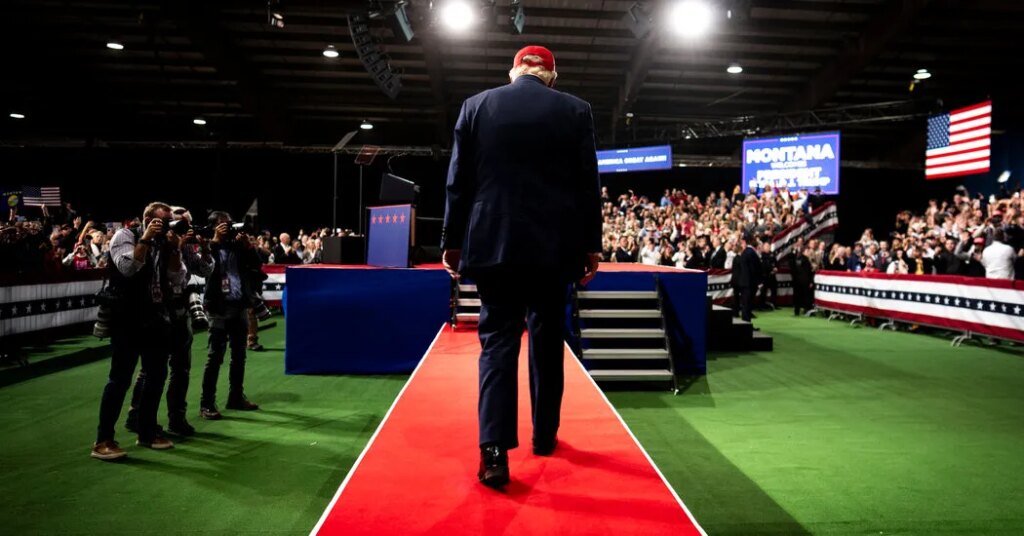
Thus, the first modern midterm convention was born, a two-day celebration of the president in Dallas in September that few members of his party had wanted.
During his convention speech, Mr. Trump rolled out a splashy new proposal to send $5,000 to every American adult — but only if Republicans won.
Almost no one knew it was coming, including his senior political advisers, the speaker and the Senate majority leader.
The idea had not even been polled before Mr. Trump said it. And when a similar proposal was tested, Mr. Trump’s team found it did little to move voters toward Republicans. Some of the president’s own advisers cringed at the giveaway, with one describing it as a naked effort to “bribe” people for their votes.
The convention did bring one piece of good news: money. On the first day, Elon Musk sent $75 million to the Senate Leadership Fund, the super PAC led by allies of the Senate majority leader, John Thune of South Dakota. It was one of the largest single contributions in American history.
At the convention, Mr. Paxton made his way into the fund’s suite, where Alex Latcham, the super PAC’s executive director, made a somewhat cryptic remark to him.
“You’re going to be happy tomorrow.”
The ads were about to begin.
Mr. Musk would spend more than $450 million to aid Republicans in the midterms, much of it in Texas to try to save Mr. Paxton. The super PAC he funded spent tens of millions on ads attacking the Democratic nominee, James Talarico, for his support of transgender rights, mirroring a line of attack that the Trump team had used effectively in 2024.
In other races, the focus on transgender ads became a point of disagreement between officials at the Senate Leadership Fund and Mr. Trump’s operation, which argued that the 2026 election was fundamentally about the economy and that running ads on other topics would be less effective. Senate G.O.P. strategists saw economic messages falling flat in the current political environment in some states.
The fight to save the Senate was hampered by party leadership that could barely work together. Mr. Trump and Senate G.O.P. leaders, Mr. Thune among them, never grew close. The president endorsed Mr. Paxton over their objections. And when Trump advisers met with officials from the top Republican super PAC at Camp David in March 2026 to plan for the midterms, no one from the National Republican Senatorial Committee was invited.
The Collapse
In late August, Julie Merz, the top strategist at the Democratic Congressional Campaign Committee, gathered her team and pulled up a slide estimating a 35 percent chance of a “blue wave.”
“It’s our job,” she recalled saying, “to hand out as many surfboards as possible.”
Committee officials made the party’s most vulnerable incumbents an unusual offer: Instead of spending millions defending them, the party would move the money into deeper red territory and poll their seats to see if they needed the resources back. Most agreed, freeing up around $10 million to expand the map.
Not long after the Republican convention in Dallas, diesel prices hit all-time highs.
In the Senate, it got so bad for the G.O.P. that by early October Republicans were ordering up polls in seemingly unthinkable states, like South Dakota and Idaho.
A month before the election, the Senate Leadership Fund pulled ads from North Carolina, ceding the state to redirect money to Kansas, then South Carolina and eventually Mississippi — a state Mr. Trump had carried by nearly 23 points two years ago.
“Battleground Mississippi,” Mr. Trump’s advisers called it mockingly on a call.
In the House, the deterioration was perhaps worse.
At one point, top officials with the Congressional Leadership Fund and Mr. Trump’s super PACs had decided to give up trying to flip Representative Henry Cuellar’s South Texas seat — only to realize that Speaker Mike Johnson was set to be in the district the day the ads were going to come off the air. They delayed the announcement for a day to spare Mr. Johnson an embarrassing episode.
Mr. Cuellar won re-election in a landslide.
In the end, the map shifted so far left that House Republicans — who polled more than 100 seats — could not keep up. It surprised even some leading Democrats.
At a September dinner, Rahm Emanuel, who ran the House Democrats’ campaign arm in the 2006 wave, asked the party’s top recruits how much Mr. Trump had won their districts by. When Zach Dembo, a military veteran and former federal prosecutor running in Kentucky’s Sixth District, said 15 points, Mr. Emanuel looked at him in disbelief.
Mr. Dembo won.
The last Sunday before Election Day, Mr. Jeffries arranged for a symbolic final stop to a battleground district.
He went to Alabama, where Republicans had redrawn Representative Shomari Figures’s district to favor their party after a Supreme Court decision weakened the Voting Rights Act. It was important to go there, Mr. Jeffries said, because “he was facing a renewed effort to subject the African American community to Jim Crow-like tactics.”
“It’s fair to say that Shomari and I both felt the weight of history given the fact that the civil rights movement led by Dr. King, Rosa Parks, and so many others began in the very place where we were ending this all important 2026 campaign,” Mr. Jeffries said.
Mr. Figures won his race on Tuesday.
On the way to the airport, Mr. Jeffries made an unpublicized stop at the Freedom Monument Sculpture Park that remembers the history of enslaved people in America.
In January, Mr. Jeffries is now set to become the first Black speaker in American history.
The post ‘I Have Seen the Enemy, and It Is Us’: Inside Team Trump’s Historic Collapse appeared first on New York Times.