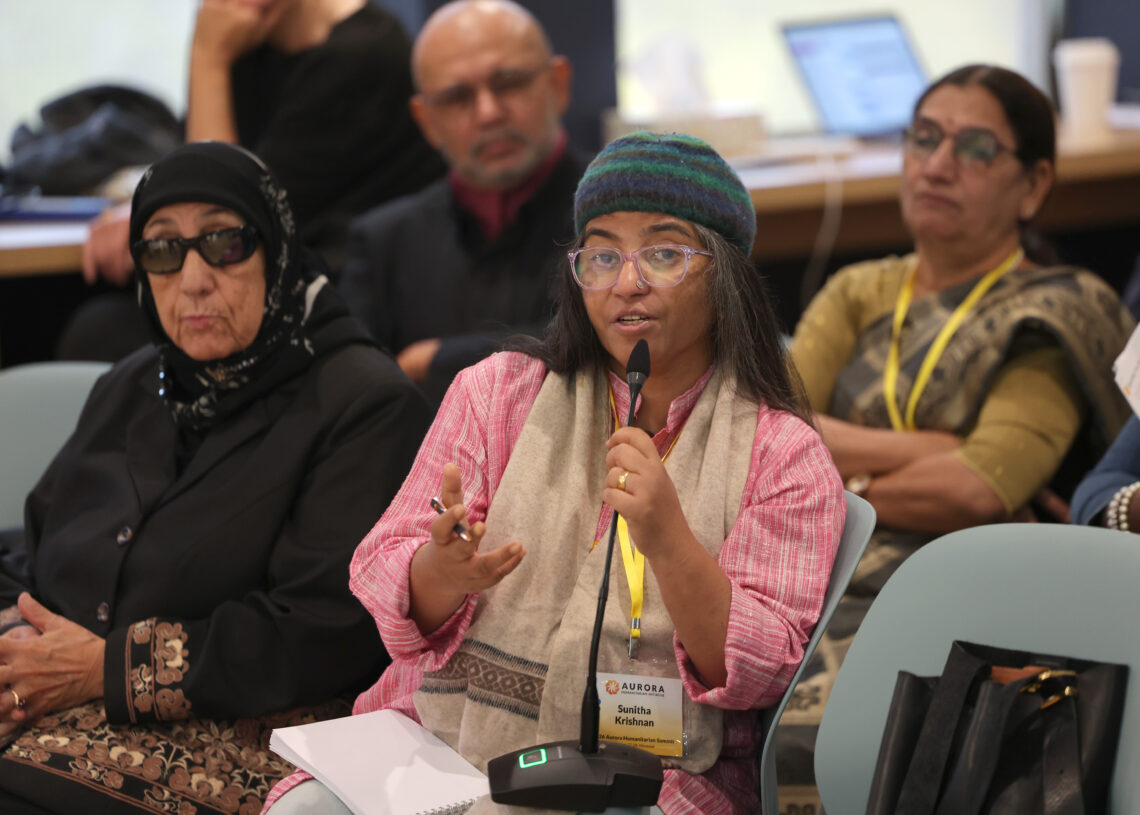
MONTREAL — Sunitha Krishnan is a diminutive woman, 4-foot-6 on tiptoes. But she speaks with one of the strongest and most inspiring voices I have ever heard about how to respond to sexual violence and the indifference that often surrounds it.
Krishnan told her astonishing story last week at a gathering in Montreal. It carries a message that’s resonant today — for politicians who demean rape victims, for college fraternity brothers who commit or tolerate sexual violence, and for women and children who are traumatized by abuse. And in this election season, perhaps it speaks more broadly to Americans who feel overwhelmed by injustice.
When Krishnan was 15, she was gang-raped by eight men in a village near Bangalore, India. She reported the crime but was denounced as a troublemaker and shunned by her neighbors. Yet she kept fighting, ceaselessly, and went on to create an organization called Prajwala that has rescued tens of thousands of women and girls from sex trafficking and abuse.
How did she find the strength to fight back? I asked Krishnan that question onstage at a gathering of human rights activists organized by the Aurora Humanitarian Initiative. (I serve as a member of the group’s selection committee, which awards a prize each year to someone who embodies its ethic of humanitarian action.)
“I refused to consider myself as a victim,” Krishnan answered. “I refused to hide my face with shame, and I refused to bow down before what the community was asking me. In my mind, the question was, if somebody has to be ashamed, it is the eight men who raped me, not me.” She felt a rage for justice that “has only increased every minute of my life.”
Krishnan protested at first to her local government. But officials were suspicious of her because, when she was 12, she had organized a small school for other girls. “I was told I got what I deserved because I’m a wrong influence on the girls. … Everywhere I went, I was treated as a criminal — somebody who deserved the rape, for I had crossed the line of decorum. … I was dishonorable for the community, so much so that parents told their children not to sit with me in school.”
But she persisted. She went to college and studied social work. She still suffered from the trauma of her attack, but she began working and meeting activists who shared her anger. She was arrested in 1996 while protesting the Miss World contest being held that year in Bangalore. Her family was ashamed anew that she had been jailed. She then moved to the sprawling city of Hyderabad.
There, Krishnan founded Prajwala, whose name means “eternal flame,” in late 1996, when she was 24. It began as a school for girls whose mothers had been trafficked into prostitution. Its first home was a room in a building that had housed a brothel. Krishnan was the teacher; she started with five students.
Prajwala has grown over the past 30 years into an organization with 191 employees and a mission to “free the world of sex trafficking and sex crime,” according to its most recent annual report. The group’s latest count is that it has rescued 33,000 women and children from abuse and provided rehabilitation for more than 30,000.
I asked Krishnan about the obstacles to rehabilitation, and she recounted a heartbreaking story about a girl she rescued this year from a brothel. She was in an advanced stage of AIDS and expected to die in a few months.
“Her only wish was that she wanted to go home and die there,” Krishnan told the audience. “We were begging the family, the parents, to come and see her. We were willing to send a vehicle to them. And the single line they said was: ‘This girl is dead for us. She is no more our daughter.’”
Krishnan pleaded with the father not to abandon his daughter, but he was insistent: “‘You are very idealistic. You can say whatever you want, but I have other children. If she comes back to the village, my other daughters will not get married. So, please, do what you want to do with her. Let her die there.’”
What haunts Krishnan is that sexual exploitation of children is increasing because of internet pornography. Two years ago, she investigated what material was circulating on a big online platform that’s popular in India and other countries. I’ll let her explain what she found: “I had menu cards coming up. ‘Sex with child,’ ‘Sex with fake child,’ ‘Sex with mentally retarded child.’ Children of all kinds, all ages.”
The Montreal audience listened in stunned silence as she continued: “The youngest child in the videos was six months. A six-month baby being raped, in a middle-class setting. It could be a parent [who filmed the images]. It could be a nanny. It could be a caregiver. One doesn’t know.” Krishnan estimated that about 30 percent of the videos she watched “were made by children themselves.”
After this investigation, she said, “I puked and I puked and had nightmares for weeks to come.” She said that she tried to get the images taken offline in India but failed. She cited a 2024 estimate by Childlight, a global child safety institute, that more than 300 million children a year are victims of technology-facilitated sexual exploitation and abuse.
How do these horrors continue? The simple answer is that we tolerate them. We turn away and allow business as usual. We haven’t lived the shattering experience of Krishnan and found the toughness to survive and fight. Even for Krishnan, it’s a daily struggle.
“You know, I’ve survived gang rape,” she told me. “Thirty-nine years later, I still find it difficult to get into a crowded room. I still find it difficult when a body odor comes to me. … I start having panic attacks. Even today, when I walk in the street, if there is a shadow falling on me, I freeze.”
But she continues to battle against injustice. She whispered to me before she began our conversation that she has been diagnosed with Stage 4 lung cancer, so she may not have much time left. But she will, she said, “fight till my last breath.”
The post She was shunned after her rape. She went on to help 33,000 others. appeared first on Washington Post.