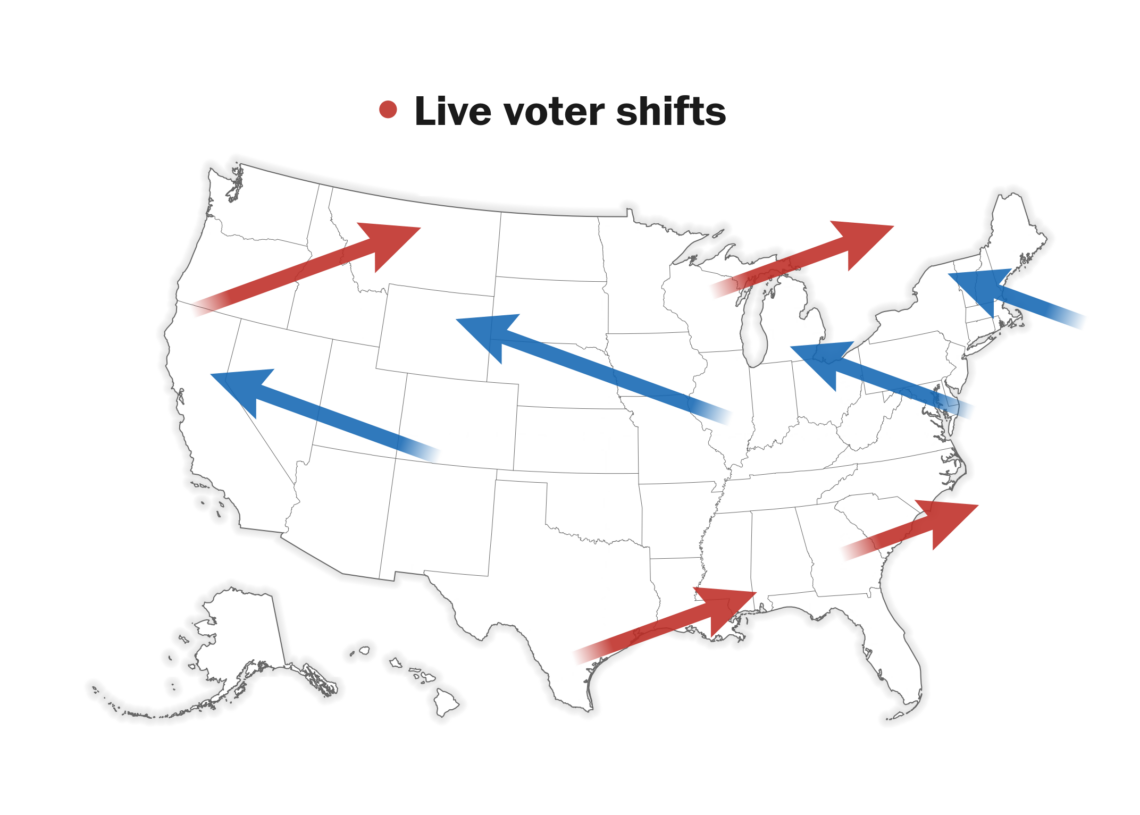
In the first referendum on President Donald Trump’s second term, small changes could mean the difference between a divided Congress or a full Democratic takeover. The Washington Post is tracking in real time how the nation’s voters are shifting from 2024 in Senate and House elections.
Senate balance of power
House
For the House, history favors the Democrats. Since 1970, the president’s party has typically lost 14 seats in the midterms, according to the American Presidency Project. The Senate tends to be more stable: The president’s party has typically lost only two seats. It’s rare for the party in power to lose both chambers. In 2018, the last Trump midterm, Republicans lost 41 House seats but picked up two in the Senate, retaining control of that chamber. In 2022, under President Joe Biden, Democrats lost nine House seats but picked up one Senate seat.
In his 2024 victory, Trump improved upon his 2020 performance in nearly every county, but he did especially well in rural areas and small cities. Now most rural voters disapprove of Trump’s handling of the economy and Iran war, putting traditionally Republican, rural states like Alaska and Kansas in play for Democrats.
Hispanic voters moved significantly toward Trump in 2024, part of a shift away from the Democratic Party among voters of color, especially younger male voters. How majority-Hispanic counties and districts shift could be the difference between an emboldened Republican majority and a combative split government.
About this story
Live election data is from the Associated Press. Past election data is from Dave Leip’s Atlas of U.S. Presidential Elections.
To calculate the demographic rates in the story, The Washington Post used 2024 five-year American Community Survey data from the U.S. Census Bureau. Race and ethnicity figures are based on citizen voting-age populations. Figures for White adult citizens represent only non-Hispanic Whites, while figures for Black adult citizens include all ethnicities. Hispanic adult citizens are of any race.
District and county populations are identified as urban, suburban, small city and rural based on the 2023 National Center for Health Statistics county-level classification system. Medium metros are in metropolitan areas with less than 1 million people but more than 250,000.
For congressional districts, The Post aggregated block-group, tract and county data to congressional districts. For areas that are part of multiple congressional districts, The Post weighted those population estimates based on the 2020 block-level adult population residing in each district.
Dylan Moriarty contributed to this report.
The post See how counties are shifting in the 2026 midterms appeared first on Washington Post.