content=”https://www.washingtonpost.com/wp-apps/imrs.php?src=https%3A%2F%2Fcloudfront-us-east-1.images.arcpublishing.com%2Fwapo%2FS5PI5UPLIPCQN3M3MZZLPOYAFY.jpg&w=1200″
Rachel Apa, 24, a first-time marathoner and former college athlete, died Sunday after collapsing near Mile 24 of the New York City marathon from rhabdomyolysis.
Rhabdomyolysis, or rhabdo, is a rare condition in which muscles break down, spilling toxic quantities of proteins and electrolytes into the bloodstream. It causes acute kidney injury in up to 50 percent of cases. In severe instances, kidney failure can occur.
Approximately 26,000 people get rhabdo each year in the United States. Causes include overexertion, severe muscle injury, dehydration and overheating, as well as certain medications.
A 2026 study reviewing hospital records immediately after the New York City Marathon from 2017 to 2023 found a total of 39 cases of post-marathon rhabdo; 24 of them occurred in 2022 — the hottest race year on record.
Symptoms of rhabdo warrant emergency medical attention and include muscle pain, weakness and swelling, as well as dark urine and in some cases decreased urination, nausea and fainting. Most people recover with intravenous fluids.
One study of runners with rhabdo suggested that the rare cases of acute kidney failure probably represent a “perfect storm” of factors, including high-level exertion and risk enhancers such as heat stress, or a concurrent viral or bacterial infection.
Alaska voters will choose Tuesday among Republican Sen. Dan Sullivan, Democrat Mary Peltola and other candidates in a key U.S. Senate race. But the state may not have an unofficial winner in the race until more than two weeks after Election Day.
Initial returns Tuesday night will show only voters’ first choices and will remain incomplete, as election officials count absentee and questioned ballots. Alaska has 131 hand-count precincts, which slow the count, especially in its rural areas.
If no Senate candidate wins a majority in the first round after all eligible ballots are counted, the state will run a ranked-choice tabulation. The last-place candidate is eliminated, and those ballots are transferred to each voter’s next available choice. The process repeats until two candidates remain.
That could matter because Daniel J. Sullivan Jr., a retired teacher whose name closely resembles the incumbent’s, received 2.5 percent of votes in the August primary. A voter who ranks Sullivan Jr. first and Sen. Sullivan second could still have the ballot count for the incumbent if Sullivan Jr. is eliminated. But a ballot ranking no remaining candidate becomes inactive.
Republicans accuse Democrats of recruiting Sullivan Jr. to confuse voters, which Peltola denies. Gov. Mike Dunleavy (R) has ordered an investigation and asserted that certification could be “stopped or changed” if wrongdoing is found. A federal judge Sunday dismissed a Justice Department suit to block certification if the senator loses; the department is appealing.
Alaska will accept eligible domestic mail ballots through Nov. 13 and overseas ballots through Nov. 18. Ranked-choice tabulation is scheduled for Nov. 18, with certification targeted for Nov. 25.
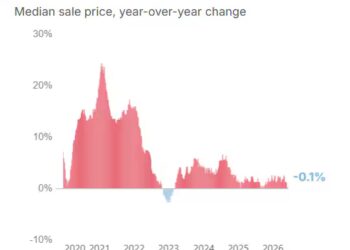
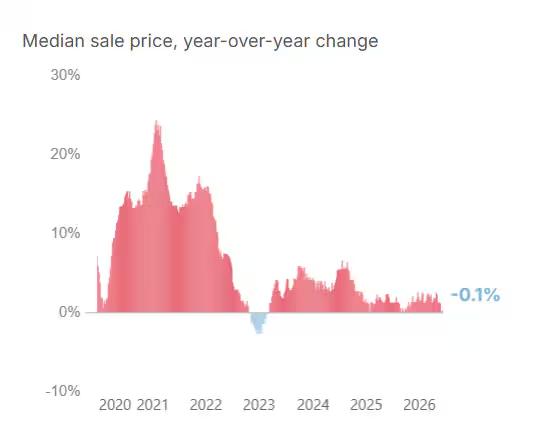
For the first time in three years, the median U.S. home price is falling.
The real estate brokerage Redfin, tracking home sales in all major markets, said prices two weeks ago fell 0.2 percent compared to one year earlier, and last week fell 0.1 percent, bringing the median price to $389,601.
Daryl Fairweather, Redfin’s chief economist, explains in two words: “Mortgage rates.”
With rates above 7 percent, renters are reluctant to become buyers, which dampens competition, and those who do choose to buy can’t afford larger payments.
During the pandemic, sale prices rose dramatically. The median home price in February 2020 was $259,000. Two years later, it was $335,000.
Prices then fell for a period in 2023, at a time of rising mortgage rates, before once again resuming their climb at a slower pace.
“Up until this point, prices had been increasing on a year-over-year basis. That’s important psychologically for homeowners,” Fairweather said.
Even when prices were rising slower than inflation, people could “look at their Redfin estimate or look at what their neighbor’s home is selling for, and they’d see it is going up in value,” she said.
The past two weeks, though, saw a small but meaningful shift.
Those weeks also saw the highest median mortgage payments ever recorded in Redfin’s data, at $2,786, more than 10 percent higher than just a year before.
In some places, prices have fallen a lot. Prices in Austin, for instance, are down more than 4 percent compared to a year before, according to Redfin.
In other places, prices have been going way up. San Francisco prices rose 15 percent in a year. Pittsburgh and Cleveland, among the country’s more affordable markets, are still attracting buyers. Prices were up 7 percent and nearly 5 percent in those cities.
Election pollsters have made big changes over the past decade following significant election misses. While polls were more accurate in 2022 and 2024 than in 2020, Tuesday’s midterm election provides another major test.
One big challenge pollsters face is differential response rates across partisan groups. A Washington Post-Schar School poll of Kansas voters last week found registered Democrats were more than twice as likely as registered Republicans to complete the survey after answering an interviewer’s call — 32 percent versus 12 percent.
And on Sunday, the New York Times reported that White Democrats were about 30 percent likelier to take the survey than White Republicans in their final state-level polls this year, a bit higher than in final polling in 2020.
To account for this, pollsters contact more voters in groups that respond at lower rates. For instance, pollsters for the Post-Schar School Kansas poll made thousands of additional calls to Republicans to ensure they were represented in line with their share of the electorate.
A second and increasingly common method is weighting polls by past presidential voting, which ensures that supporters of President Donald Trump and former vice president Kamala Harris, as well as nonvoters, are represented in proportion to the previous election’s results.
This “recalled” vote weighting improved the accuracy of many polls in 2024 and has been adopted by The Post, the Pew Research Center, the New York Times and many other pollsters. But lower-turnout midterm elections pose unique challenges, and Tuesday’s results will provide a fresh indication of how effective pollsters’ changes were at improving accuracy.
Read more about how to understand midterm election polls in The Pollwatcher.
There’s a Tuesday night in November that captivates the nation, leaving households on the edge of their couch cushions as they await the results. This week is no different.
The College Football Playoff will release this season’s first round of rankings in its annual made-for-TV ESPN special tonight at 7 p.m.
For the sixth time in its 12-year history, the CFP’s first rankings reveal of the season coincides with Election Day. As a handful of states close their polls, teams and fans will learn where they stand entering the final month before the postseason. The same ratings collision unfolded during the 2024 presidential election.
In past years, when the show ran on the same night as election coverage, its viewership dipped from well over 1 million to an estimated 800,000. But neither ESPN nor the CFP expressed concern over the alignment.
Each Tuesday night from the first week of November through the end of the regular season, the CFP committee releases rankings that help schools understand how they’re viewed by the committee that will ultimately decide whether they compete for a national championship in December.
This fall’s edition, as little as it may be viewed, is especially intriguing. Only three teams remain undefeated, the fewest since 2014. The biggest surprise? No SEC team is without a loss, while Georgia and Kentucky are the conference’s only schools with one loss. Chaos. This may also be the last iteration of the 12-team playoff, as the CFP and ESPN are reportedly pursuing an expansion to 24 teams as soon as next year.
The Justice Department has deployed roughly 1,000 election monitors to observe voting at polling sites Tuesday, and nearly two-thirds of the jurisdictions chosen have consistently voted for Democrats in recent elections, according to a Washington Post analysis.
The department described the deployment as a record-setting effort to ensure election integrity at polling locations in more than 120 jurisdictions in all 50 states.
Though department monitors are dispatched every Election Day, this effort has prompted anxieties among Democrats who say they worry it will allow the Trump administration to interfere with the election or cast doubt on the results.
Harmeet K. Dhillon, head of the department’s Civil Rights Division, maintained in a statement Tuesday the monitors were sent to pursue “transparency for elections in an assertive and nondiscriminatory manner.”
Of the jurisdictions the department selected for monitoring Tuesday, at least 89 voted for the Democratic candidate in the most recent three presidential election years. At least 29 consistently voted Republican, and five have swung between the parties at least once during the last three presidential cycles.
During the 2022 midterms, the Biden administration sent Justice Department monitors to 24 states, including to Democratic-leaning jurisdictions in roughly the same proportion as this year’s deployment, The Post’s analysis found.
Typically, Democratic administrations are interested in monitoring voting in heavily Democratic areas such as large cities because of concerns over voter disenfranchisement, language barriers and access to the ballot. This year, President Donald Trump and his allies have accused Democrats of attempting to cheat and pushed for greater federal control over how voting is conducted — claims that have largely been rejected by federal courts.
President Donald Trump said Tuesday that the United States would end $4 billion in annual military aid to Israel at the end of this year, following previous discussions with Israeli Prime Minister Benjamin Netanyahu.
In 2016, President Barack Obama signed a 10-year Memorandum of Understanding with Israel to provide at least $38 billion to subsidize purchases of weapons, mostly made in the United States. The agreement was due to expire at the end of 2028.
Trump said, however, that the funding will end early.
“We were giving them $4 billion — we are — but it gets cut off at the end of the year,” Trump said in a phone call with Fox News in which he cast the announcement partly as a bow to domestic political reality. Direct aid to Israel has become less popular in both parties, but especially among Democrats, who are likely to take control of at least one chamber of Congress in Tuesday’s midterm elections.
Trump pointed to Democratic Senate candidate Abdul El-Sayed in Michigan, who has made a cutoff of aid to Israel a campaign issue.
“They don’t need it,” Trump said, referring to Israel. “Why should we suffer the slings from lunatics like an El-Sayed when they don’t need it? It’s a bad talking point.”
Netanyahu has said in recent months that he anticipated U.S. aid will wind down and has repeatedly called on Israel to strengthen its own defense production. In a visit to a West Bank settlement in May, the prime minister said that Israel “needs to free ourselves from dependence.”
Netanyahu’s advisers have long said they anticipated that U.S. public opinion would eventually turn against direct military aid.
Instead of financial support, Netanyahu has pushed for deeper military, intelligence and industrial integration with the United States to be written into the upcoming fiscal 2027 U.S. defense spending bill, known as the National Defense Authorization Act.
Israel critics in Washington say that if it is written into law, the two militaries would be intertwined more deeply than ever.
The post The rare muscle condition that caused a 24-year-old marathoner’s death appeared first on Washington Post.