What a time to be a religious litigant at the United States Supreme Court. From challenges to LGBTQ-inclusive school policies and curricula, to exemptions from public health and anti-discrimination measures, religious groups have virtually run the table in recent years.
But in the next big religion case to be argued in the Supreme Court, happening on Tuesday, Christian litigants are advancing an argument that, if it prevails, could lead to a surprising outcome: the elimination of a school choice program that has directed millions of taxpayer dollars to religious schools and has become quite popular on the right.
The case, St. Mary Catholic Parish vs. Roy, concerns a Colorado universal pre-K program enacted in 2022. Before 2022, Colorado, like many states, funded pre-K for just a limited number of students. Based on evidence that pre-K benefits all children, however, the state invested more than $300 million a year to make access universal. That led lawmakers to a difficult policy choice: What kinds of preschools should be eligible for this new influx of funding?
One easy answer would have been to fund pre-K through traditional public school districts, which are the most common providers of state-funded pre-K nationwide. That’s how Colorado’s previous program worked, and how California’s universal program runs today. But Colorado took a different route, paying so that families could choose among public and private preschools — including religious providers.
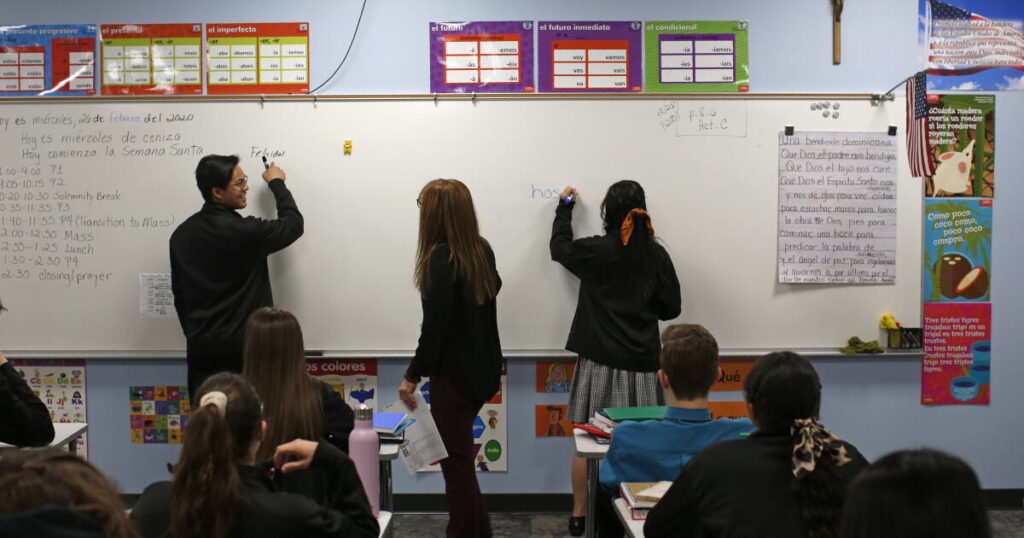
The result has been a boon for religious education. Seventy-nine religious preschool providers participate in Colorado’s universal pre-K program, receiving millions of dollars each year. Significantly, Colorado made clear that these schools are free to engage in religious instruction.
So why, then, did a group of Catholic preschools sue the state, arguing that the pre-K program violates its freedom of religious exercise?
The answer lies in Colorado’s commitment to protecting people from discrimination. When the state opened its coffers to private preschools, it wanted assurance they would play by the same antidiscrimination rules as public schools. So Colorado enacted a law prohibiting all pre-K providers from discriminating based on protected characteristics such as race, sexual orientation, gender identity and disability.
And that, according to the challengers in the new Supreme Court case, was a bridge too far. Once Colorado decided to fund private pre-K providers, the religious schools argue, the state was obligated to allow them to deny enrollment to gay, lesbian and transgender families. Anything less would constitute religious discrimination in violation of the Free Exercise Clause of the 1st Amendment.
There are reasons to doubt this argument. Both lower courts rejected it. And a contrary ruling could have sweeping implications, imperiling any attempt by states to condition public benefits on neutral rules that incidentally burden religious exercise. After all, if conditioning pre-K funding on a basic anti-discrimination requirement violates the Free Exercise Clause, how about requiring a religious driver’s license applicant to take a photograph, or forbidding a religious teacher to engage in corporal punishment?
Even still, it’s hard to imagine the Supreme Court ruling for Colorado in this case. Not when the court has ruled so consistently in favor of religious causes in recent years, including in three high-profile cases against Colorado itself.
There is, however, one important reason the conservative justices might pause before handing a victory to the religious schools: a ruling in their favor may come at a great cost to the very school choice movement they’ve championed.
Notice the glaringly obvious policy response for states like Colorado, who wish both to increase pre-K access and prohibit discrimination. If the court forbids them to do both through private, religious preschools, then they can simply do what California has done: fund universal pre-K access through the public schools.
Even the religious challengers agree that such a response would be perfectly constitutional. As they admit, “a state need not subsidize private preschools at all.” And is there any doubt that, if forced to choose between funding only pre-K programs run by public schools and greenlighting discrimination against LGBTQ+ families, states like Colorado would prefer the former?
The upshot of the religious schools’ position in this case is thus a deeply ironic one. The schools are so intent on getting rid of Colorado’s anti-discrimination provision that they are willing to chance the elimination of the private school choice program itself. Public school supporters and teachers unions would no doubt celebrate that outcome, but there are costs— particularly for the dozens of religious pre-schools and thousands of religious families who would lose their taxpayer-funded religious instruction.
There is a way to avoid this result. The court can simply uphold Colorado’s antidiscrimination mandate under the longstanding Free Exercise rule that neutral laws of general applicability are presumptively constitutional, even if they incidentally burden some religious actors.
That outcome would reflect the reality that when Colorado created its new universal pre-K program through a hybrid system of public and private preschool providers, the state was not surreptitiously trying to target religion for inferior treatment. The state’s goal was instead to strike a compromise, funding religious schools and allowing them to still teach their beliefs as truth, while also protecting the public from status-based discrimination.
To be sure, that compromise upset people on both sides of the political spectrum. Just as some Catholic schools object to the antidiscrimination provision, some liberals oppose the idea of publicly funded religious preschools.
But in our pluralistic society, this kind of double-edged anger is more a sign of virtue than vice. And by upholding Colorado’s law, the Supreme Court can go a long way toward reminding Americans that sometimes, compromise is a good thing, not a dirty word.
Aaron Tang is a law professor at UC Davis and a former clerk to Justice Sonia Sotomayor. He hosts the PBS series “Breaking the Deadlock.” X: @AaronTangLaw
The post The left and the right may loathe this next ruling on religious school funding appeared first on Los Angeles Times.