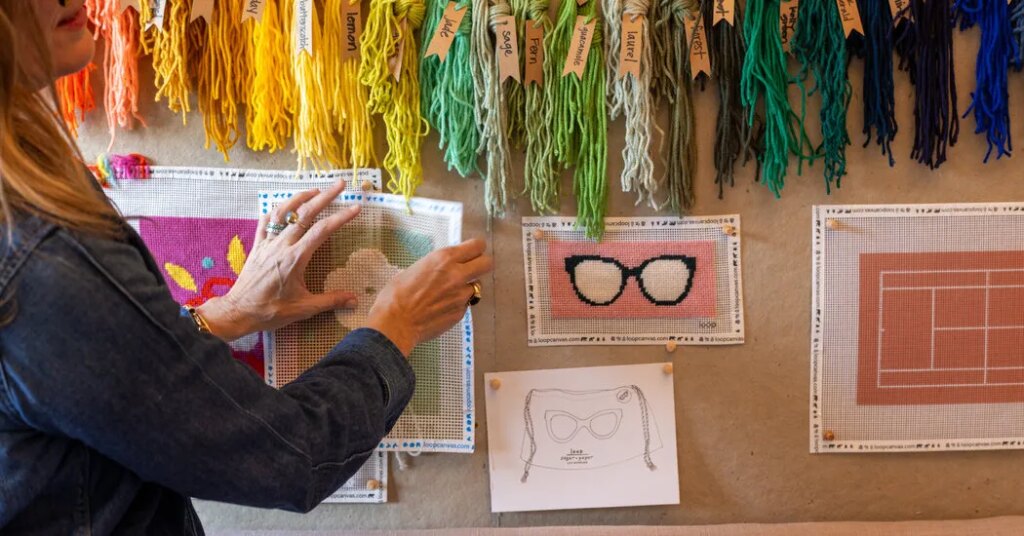
The needlepoint brand Loop Canvas came to life on a bar napkin after a visit to the haberdashery department at Liberty London.
After walking around and looking at the department’s elaborate needlepoint kits, Amy and Sarah Blessing, sisters who once owned upscale men’s clothing boutiques in Chicago and Los Angeles and have done retail consulting, stopped for a glass of Champagne at the store’s oyster bar (which has since closed). Lifelong fans of needlepoint, but not of carrying the unwieldy canvases around on flights and to the beach and their children’s sporting events, they talked about wanting to create canvases that were aesthetically fun and modern yet easily transportable.
Grabbing a napkin, they plotted out their business idea, deciding that everything would be included in a kit — the canvas, yarn, needles and even a project bag — all at an accessible price point. “The idea for Loop was very ‘take on the go’, more simple, graphic and not hand painted,” Amy said during a video interview from their design studio in Chicago. “We started thinking, There is a market for something that is just a little bit easier.”
That idea of accessibility — in terms of pricing and designs that appeal to a range of ages — seems to be just one reason needlepoint has taken off in the past few years.
“Needlepoint stores are popping up like mushrooms overnight — it is insane,” said Kate Latham, the owner of Modern Hoopla, a business in Virginia that sells needlepoint accessories such as round frames (from $20) and thread winders ($10) online and to wholesalers.
But she noted that there was an appeal to the craft’s simplicity: “The canvas already has the paint color on it so, unlike with cross-stitch where you have to be following a pattern and counting your stitches, and that takes brain power, with the needlepoint canvases, you’re just putting blue thread where the canvas is already blue. So it’s almost like a coloring book.”
A Sense of Community
This repetitive craft has appealed to celebrities such as Taylor Swift, Cher and Parker Posey, and TikTok influencers have also helped make the craft more mainstream.
Annie Bouquet, who has run her needlepoint boutique in Paris since 1978 and sells items like hand-painted canvases for leopard-print pouches ($126) and Christmas stockings (starting at $189), said social media had helped create a sense of approachability for a craft that many had considered obscure. “It’s less intimidating and the sense of community through social media has been really strong and helped democratize it,” Ms. Bouquet said in a video call through a translator. “Influencers explain from A to Z how to start through how to finish, so it’s not as scary as it used to be.”
Needlepoint, sometimes also referred to as petit point and which falls under the broad umbrella category of needlework or embroidery, has seen its popularity as a craft wax and wane over centuries.
According to Isabella Rosner, the curator of textiles and contextual studies lecturer at the Royal School of Needlework in Britain, needlepoint started “hitting its stride” in the 16th century. At that time, pieces that were done entirely in tent stitch — the foundation stitch for needlepoint — tended to be cushion covers and wall hangings depicting things such as flowers, stories from the Bible and classical narratives.
During the 19th century, with the growth of the Arts and Crafts movement in the United States and Britain, she said, needlepoint became a popular pastime again.
Throughout the 20th century, needlepoint continued to flourish, peaking in the 1970s. The cover of Carole King’s album “Tapestry,” from 1971, showed the singer working on a needlepoint, while Erica Wilson, called the “Julia Child of needlework,” had a popular program on PBS that helped the needlework community flourish across the United States.
“She’s really at the forefront of this world where people are getting excited about reviving historical embroidery techniques,” said Dr. Rosner, the author of a forthcoming book called “Fierce is the Needle,” which charts the history of needlework. “That is tied to this larger interest in needlepoint specifically because it is the easiest, most accessible and most kit-friendly type of embroidery you can find.”
What made the craft popular then, as now, is that needlepoint is both innately social as well as solitary, meaning stitchers can choose to do their work on their own or out and about with friends or at social events. “There is a history of women together gathering and stitching, it was communal, it was a thing that you did that was social,” said Sarah Blessing, adding that Loop Canvas has done kit collaborations with brands such as Heather Taylor Home and Clare V. “I would bring needlepoint to a family thing, and my husband would say ‘Oh, but you shouldn’t bring that, isn’t it kind of antisocial?’ And then he quickly realized no, in fact, I’m much calmer and more engaged.”
Act of Self-Care
The meditative effect of needlepoint also seems to be an antidote to a frenetic age filled with social media, artificial intelligence and screen addiction. “People want to get off their phones and out of the endless doom scroll,” Rachel Barri, the owner of Rachel Barri Designs in Toronto, wrote in an email. “Taking a moment out of your day to put a few stitches into a canvas is an act of self-care.”
Her business offers things like in-person needlepoint courses and kits of Tim Horton takeaway cups ($58), and it has a “Sense and Sensibility” needlepoint collaboration with Focus Features, the production company behind the new Jane Austen film.
There is also a sense of accomplishment that can be acutely measured with each stitch. “You can give yourself goals so that when you are watching television at night, you are just going to do the green section,” said Emmie Hope, an owner of Hunt and Hope, a British bespoke needlepoint design company that is scheduled to release its kits in early 2027. “It’s bite-size chunks of addiction.”
With so many kits, classes and accessories to choose from, needlepoint is a gift not only for the person creating the craft but also for those lucky enough to receive the completed work.
“There is something so nice about how you can gift the kit to somebody as a kit to do or you can create that piece of magic for them,” said Katie Hall, head of merchandising at Liberty, who added that the store recently introduced a number of in-house craft classes, including needlepoint. “It’s a lot more special when you’ve taken time and energy into something to create, and then it tells a bit more of a story when you get gifted something that someone’s made.”
The post Stitch Up a Present This Holiday appeared first on New York Times.