Initial election results throughout Tuesday night and into Wednesday morning will say a great deal about which party prevails in the midterms.
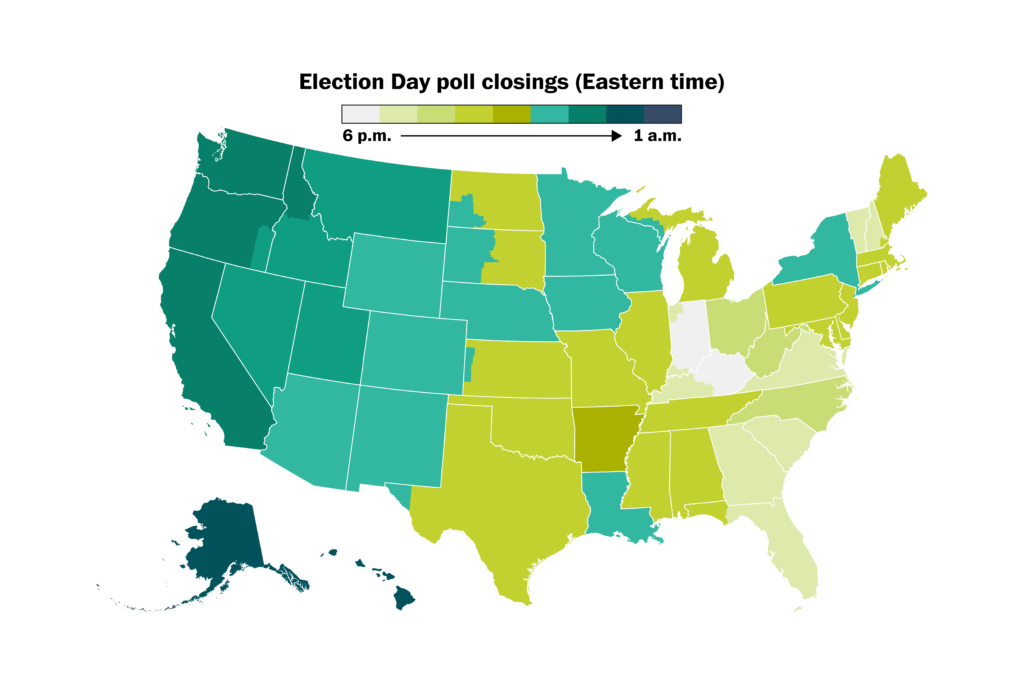
The first polls will close at 6 p.m. Eastern in parts of Indiana and Kentucky, and then cascade throughout the night, with the last polls closing at 1 a.m. Eastern in Alaska’s Aleutian Islands.
Early races in Kentucky, Virginia and Florida will provide initial answers on whether the Democratic wave many expect to crash Tuesday has materialized, or whether polls underestimated Republican support. Later results in Maine, Texas and Iowa will show how far-reaching voter anger at President Donald Trump could extend into heavily Republican territory.
How race calls are made
The Washington Post does not make race calls on its own but relies on the Associated Press to report results and declare winners. The AP’s process of counting and reporting election results is an extensive, highly calibrated operation that this year began well before Nov. 3.
On Election Day, thousands of AP journalists are stationed around the country in election offices and local voting precincts, reporting results from inside the locations where the ballots are counted.
As votes roll in after the polls close, the AP will declare a candidate a winner only when they are fully confident that none of the trailing candidates have a path to victory.
Many races are won on election night, but it is not uncommon for results to come in the days — and in rare cases, weeks — after.
Here’s a look at the key early races to watch and what their outcomes will suggest about the night’s trajectory.
Kentucky
The open race to replace Rep. Andy Barr (R-Kentucky) could give us the earliest indication of how the night is going for each party.
Ralph Alvarado (R) and Zach Dembo (D) are locked in a surprisingly competitive race given that Trump won the district by 15 percentage points less than two years ago. If Dembo, a former federal prosecutor, pulls off a victory or at least comes within single digits in the district around Lexington, Democrats could have a big night. In 2024, results started quickly coming in after 7 p.m.
Florida
Florida is one of the fastest states to count ballots. The vast majority of votes are usually counted within an hour, and will provide an early preview of a national Latino voter backlash and whether Republican redistricting backfired.
Florida Republicans had hoped redrawing congressional districts would limit the number of competitive races in the state this cycle. But the poor national environment for Republicans has put even some redistricted races on the line in what has become a reliably red state.
Surprise Democratic wins or narrow defeats in the governor and Senate races where Republicans are favored will set off warning bells in Republican offices nationwide.
Florida’s congressional races are more scattered. Democrats are increasingly confident Rep. Jared Moskowitz can win in a redrawn South Florida district, so a win there would be expected. The most telling races will be the contest between Kathy Castor (D) and Mike Beltran (R) around Tampa, and the contest between Pia Dandiya (D) and Casey Askar (R) in a new district stretching across South Florida. Both races are toss-ups, so Democratic victories signal a Democratic wave.
If Republican incumbents Anna Paulina Luna and María Elvira Salazar are ousted in races they are favored to win, the night probably will be a boon for Democrats. A loss for Salazar in a heavily Latino Miami-area district also would mean the party reversed trends with Latino voters in South Florida.
Virginia
Virginia offers viewers a trio of compelling races that will provide some of the earliest insights on where the night is headed. In 2024, half of the votes were counted by 9 p.m., meaning we could see early calls if a candidate has a substantial lead.
The seat most likely to flip is the 2nd Congressional District featuring a rematch between Rep. Jen Kiggans (R-Virginia) and former congresswoman Elaine Luria (D) in the commonwealth’s southeastern Tidewater region. The race tests anti-incumbent sentiment, and Republicans believe it will go a long way toward showing how their incumbents could fare later in the night. If Luria can’t oust Kiggans in a district Trump won in 2024 by 0.2 percentage points, Democrats will worry whether the night will deliver a wave.
A similar story unfolds in Virginia’s neighboring 1st Congressional District, where Rep. Rob Wittman is seeking his 10th term in Congress. The district, which Trump won by 4.9 percentage points in 2024, is a national bellwether because its presidential results are exactly in the middle of all 2026 districts nationwide, according to the Center for Politics at the University of Virginia. A Democratic win will boost excitement about a blue wave.
And the fact that Virginia’s 5th Congressional District, a large district stretching from the Shenandoah Valley mountains in the north to the North Carolina border, is even in play for Democrats highlights how difficult the political environment is for Republicans. If former congressman Tom Perriello can oust Rep. John McGuire in a district Republicans have dominated for years, the Democratic wave could be bigger than many expected.
North Carolina
Republicans have all but given up on Michael Whatley’s (R) Senate campaign, pulling money from his bid. Democrats are banking on their nominee, Roy Cooper, to win their first Senate flip of the night, and a loss here or a narrow victory would shock the party.
Cooper’s stout campaign also has helped the state’s downballot races. Jamie Ager (D) is the favorite to replace scandal-tainted Rep. Chuck Edwards (R), who pulled out of his reelection bid.
The state’s most competitive race is Rep. Don Davis’s reelection bid in the state’s northeastern corner. Republicans redistricted the area to one that would have backed Trump in 2024 by double digits. If Republicans can’t flip this seat, party operatives will worry they are in for a long, disappointing night.
Ohio
Two statewide contests in Ohio have dominated the state for months: the gubernatorial contest between Amy Acton (D) and Vivek Ramaswamy (R), and the Senate race between former senator Sherrod Brown (D) and incumbent Sen. John Husted (R).
Acton is a narrow favorite over Ramaswamy, in part because an attack ad from the Republican featuring the Democrats’ estranged mother drew bipartisan condemnation. And the race between Brown and Husted has been incredibly expensive, with over half a billion dollars spent on ads.
Republicans acknowledge both races look difficult for their candidates in a state they long dominated. Democrats also hope a strong top-of-ticket showing could help downballot races, even in districts redrawn to favor Republicans.
Democrats have the best shot at unseating a Republican in the district represented by Rep. Max Miller, who faces domestic-abuse allegations. And they hope Rep. Marcy Kaptur (D), seeking her 23rd term, can win in a red district that grew even redder after redistricting.
If Democrats can oust Republican Reps. Mike Turner or Mike Carey in two other reliably red districts, party operatives will start to believe a significant Democratic wave is crashing.
Pennsylvania
The margin in the House headed into the midterms is so narrow that Pennsylvania contests alone could decide control of the body, with Republican incumbents in four uber-competitive races in a state Trump won two years ago.
Gov. Josh Shapiro’s (D) reelection is largely a foregone conclusion, with polls showing double-digit leads.
Shapiro has turned his focus to the competitive House races:
All four races have their nuances. Reps. Brian Fitzpatrick and Scott Perry are longtime congressmen, while Reps. Rob Bresnahan and Ryan Mackenzie are in their first terms. Both Republicans and Democrats acknowledge they all could go in different directions. A clearer picture should emerge around 10 p.m., when half of the ballots statewide were counted in 2024.
Maine
Few races have drawn more national attention than Maine’s contested Senate race, with longtime incumbent Sen. Susan Collins (R) seeking a sixth term against Troy Jackson (D) in a state Trump lost by seven percentage points in 2024.
The race is the purest test of whether Republicans can outrun Trump’s disapproval. Collins has tried to distance herself from the president when possible, acknowledging that Maine has grown bluer since she was first elected in 1996. Jackson, likewise, has tried to tie Collins to all of Trump’s most unpopular positions that directly affect Maine.
A Collins win will cement her as arguably the most resilient Republican in modern Senate history, while a Jackson victory will showcase how few Republicans, if any, could outrun Trump in these midterms.
The congressional district sweeping across northern Maine is one of Republicans’ clearest chances at flipping a seat this cycle, with Democratic incumbent Jared Golden retiring. Former two-term governor Paul LePage is the favorite to win the district, which backed Trump by 10 percentage points in 2024, but a win by his opponent Matthew Dunlap would suggest Democrats will have a healthy majority in the House next year.
Maine is slow at counting ballots and has ranked-choice voting that requires complicated tabulation if no candidate clears 50 percent of the vote, so the races could take days to call.
Michigan
Few states have more toss-up races than Michigan, and the results here, especially in the House races, will say a great deal about the night’s tenor.
Hanging over the entire ballot in Michigan is the staggeringly expensive Senate race between former congressman Mike Rogers (R) and Abdul El-Sayed (D). The contentious campaign has turned on Rogers’s ties to Trump, which the Republican has tried to outrun, and notably anti-Muslim attacks against the Democrat, who would be the first Muslim senator elected. Both Democrats and Republicans hope the focus on the race will help their candidates downballot.
The race between incumbent Rep. Tom Barrett (R) and William Lawrence (D) will be one of the most closely watched House races. It’s been a back-and-forth district for years, and Barrett is widely seen as one of the most vulnerable Republican incumbents. But a fractious Democratic primary led voters to nominate Lawrence, whose progressive views have been cast as out of step with the more moderate district. The results will test whether even a more far-left candidate can ride the poor national mood to victory in a more centrist district.
In Western Michigan, Rep. Bill Huizenga (R) is in a tough race against Sean McCann (D). In a Detroit suburbs district, Christina Hines (D) faces off against Mike Bouchard (R) for a seat opened when Rep. John James (R) decided to run for governor.
Texas
Everything is bigger in Texas. Including the political stakes.
The poor national environment for Republicans has made the gubernatorial contest between incumbent Gov. Greg Abbott (R) and challenger Gina Hinojosa (D) more competitive than expected. And Republicans’ decision to nominate scandal-plagued Ken Paxton in the hotly contested Senate race against James Talarico (D) has turned the race into a pure toss-up — and one of the most expensive in the country.
Any Democratic victories statewide in Texas would be a political earthquake, given the state’s core role in the modern Republican Party and the fact that no Democrat has won statewide there since 1994.
Texas Republicans’ decision to redistrict in 2025 set off the mid-decade redistricting fight that engulfed the political world ahead of these midterms. But the national environment is now weighing on the party, causing the redistricting plan to backfire and possibly take out a series of Latino Republican stars. This is clearest in two Rio Grande Valley races: the contests between incumbent Rep. Vicente Gonzalez (D) and Eric Flores (R), and between incumbent Rep. Monica De La Cruz (R) and Bobby Pulido (D). Democratic victories in both races would signal Trump’s victories with Latino voters in 2024 were fleeting.
Iowa
Iowa has been ground zero for Republican issues this cycle.
The state has been reliably Republican since Trump entered the political scene in 2015, backing him by double digits in 2024. But the impact that tariffs and high gas prices have had on the farm economy has threatened to upend Republican control of the Midwestern state, and Democrats are on offense in two statewide races in the state and three of the four House districts in Iowa.
Rob Sand (D) is favored over Zach Lahn (R) in a gubernatorial race Republicans have acknowledged is slipping away. Incumbent Sen. Ashley Hinson (R) has carefully broken with Trump and her party as the election closes, acknowledging the weight the president carries for candidates but a possibly savvy move that has put her in a dead heat with Josh Turek (D). A win in either race would boost Democrats, given how red the state has become.
The same is true for Iowa’s three competitive House races. Winning any of them would be a good sign for Democrats — especially in northeast Iowa, where Joe Mitchell (R) faces Lindsay James (D) in a bid to hold onto the district Hinson is vacating. Democrats are favored in the two other competitive races, and some Republican groups even have withdrawn money from Rep. Mariannette Miller-Meeks’s reelection bid.
Arizona
By this point in the night, control of the House probably will be close to decided.
So while earlier results won’t influence the competitive House races in Arizona, their outcomes will be seen through the lens of how the night has gone.
Democrats are favored in Arizona’s 1st Congressional District, a race between Amish Shah (D) and Jay Feely (R). But the most compelling contest may be in Arizona’s 6th District, a large area around Tucson, where JoAnna Mendoza (D) is favored to oust Rep. Juan Ciscomani (R), who won the seat in 2022.
If this is a true Democratic wave, Rep. Eli Crane (R) could be in trouble in the northeast-Arizona district that includes much of the Navajo Nation. He faces Jonathan Nez (D), a former Navajo Nation president, in a district Trump won by 15 percentage points in 2024. Republicans had surged money to the district at the close of the campaign, a sign that they are worried about Crane’s standing.
The post On election night, here are the key races to watch and when polls close appeared first on Washington Post.