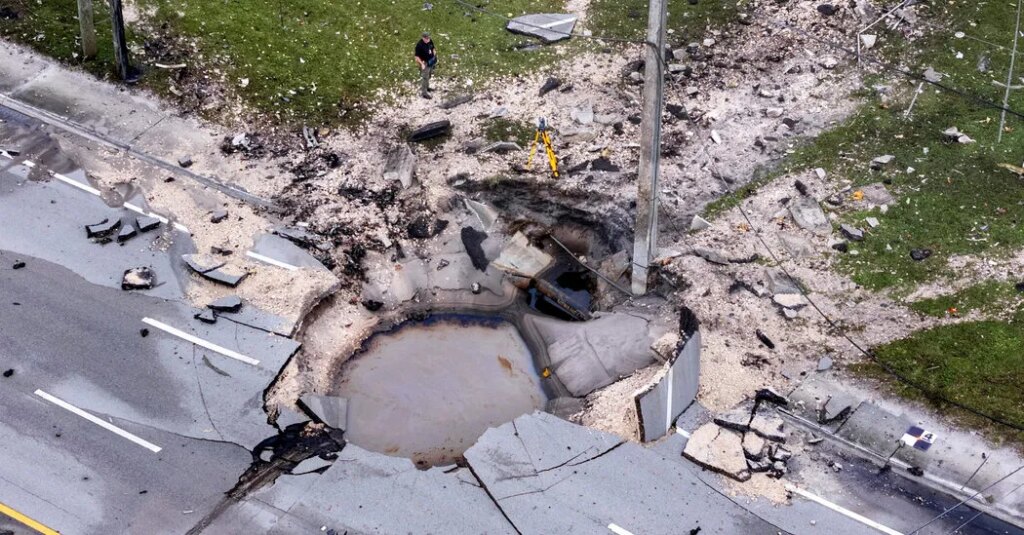
A crucial part of the private jet that crashed in Florida on Sunday was found in fragments far from where the aircraft slammed into the ground in Palm Beach County, federal investigators said on Tuesday.
The fiery crash killed all nine people aboard, and the part, a mechanism that controls the angle of the plane, was found in three pieces, including at a spot nearly four miles from the crash site.
The discovery of the part, known as the left tail elevator, was a “very important piece of evidence,” Thomas B. Chapman, a member of the National Transportation Safety Board, said at a news conference on Tuesday.
But it was not yet clear whether the tail part broke off before the plane began to plummet or during the aircraft’s plunge to the ground.
Still, the recovery of the part was a bit of progress in an investigation that has been hampered by a host of complications, including the powerful storms that investigators believe were a factor in Sunday’s crash. There were severe thunderstorms in Palm Beach County on Sunday afternoon when the plane, a Learjet 60, crashed nose first on a road, erupting into a fireball that was captured in harrowing video footage.
Mr. Chapman said much of the wreckage remained in a crater, still off limits to investigators, who hope to have access by Wednesday once public works teams finish clearing the site of water and other damage caused by the crash.
The extreme force of the impact, Mr. Chapman said, meant that most of the physical evidence the N.T.S.B. team had been able to recover was in very small pieces.
“We don’t even know in most cases what we’ve found,” he said on Tuesday, adding, “Even the elements of the aircraft that are in the crater are going to be very likely in smaller pieces.”
Among the missing and potentially critical pieces of evidence is the aircraft’s cockpit voice recorder, which investigators often rely on for insights into pilots’ decision-making leading up to an accident. On Monday, N.T.S.B. officials told reporters that the plane had been outfitted with such a recorder, but that they could not confirm whether it was present on the aircraft when it crashed.
The pilots were Jeff Gregory, 55, and Nathalia Filgueiras, 20, who had earned her pilot’s license at 17, her mother said. Ms. Filgueiras, who was talking to air traffic control during the plane’s descent, was certified as a commercial pilot earlier this year, according to records.
Among the passengers who were killed were Adam Robinson, a technology executive; his wife Helen Sharp, who worked in public relations; the couple’s two children, Emma and Charlie; and Anita Maria Cetina, a nanny for the children.
The plane was flying from Austin, Texas, where the family lived, to the Bahamas, when it plunged from the sky, eventually reaching a rate of 22,000 feet per minute.
According to the pilots’ exchanges with air traffic controllers, they initially sought permission to fly across Florida on a course that would have led them straight through a large thunderstorm system. A controller warned them that the weather was bad in the area, and flight maps show that they subsequently changed course to fly south of the worst storms.
Several minutes later, Ms. Filgueiras reported to another controller that they were encountering turbulence she described as “moderate,” what she called “manageable” problems with icing on the plane, and precipitation. But shortly after that, the pilots appeared to lose control of the plane, prompting Ms. Filgueiras to issue a mayday call as the aircraft began to plummet to the ground.
It was not immediately clear to investigators what condition the aircraft’s radar and anti-icing systems were in leading up to the accident.
In an interview, Michael McCormick, a former director of air traffic operations at the Federal Aviation Administration who now teaches at Embry-Riddle Aeronautical University, said the Learjet 60 has three complementary de-icing mechanisms, but stressed that they work best when activated in advance of encountering bad weather.
“Any one of them could fail and you’re in trouble,” he said.
Investigators will also be trying to determine what caused the plane’s left tail elevator to break off the airplane before impact — though Mr. Chapman cautioned that it would not likely have been able to save the aircraft from disaster, even if it had remained intact.
“The function of the elevator is to control pitch up and down,” he told reporters Tuesday. “At those speeds, I don’t know if it would have been effective, even if attached to the aircraft.”
Billy Witz contributed reporting, and Georgia Gee contributed research.
The post Key Part of Jet in Deadly Florida Crash Found Far From Impact Site appeared first on New York Times.