The dead here do not really die.
Deep in the rugged mountains of southern Mexico, the dead returned home last week to Metlatónoc, a remote Indigenous town reached by winding dirt roads where ancestral beliefs remain woven into daily life.
All weekend, firecrackers thundered across the small town of roughly 19,400 in the southern state of Guerrero. The scent of copal incense hung thick in the air, and marigolds blazed orange everywhere. The Celebration of the Dead was underway for the Indigenous people known as the Na Savi, or People of the Rain. For this Mixtec group, death is not an ending but a passage to the place where the dead dwell. And during their 10-day celebration, the departed return to visit with the living.
Inside homes, elaborate altars stand beneath arches of brilliant orange marigolds, the flower long associated with the passage between life and death. Fruit and sugared bread hang from the arches, their scents joining the flowers’ to guide loved ones home. Under the arches, photographs of the departed stand among tamales, atole (a warm, thick corn drink) and other foods the dead once enjoyed. Tiny, coin-sized tortillas for children and pets that have passed. Cigarettes for those who smoked.
Millions of families across Mexico gathered over the weekend to honor their deceased loved ones. The Day of the Dead has become a major tourist draw in recent years, featured in Hollywood films and embraced by global pop culture.
But for many, the holiday remains an intimate family tradition. In a country so often scarred by violence and tragedy, the Day of the Dead offers a shared ritual of remembrance across social, cultural and ethnic divides — a collective moment of pause to honor the dead and perhaps confront the fragility of one’s own existence.
In some parts of Mexico, the holiday is two days long. In Metlatónoc, it is commemorated for 10.
While altars and visits to cemeteries are common, Metlatónoc’s 10-day observance blends ancestral Mixtec beliefs with Catholic rites. It includes dances and processions to summon the souls of the dead. Here, the belief that death is just a passage remains particularly strong.
“Life does not end here; it goes on,” said Celso Guevara, who emigrated to California two decades ago, joining the many residents who have left this remote mountain town in search of a better life. California is now his home, but he returns each year for the celebration. “The body perishes, but the spirit continues and returns these days. That is why we are happy.”
Inside his home, perched above the town’s cemetery, a brass band played funeral marches before an altar dedicated to his late grandparents. A smaller shrine beside it honored his brother, who died at age 7. But there was little sorrow in the room. His mother, Aurora Solano, swayed and danced to the music.
“Metlatónoc is the only place where people are not afraid of dying because we know that next year you will come back, to hang out, to dance, to eat with your loved ones,” Mr. Guevara said.
Time here stands still as the veil between the living and the dead dissolves and the town gathers to welcome its departed with tenderness and devotion. Beginning on Oct. 24, families summon the recently departed, followed by those lost for many years on Oct. 28. On Oct. 31, the spirits of children are called home. Everyone else is summoned the next day before they all depart on Nov. 2.
Mexico’s relationship with death has fascinated Mexican writers, poets, philosophers and anthropologists for generations, particularly the apparent paradox at the heart of its culture: Death is not only mourned, it is celebrated, invited to dinner and even mocked.
That idea echoes the ancestral beliefs of the Na Savi here in Metlatónoc.
The dead remain members of the community. Their stories do not end, nor are those who passed away relegated to memory. For these few days, they come back to be part of the village.
On Saturday, hundreds circled the town’s church through thick clouds of incense smoke, carrying armfuls of marigolds and burning white candles to guide the spirits of children home. Girls carried a small, doll-like figure dressed in a traditional embroidered tunic, representing the children’s souls.
At the cemetery, Petra García Moreno sat on her husband’s gravestone, gathering blossoms into small bouquets as her son, Rotilio de la Cruz, tied them to a wooden arch above the grave.
The dead are “like gods for us, watching over the living,” Mr. de la Cruz said. During these reunions, he explained, families ask them for protection, health and guidance. Their answers, he believes, come in dreams.
Sometimes the messages come in more mischievous ways.
Yarivi Guevara, 27, said she believes her late father, Paulino, and her grandparents express any grievance or displeasure by toppling offerings in the shrines, or leaving peculiar patterns in candle wax.
Like most families here, she treats the dead as honored guests, serving them hot coffee and breakfast before anyone else eats, then two more meals. At night, she and her siblings wish them good night.
For decades, families in Metlatónoc lived off cultivating corn, beans and squash. Yet jobs beyond farming and other basic services remain scarce. A small clinic serves a town with no hospital. Such hardships have pushed roughly 35 percent of the population to migrate to the United States in the past decade, according to Marvin Rojas, the town’s mayor, who took office last year after his brother was killed.
Money sent home has brought a measure of prosperity to what was considered Mexico’s poorest municipality until 2003. Adobe houses have gradually given way to two-story cinder-block constructions.
For those who have left for the United States, like Mr. Guevara, the bond with their home and its shared beliefs endures despite the separation, even beyond death.
“Everyone in this town dreams that when we die we will be buried here because we know that only here will we remain alive,” he added.
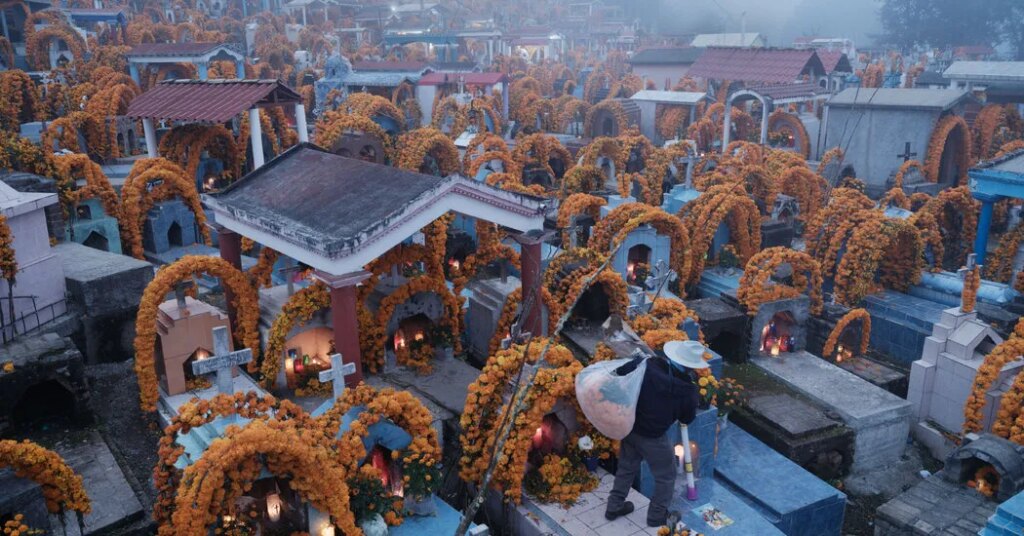
Later on Saturday, in the neighboring town of Cochoapa el Grande, graves disappeared beneath a sea of incandescent orange. Marigolds formed towering arches above the tombs like floral gateways. As daylight faded, the blossoms glowed like small flames against the storm-blue sky.
Families carried flowers, lit candles and arranged offerings. One woman set out popcorn for her deceased sister. Men in cowboy hats drank beer at gravesites as musicians played solemn tunes. Women with long white braids and embroidered blouses sat on tombs, talking to their deceased relatives. Others sat silently beside their dead.
There was something both intimate and communal about the rituals, each gathering marked by small acts of devotion.
By Sunday afternoon, the streets of Metlatónoc had filled with a solemn procession. Hundreds of mourners moved slowly through town, carrying white candles and flowers, calling for the souls of the departed. Above the sea of mourners rose a black-robed Virgin of Solitude, carried on the shoulders of men and women.
Families waited with flowers laid on the ground facing east, where the sun rises and, they believe, the dead return. Before joining the procession, they lit tall candles to summon their loved ones and illuminate the way home.
“Get up now, Marcelino Rojas!” Florencia Sierra Mendoza, a cultural promoter, called out to her late great-grandfather, pointing to the candle that she said represented his spirit. “Let’s go back to your home!”
The post High in Mexico’s Mountains, a Homecoming for the Dead appeared first on New York Times.