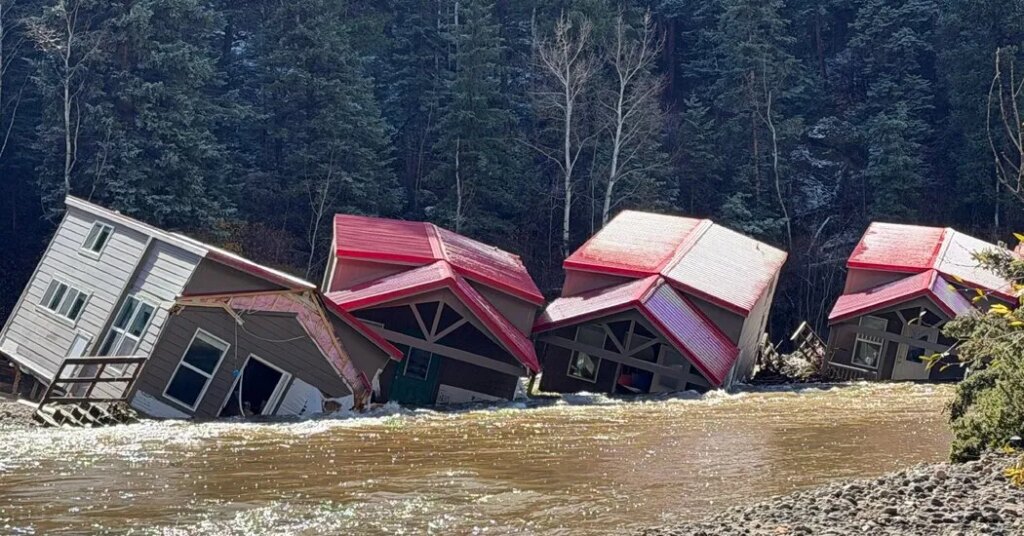
Torrential rains brought a new round of flooding to the Southwest on Monday, washing away roads and prompting fresh evacuations and anguish in a region still reeling from floods a week earlier.
The damage sprawled across the high desert and mountains of Arizona, Colorado, New Mexico and Utah, a vast area where some towns received twice as much rain in a single day as they typically get during the entire month of November.
“I’ve never seen anything like this,” said Shawn Koss, whose house along the Animas River in Flora Vista, N.M., flooded. “The roads are cut in half. Gas stations look like a lake. It’s devastating.”
Gov. Katie Hobbs of Arizona declared a statewide emergency in response to the floods on Monday. Other officials in the Four Corners region, where much of the worst flooding occurred, said they had not even begun to grapple with the extent of the damage.
Many communities were still under evacuation orders or cut off altogether by landslides and damaged roads, and local police were struggling to navigate roads clogged by boulders and three feet of mud.
“We’re so cut off from some of those places,” said Brice Current, the police chief in Durango, Colo., where emergency workers rescued people from flooded neighborhoods and trailer parks. “It’s underwater and impassible.”
The timing of the floods — just before Election Day — also forced election officials in some parts of Colorado to find alternative voting locations or to offer displaced voters help in requesting emergency ballots or casting their votes from another county.
Some flooded streams in the high country began to recede on Monday as the skies cleared, making way for a drier weather forecast for the days ahead. But new dangers were emerging downstream, as billions of gallons of water coursed into lower-lying cities like Farmington, N.M.
There, officials issued new evacuation orders on Monday as the Animas River spilled over its banks and into downtown. On the Navajo Nation, where 500 homes were damaged by floods over the past month, officials were bracing for more impact to roads and residences.
Despite the widespread destruction, there were few reports of deaths or injuries from the weekend rains. In the mountain town of Flagstaff, Ariz., a 73-year-old man was killed after falling into the floodwaters on Sunday night, the police said.
Officials in southwestern Colorado said some people were still stranded in their homes and cut off because of damage to cellphone infrastructure, but they did not have reports of anyone missing in the floods.
Much of the Southwest withered under a drought all summer. But in recent weeks, a powerful El Niño weather pattern has lashed the region with wave after wave of rain, refilling reservoirs but also saturating the ground and raising the risk of flash floods.
Jennifer Tate, a National Weather Service meteorologist, said central Arizona had been the “hot spot” for the highest rainfall totals over the past 60 days, along with southern Utah, southwestern Colorado and western New Mexico.
“It’s generally been wet across the Four Corners region,” she said. “And that would be consistent with the El Niño pattern that we’re in.”
Although drier conditions are expected, the National Water Center has warned of considerable flooding along rivers and smaller streams across parts of central Arizona, southwestern Colorado and northwestern New Mexico through Tuesday.
“But after that, there’s not much precipitation expected for much of the Southwest,” said Ms. Tate. “It’s definitely going to start drying out and give them a break.”
Robert Rickey, a meteorologist at the Flagstaff office of the National Weather Service, said there were widespread rain totals in the area between two to six inches. The Flagstaff airport reported 3.37 inches on Sunday alone. The average rainfall for the entire month of November in Flagstaff is 1.55 inches, he said.
The heavy rain overwhelmed rivers across the region, transforming trickling creeks and tiny streams into roaring, muddy monsters. The Little Colorado River near Winslow, Ariz., along Route 66, reached a record level of more than 25 feet, or more than twice its typical height.
About 2.4 inches of rain fell in the storm-weary town of Pagosa Springs, Colo., pushing the San Juan River over its banks for the second time in a month. At least one home fell into the river, and on Monday, the town museum was perched precariously on the edge of an eroded riverbank, in danger of tumbling in.
“I do anticipate we will lose the front part of the museum,” said Shari Pierce, the mayor.
Ms. Pierce, who is also the publisher of the local newspaper, The Pagosa Springs Sun, said that the downtown was still under evacuation orders on Monday and that it was still too soon to assess the extent of the damage.
She did, however, manage to save 12 tote bags’ worth of family documents and written memories that people around Pagosa had given to the museum as keepsakes. And she said that despite two floods in less than a month, the town would bounce back.
“We’re encouraging people to keep loving Pagosa,” she said.
The post ‘Devastating’ Damage as Hard Rains and Flash Floods Batter the Southwest appeared first on New York Times.