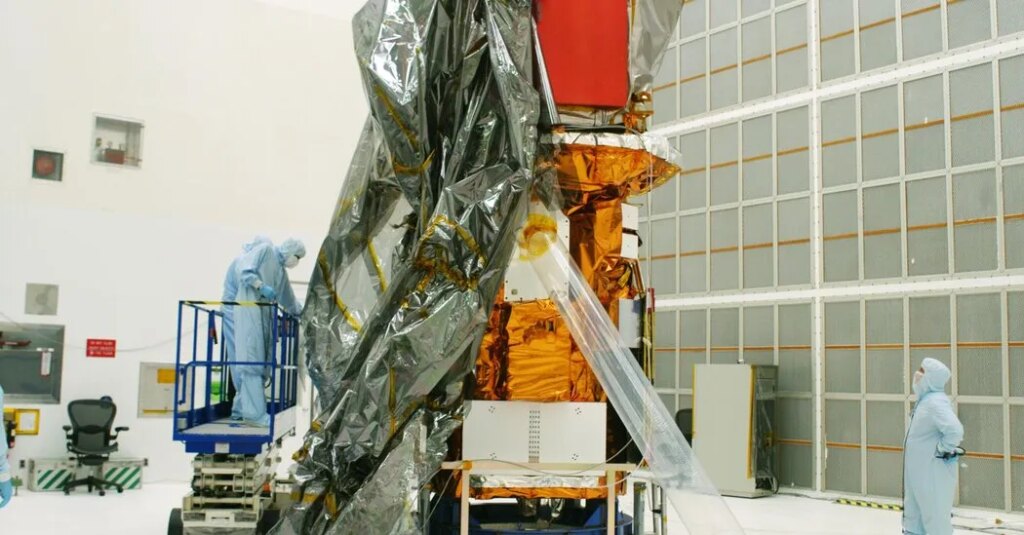
In the coming hours, NASA’s Neil Gehrels Swift Observatory will crash back to Earth.
Most of the spacecraft, which weighs about 1.5 tons, will burn up as it re-enters Earth’s atmosphere. Some of the bigger, heavier pieces, however, are expected to survive all the way to the surface.
As of Tuesday afternoon, the Aerospace Corporation, a nonprofit that performs research and analysis, predicted that Swift’s demise would occur at 5:12 a.m. Eastern time on Wednesday, give or take eight hours.
“Examples of orbital debris could include components made of titanium, such as an instrument mount, rings and fittings, or the mirror assembly made of nickel,” a NASA spokeswoman said in a statement.
NASA estimates the odds that a piece of Swift would injure someone to be about one in 2,100.
However, for people in many parts of the world, the risk is zero.
Swift’s orbit is angled 20.6 degrees to the Equator. That means if you live north of 20.6 degrees north latitude or south of 20.6 degrees south latitude, there is no chance that a piece of a space telescope will fall on you.
The risk-free areas include Europe and the United States. (The Big Island of Hawaii is technically far enough south, but Swift will not pass over it during its final orbits.)
The observatory’s trajectory does pass over swaths of Africa, Central and South America, Asia and Australia, posing a tiny danger.
Launched on Nov. 20, 2004, the Swift observatory was designed to observe the afterglow of explosions known as gamma-ray bursts.
Gamma rays are a form of light like radio waves, the visible spectrum of light and X-rays, but they possess the very highest energies. In the 1960s, satellites that were built to monitor nuclear weapon tests unexpectedly discovered flashes of gamma rays popping all around the cosmos.
The bursts were a mystery for years as astrophysicists puzzled over how explosions so far away could be so bright. The Swift observatory helped come up with answers.
One of Swift’s instruments took in a broad view of the gamma-ray sky. When that instrument or another telescope spotted a gamma-ray burst, Swift lived up to its name by quickly swiveling toward the newly discovered burst and making detailed measurements of the high-energy light as it faded away.
Those brief torrents of gamma rays tell stories about moments of extreme cosmic violence, like explosions of stars and collisions of small, ultradense stars known as neutron stars.
The original mission was set to last only two years, so NASA did not include any contingency plans for boosting Swift’s orbit. Over time, friction from air rubbing against the spacecraft gradually dragged it downward.
Now it has reached an altitude where the fall is speeding up, and the air will soon be dense enough to rip Swift apart into a trail of flaming debris.
The end of Swift brings “a mix of emotions,” said Brad Cenko, an astrophysicist at NASA’s Goddard Space Flight Center in Greenbelt, Md., and the mission’s principal investigator. “Certainly sadness.”
John Nousek, a professor of astronomy and astrophysics at Pennsylvania State University, served as the director of mission operations for all 22 years of the spacecraft’s lifetime. He said it was not a complete surprise that the telescope lasted as long as it did.
“We consciously made decisions as well as we could to do nothing that would limit the lifetime of Swift,” he said. The spacecraft did not use any thrusters and thus could not run out of fuel.
“We just eat sunshine,” Dr. Nousek said. “Everything is battery-powered and so on.”
But two years ago, the sun was more active than expected, and the bombardment of solar particles puffed out Earth’s atmosphere, accelerating the fall of satellites like Swift.
NASA hired a start-up company, Katalyst Space Technologies of Flagstaff, Ariz., to undertake a rescue mission to push Swift back up.
Katalyst’s spacecraft successfully launched in July, but as it was closing in on Swift, it suffered a malfunction, and in August, Katalyst and NASA abandoned the rescue attempt. Swift resumed science operations for one final sprint of astronomical observations before NASA turned it off on Oct. 20.
“There’s some risk of an explosion if you’ve got a charged battery, and we didn’t want to put space debris in orbit,” Dr. Nousek said. “It’s still up there, but there’s no way to talk to it. So the poor little satellite is going into that cold, dark night all by itself right now.”
Dr. Cenko said the Swift team would gather Wednesday evening to pay final respects to the spacecraft. “We’re having a little celebration tomorrow night,” he said, “just to get together, reminisce a little bit, share stories, all of that.”
The post A NASA Telescope Is Predicted to Crash Back to Earth Within Hours appeared first on New York Times.