Christopher Peterson had worn glasses since he was 21, but by his late 40s, he noticed something was very wrong with his vision. His eyesight was getting progressively worse, and there was a cloudiness that hadn’t been there before.
It was 2020, during the height of the covid-19 pandemic, and Peterson was reluctant to go to a medical facility unless absolutely necessary. Finally, “it got to a certain point that I was like, ‘I’ve got to have this checked out,’” he said.
Peterson was surprised when he was diagnosed with cataracts in both eyes. His father had developed them in his 70s, so Peterson assumed it was a condition that affected only older people. “I’m 50. I’m not an old man,” he recalled thinking. He had surgery to remove the more advanced cataract in his right eye in 2021 but was able to delay surgery on his left until this year.
Cataracts, a common age-related eye disease, are a clouding of the eye’s lens. As the lens gradually becomes less clear, things start to look blurry, hazy, and less colorful or yellow-tinted. Though we tend to think of cataracts as something that affects older people, the process begins earlier than people think, said Sonia Yoo, professor of ophthalmology at the Bascom Palmer Eye Institute at the University of Miami Miller School of Medicine.
In fact, cataracts typically start forming in your 40s and 50s, as proteins in the eyes begin breaking down and clouding the lens. And because the changes can happen so slowly, symptoms are easy to dismiss early on as normal age-related vision changes, said Isa Mohammed, director of refractive surgery and the associate program director of the ophthalmology residency program at the Wilmer Eye Institute at Johns Hopkins Medicine.
For many people, cataracts won’t become significant enough to require treatment until later in life, if at all, Mohammed said. But that isn’t the case for everyone. Here are the most common signs of cataracts that can be easy to write off as something else.
Driving at night is a challenge
Difficulty seeing at night, particularly when driving, is a frequent complaint among people with cataracts, Mohammed said. Headlights may seem unusually bright, or you may notice halos around lights. That’s because the clouding of the lens in your eye causes light to scatter instead of forming a focused image, he said. (Although yes, it’s not your imagination, headlights are brighter than in the past.)
Peterson didn’t have trouble driving at night until last year, when the cataract in his left eye worsened. “The night driving got really, really scary,” he said. Lights from oncoming cars began to look like multiple headlights. “I would try to avoid driving at night whenever I could,” he said.
Mohammed often sees patients who have stopped driving at night because they can’t tolerate the glare. Many of them don’t realize that cataracts, not normal aging or brighter headlights, are causing the problem, he said.
Your vision is blurry or less sharp
Yoo said that while some of her patients can still read the 20/20 line on an eye exam chart, they note that their vision isn’t as crisp as it used to be, as if “it went from being high definition to being like a soft focus.”
Blurry vision is a symptom of cataracts, but it can also be caused by other conditions including dry eye, which is common in midlife due to declining natural tear production, and hormonal shifts in perimenopause and menopause.
One clue is whether the blurriness comes and goes. Vision affected by dry eye tends to improve when you blink, while blurriness caused by cataracts is more consistent, said Christine McGowan, chief of cataract and primary eye care service at Wills Eye Hospital and an assistant professor at Sidney Kimmel Medical College of Thomas Jefferson University. Dry eye also may cause other symptoms, such as redness, stinging and burning.
Increasingly blurry vision also can be caused by presbyopia, another age-related change that often starts in your 40s. Presbyopia happens when the eye’s lens becomes less flexible, making it harder to focus on nearby objects. If you start needing reading glasses to see up close, holding a book or phone farther away from your face to make out the words, or noticing more eyestrain at the end of the day after reading a lot, you may be dealing with presbyopia rather than a cataract, Yoo said.
You need more light to read
If you’ve started turning on extra lamps to read, increasing the brightness on your phone or struggling to see the menu in a restaurant’s dim lighting, cataracts could be one explanation, Yoo said. But the need for more light to read can also signal presbyopia. The main difference? Presbyopia can typically be corrected with reading glasses, but blurry vision due to cataracts gradually reaches a point where glasses no longer help, she added.
As the lens becomes cloudier, less light reaches the back of the eye, making it harder to see in lowlight conditions. People with mild cataracts may notice that they need brighter light for everyday activities, or that they have difficulty reading small print in dim conditions even if they can still function normally in most situations, Yoo said.
Your glasses prescription keeps changing
Needing a new prescription isn’t unusual in your 40s and 50s, particularly as presbyopia makes reading glasses more necessary. But frequent changes in your distance prescription can sometimes signal a developing cataract, Yoo said.
Some people with certain types of cataracts will have an unexpected improvement in their near vision, allowing them to read without glasses they were previously dependent on, Yoo said. This phenomenon, called “second sight,” indicates that the developing cataract is changing how the lens focuses light, she said.
Colors seem duller
Cataracts can affect how you perceive colors and contrast. You may notice objects don’t stand out as sharply from their surroundings, an overall dulling of colors, or that everything looks a little less vibrant or appears yellowish or brownish, Mohammed said.
Peterson recalled that by the time he had surgery to remove the more advanced cataract in his right eye, his vision had an amber tint.
When to see a doctor
There’s no universal eye exam schedule for people in their 40s and 50s. How often you should see an eye doctor depends on your overall health, medical history and risk factors. For example, people with diabetes should have an annual eye exam. Other risk factors include previous eye trauma, long-term corticosteroid use, significant nearsightedness, exposure to UV radiation from tanning beds or the sun, a family history of cataracts at a young age and smoking, Yoo said.
Mohammed suggests seeing an ophthalmologist every two years after age 40. But anytime you notice a persistent change in your vision, it’s worth getting checked out rather than assuming it’s simply a part of aging. That’s especially true if the changes interfere with everyday activities such as driving, reading and working, he said.
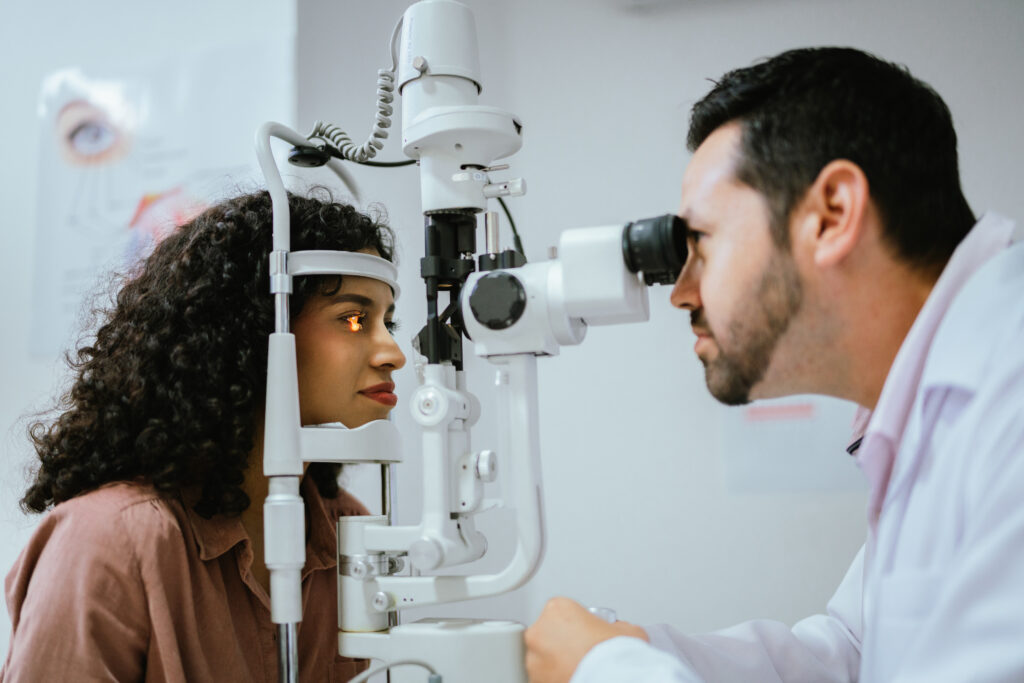
An ophthalmologist can examine your eyes to determine whether a cataract or another condition is responsible for your symptoms. While an ophthalmologist can give you a comprehensive medical exam, an optometrist also can evaluate vision changes and refer you to an ophthalmologist if needed, McGowan said.
If your cataracts are mild, a new glasses prescription may be enough to improve your vision. If a cataract has progressed to the point where glasses no longer help and your vision problems interfere with your daily life, surgery may be an option, she said.
Cataract surgery is one of the safest and most commonly performed procedures in the United States. It’s incredibly low risk, Mohammed said. During the surgery, the cloudy lens is removed and replaced with a clear artificial one. The procedure takes only about 10 to 20 minutes per eye (each eye requires its own surgery). Your vision probably will improve in just a few days after surgery, but it may take up to two months for your eye to fully heal.
But surgery isn’t inevitable. Some people live with mild cataracts for years without needing treatment, and others may never need surgery.
The most important thing is to pay attention to your vision changes, even if they happen slowly, Mohammed said. If you’re in your 40s or 50s, and your vision is holding you back from living the life you want, then it could be due to cataracts, and it’s worth addressing, he said.
Peterson said he’s relieved that he got help and was able to do something to improve his vision. “Facing cataract surgery can feel a little daunting and even scary, but once you’ve done it, it’s a relief.”
The post 5 early signs of cataracts that can start in your 40s or 50s appeared first on Washington Post.