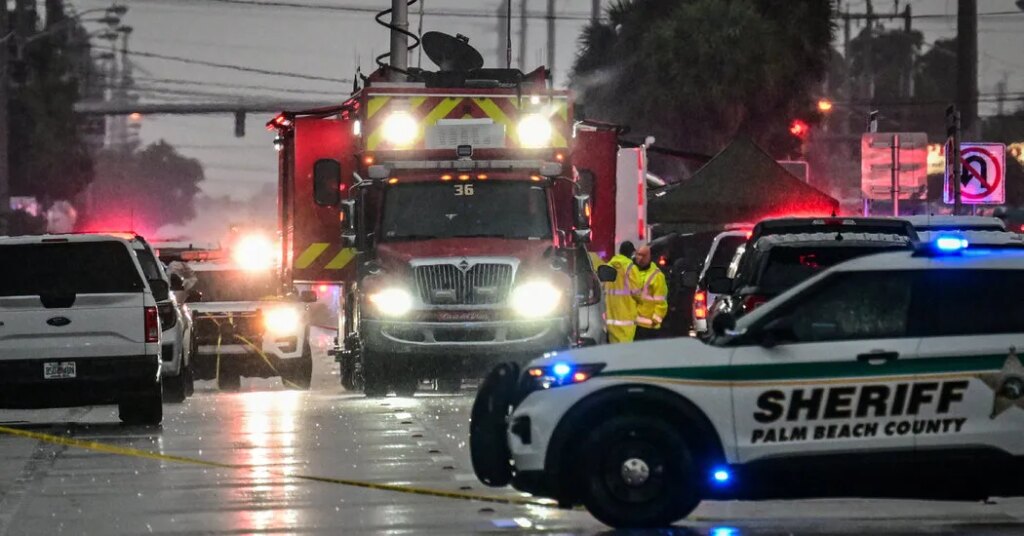
As a private jet plunged toward the ground in Florida on Sunday, a pilot issued one of the most widely recognized distress calls: “Mayday.”
“We’re going to crash into the ground,” she told air traffic controllers, reporting a descent of 20,000 feet per minute. Her Learjet 60 smashed onto a road in Palm Beach County, killing all nine people aboard, the authorities said.
The word “mayday” signals the gravest kind of emergency in international aviation and at sea, giving the call priority over other radio communications. Its first usage in aviation dates to more than a century ago, originating in a French plea for help.
Pilots around the world now use the word — including during a memorable water landing in New York in 2009 — in order to set in motion coordinated assistance for aircraft or vessels in distress.
Here’s what to know about the term.
What does ‘mayday’ mean?
A pilot can declare “mayday” when an aircraft faces imminent and serious danger and needs assistance. But it does not necessarily mean an aircraft is about to crash.
A plane can be flying normally while facing a life-threatening emergency, such as a fire on board, smoke in the cockpit or a critically ill passenger, according to guidance from the Federal Aviation Administration.
Pilots are instructed to repeat “mayday” three times to make the signal unmistakable over the radio, according to F.A.A. procedure. They can also use the less urgent “pan-pan,” which signals an urgent safety concern that is controllable and does not require immediate assistance, such as an open door or a sick passenger.
Pilots can switch from “pan-pan” to “mayday” if the danger grows, or they can downgrade the call if the situation improves.
Where did ‘mayday’ come from?
“Mayday” emerged in Britain in 1923, in the early years of commercial aviation. Just four years before, converted World War I bombers had begun making daily scheduled passenger flights between London and Paris, with some carrying only two passengers.
Air travel was a risky undertaking at the time. The planes were noisy, cramped and prone to delays, and there were few arrangements for rescuing pilots who were downed at sea, according to historical accounts from the British Science Museum and Royal Air Force.
Flights across the English Channel posed a particular concern. Officials needed a reliable way for pilots in trouble to summon help.
At the time, S.O.S. was the international distress signal for telegraphic communications. But the letter S was difficult to distinguish over spoken radio, according to a report in The Gloucestershire Echo in 1923. “Mayday” sounded like the French “m’aidez,” meaning “help me,” the newspaper explained. (“Pan-pan” derived from the French word panne, meaning breakdown or failure, according to the F.A.A.)
British officials tested the new “mayday” procedure with a Royal Air Force flying boat in the English Channel in 1923. The aircraft radioed that its engines had failed, according to an account in The Western Daily Press. A tugboat dispatched from Dover reached the aircraft in 20 minutes, despite the authorities there having received no special warning to prepare.
“Mayday” became the global standard under radio regulations adopted at a conference in Washington in 1927. Today, it remains the international distress signal for pilots.
What happens when a pilot declares mayday?
A mayday call takes priority over other radio communications, requiring others on the same frequency to stop routine transmissions so the distressed pilot and air traffic controllers can focus on the emergency, according to the F.A.A.
Controllers can direct other aircraft out of the way, arrange for a priority landing or alert firefighters and other emergency responders on the ground.
The pilot remains responsible for determining the safest course of action. And controllers are instructed to treat a situation as an emergency whenever they believe one exists, even if they do not hear the word “mayday.”
When Capt. Chesley B. Sullenberger III was piloting a US Airways flight in January 2009, he declared “mayday” three times after the jet struck a flock of birds shortly after takeoff from New York. But air traffic controllers at LaGuardia Airport never heard his words because another pilot was transmitting on the same frequency, according to an accident report by the National Transportation Safety Board.
Controllers nevertheless recognized the emergency and offered Captain Sullenberger alternative runways. He determined that neither was within reach and brought down the plane on the Hudson River.
All 155 people aboard survived the so-called Miracle on the Hudson, even though the captain’s mayday call wasn’t heard.
The post Why Do Pilots Say ‘Mayday’? The Story Behind the Distress Call appeared first on New York Times.