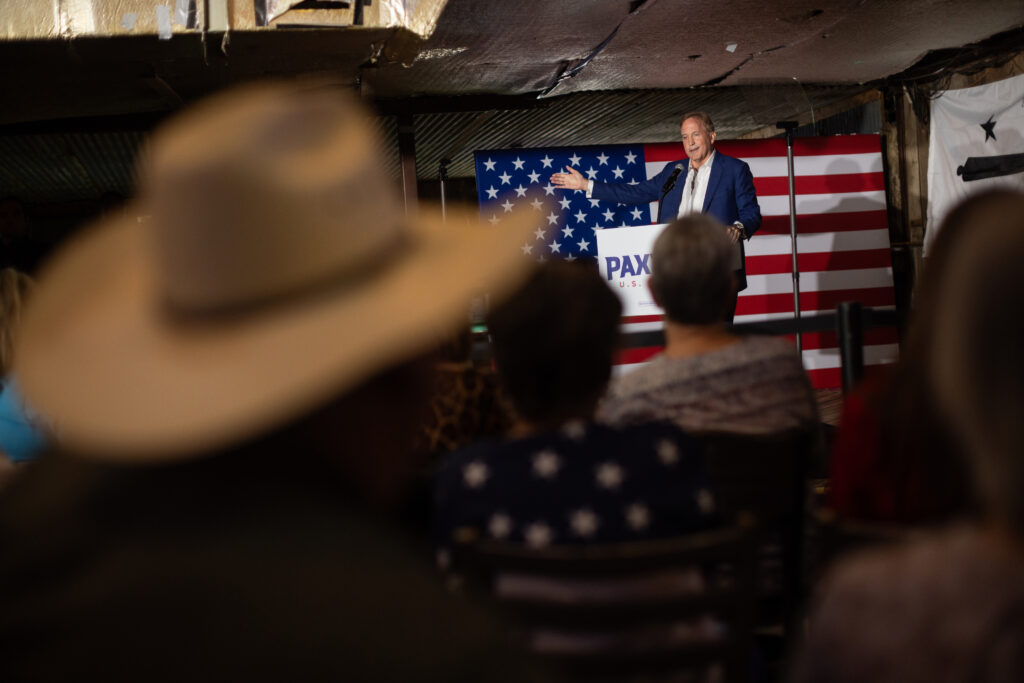
When Ken Paxton rolled up outside an airplane hangar in Rockwall, Texas, this October, he was putting three hard years in his rearview mirror. Paxton had faced some serious setbacks at work (impeachment); he’d weathered legal troubles (accusations of securities fraud); and his wife had filed divorce papers. But Paxton wasn’t going to be held down. The 63-year-old Texas attorney general left these setbacks behind, got in a freshly painted new vehicle and hit the open road.
Instead of a Porsche or Corvette, Paxton opted for a tour bus. In between getting impeached and getting divorced, Paxton had announced a run for U.S. Senate, and on Oct. 17, he invited supporters to the small airport in Rockwall to kick off a 17-day trip across Texas. AC/DC’s “Thunderstruck” played over the loudspeakers as the hangar’s huge bay door opened to reveal Paxton’s bus parked just outside.
Right-wing pastor Daniel Hayworth’s amplified voice bounced in a tinny echo as he introduced “the next United States senator from the great state of Texas, my father-in-law, Ken Paxton!” The bus’s door swung open, and Paxton, dressed in his go-to blue sport coat, walked down its stairs. The crowd let out a sustained cheer.
Paxton’s Democratic opponent, state Rep. James Talarico, has drawn huge crowds and wall-to-wall coverage with his promise to change Texas. Paxton has gotten less positive attention, and that’s in part because what he offers the state isn’t change; it’s continuity.
Democrats haven’t won a statewide race here since 1994; no other state party, in any other state, has had a longer drought. Paxton is one of the Republicans who has managed to keep the Democrats at bay by constantly evolving his message; even after nearly 24 years in elected office, he has managed to portray himself as antiestablishment by persistently tacking to the right. Since he first entered politics in 2002, he has deftly transformed from a Bush-era conservative to tea party stalwart to MAGA warrior. That ideological nimbleness has kept Paxton and other Republicans in power. As once-red Arizona and Georgia turned into swing states, Texas held the line.
That could change. If the current polls are to be believed, Paxton is likely to lose. In a historic shift, Democrats have enjoyed a steady lead all fall (in 2018, Beto O’Rourke, the Democrat who has come closest to winning in Texas in recent years, only led in one poll in his challenge to Sen. Ted Cruz).
During the Republican primary, Democrats openly rooted for Paxton to beat the four-term incumbent, John Cornyn, believing Paxton to be flawed enough that a Democrat could beat him. But while Paxton is weighed down by considerable negatives, he has a structural advantage: There are more Republicans in Texas than there are Democrats. While voters in Texas don’t register with party affiliation, Trump beat Harris by almost 1.6 million votes in 2024.
That made Paxton’s closing message, and his final bus tour, critical. Forget swing voters. If he can’t turn out Republicans, he’ll lose.
In the hangar, Paxton walked to the lectern and looked nervously from side to side. “They have a teleprompter for me here, but there’s nothing on it, so I’m going to just talk,” he said. Paxton’s supporters call him a “pit bull,” but, in front of crowds, he comes across more like a hapless Labrador. He turned to point at his vehicle. “You’ll look at my bus, which I just saw today,” he said. On the side was the black-and-white “Come and Take It” flag, the message made famous in the first battle of the Texas Revolution, when Texians guarding a cannon wove a flag telling the Mexican army, “Ven y tómalo.” “I think it’s appropriate,” Paxton said.
Legend has it that in 1836, William Travis, the commander of the Alamo’s defenders, used his sword to draw an actual line in the sand, asking the Texians to cross to his side of the line and fight to the death to resist Santa Anna’s troops. To this day, the Alamo, with that line in front of it, is still the most potent symbol in Texas politics, and it’s one that Paxton turns to again and again. In public, he struggles to finish a sentence without turning to “us or them” rhetoric.
That’s what the crowd in Rockwall wanted to hear. Paxton’s warnings of invaders and end times quickens the pulse of not just his fellow evangelicals, but also Texans nostalgic for an older version of their state. Texas is one of the fastest-growing and fastest-changing states in the country, and that transformation hasterrified many long-term residents. Paxton has given them enemies to blame. Over the past 11 years, as Texas’s attorney general, Paxton waged dozens of successful legal battles against the Obama and Biden administrations; in the culture wars, he’s used his office to oppose transgender rights, same-sex marriage, immigration, taxation and federal welfare programs. His constant clashes with the federal government made Paxton something close to a household name around the country and earned him powerful support among conservative Texans.
Now, Paxton stood in front of his tour bus, pointing to the “Come and Take It” flag, struggling to work the crowd. In the final days of his campaign, Paxton has had to avoid sounding like an aging rock star, playing his old hits to rooms full of retirees. He still has millions of fans who love him. But his message, about holding the line, no longer sounds the same in a state that has transformed profoundly during his almost quarter century in office. And some of the old truths about the state — such as the fact that it always votes Republican — might no longer hold.
The first tour stop in Rockwall offered Paxton a hangar with a big enough door to fit his new bus, but it also let him return to his political roots. For decades, Paxton’s political home base has stood in the affluent eastern suburbs of Dallas, where tracts of cookie-cutter mansions line glittering artificial lakes.
Born to a military family, Paxton lived all over the country in his youth before coming to Texas to attend Baylor University, earning a BA in psychology and then an MBA. There, he met two of the loves of his life: politics (he was class president) and Angela Allen, who would become his wife and take his last name. After a stint in Virginia while Paxton attended law school, the couple moved to Collin County, to the east of Dallas, where Paxton took on the town with all the ambition and verve of a onetime college president.
Collin was one of the places that turned Texas red. When the Paxtons arrived in North Texas in the early 1990s, the Democrats held the governor’s mansion, and Republicans hadn’t controlled the legislature since Reconstruction. That was changing: As the economy boomed, wealthy suburbs in places such as Collin exploded, bringing in the aspiring, college-educated professionals who, at that time, were the GOP’s base. Paxton was one of these entrepreneurial young people. He started his own law firm in McKinney, taking on corporate clients.
In Collin, the couple was active in the fast-growing evangelical community, and they became regulars (alongside 10,000 others) at the Prestonwood Baptist megachurch. In 1991, Prestonwood opened a crisis pregnancy center, a clinic that sought to deter at-risk pregnant women from seeking abortion. Paxton would eventually take a position on its board. The Paxtons also helped found the Stonebriar Community Church, a nondenominational evangelical megachurch in Frisco.
While Paxton didn’t have the fluency and magnetism required of a pastor, he had a charisma that worked in smaller settings, and he showed talent as an organizer. As the evangelical movement flourished in the state — today, more than a quarter of Texans identify as evangelicals — Paxton learned how to connect the grassroots worshipers with the funding to found churches and activist campaigns.
Religion was Paxton’s way into politics. In 2002, Paxton narrowly won a five-way primary race for a state House seat in Collin County, running as an overtly religious candidate. During a tour of churches in 2016, Paxton looked back to the start of his political career and told the audience that “what I felt God was telling me was ‘Get the Christian community out to vote.’”
Paxton was part of a new era in Texas politics. By the time he took his first votes in the House, Republicans had ousted all statewide Democrats and had sent one of their own — Gov. George W. Bush — to the White House. After a century of living under Democratic rule, conservatives began to flex their newfound power. Soon, Republican primaries became the only actually competitive statewide races, as activist upstarts strove to push Texas further right.
One of the new ideologues pushing for these primary battles was billionaire Tim Dunn, a Bible-thumping tycoon who had made his riches working oil in the flatlands of the Permian Basin. Within a generation, Dunn and his anti-tax, zealously Christian activist network would become one of the most powerful forces in Texas politics.
As Texas Monthly has reported, Paxton was one of the first beneficiaries of Dunn’s spending during his 2002 race. Over the next quarter century, Dunn and his allies would spend millions supporting Paxton’s political career. Both men’s scorched-earth tactics won them passionate fans among the conservative grass roots, but their willingness to criticize their own party’s establishment also earned them enemies among elected Republicans, who became increasingly afraid of being labeled RINOs (Republicans in name only).
Paxton did well in the legislature. In 2004, the Dallas Morning News editorial board called him an “easy-going consensus builder” who “focuses like a laser beam on two issues: school finance and transportation.” That began to change during the Obama era, when Paxton steadily built a reputation as a right-wing firebrand, taking more vociferous antiabortion and anti-federal stances. In 2014, Paxton ran for attorney general, running to the right of his primary opponents. In the final two weeks of a tight runoff, Dunn helped secure a $1 million loan to Paxton’s campaign, and Paxton narrowly won office.
Paxton’s first appearance on the national stage came after the Supreme Court’s Obergefell v. Hodges decision in 2015, when the attorney general declared he would defend Texas clerks who refused to give marriage licenses to same-sex couples. Yet even as Paxton waged the culture war, the movement he’d championed in the legislature was doing more to change Texas culture than any legal cases. When lawmakers like Paxton cut taxes and regulation in the 2000s, they attracted huge new multinational companies to the state. Once a mostly rural, oil-rich state, Texas began to look more and more like California, as professionals from around the country — and the world — followed the new jobs, filling up the suburbs.
This time around, that white-collar suburban growth began to tilt the state’s politics in the opposite direction.
Five days after starting his bus tour, Paxton rolled into a safari park in Richmond, Texas. The town, in Fort Bend County, once sat at the edge of sugarcane fields, which felt far away from the city of Houston to the northeast. Now, Houston had swallowed the county, turning it into a diverse suburb full of office job workers. Near the safari park stood a Turkish restaurant and an upscale Yemeni cafe. Peacocks walked through a parking lot as Paxton’s bus idled outside an event hall.
Inside, a line of patrons circled across the edge of the hall, waiting their turn to fill their plates with complimentary barbecue. A diverse array of Paxton’s supporters — White, Latino, South Asian, African American — said they’d put their trust in him to hold back the flood of changes they saw coming for the state. Some of these conservatives worried about “sharia law” and non-Christian values taking hold; others feared out-of-state transplants pushing for transgender rights; and still more of them (including transplants and foreign immigrants themselves) feared that if Democrats begin winning statewide elections in Texas, they might eventually institute a state income tax.
As the rally started, the room stood for the pledges of allegiance: After finishing their oath to the American flag, everyone in the room swerved to stare at the state flag, reciting the pledge that all Texans learn as schoolchildren: “Honor the Texas flag; I pledge allegiance to thee, Texas, one state under God, one and indivisible …” As the state pledge ended, a few men around the room cried out, “Yeehaw!”
Paxton’s discomfort in front of a crowd can be awkward when he takes the mic at a stadium during Trump rallies; but here, in a smaller room, his lack of polish came across as avuncular, like a father cracking middling jokes during a wedding toast. At this stop, he made several warm asides to state Sen. Lois Kolkhorst, who was sitting near the front in a bright red blazer. In a speech she had given earlier in the evening, Kolkhorst had described her multi-decade friendship with Paxton, which began when they served together in the state House.
In 2023, Paxton’s political life lay in the hands of Kolkhorst and other Texas senators. That year, as the Texas House of Representatives began to finish its biennial session, a group of Republican members revealed articles of impeachment against Paxton.
Four senior officials in Paxton’s office had come forward with corruption accusations, alleging that Paxton used his office to benefit Nate Paul, a troubled property developer who was a donor and friend to Paxton. In the final tally, the House voted 121-23 to impeach Paxton, with 60 Republicans voting in favor of impeachment. Paxton was temporarily suspended as attorney general as the case moved to the Senate.
It was only a brief suspension. Before the Senate took up the case, the activist network funded by Dunn and his allies launched a ferocious campaign to deter senators from voting to impeach Paxton, threatening Republican defectors with primary campaigns. Within days, the chamber voted, handily, to acquit Paxton. In the end, only two Republican senators voted to convict. (One senator was barred from voting: Angela Paxton, the attorney general’s then-wife.)
The exoneration launched a stunning political comeback. In 2025, when Paxton announced his Senate campaign on Fox News, it had sounded like a long shot. That same year, Paxton had paid $300,000 to settle a long-running securities fraud case (he admitted to no wrongdoing), and a judge had ordered his office to pay $6.6 million to the four whistleblowers. Soon after he announced his campaign, Angela filed a divorce petition, which accused Paxton of adultery.
To win his Senate race, Paxton would have to shed this heavy baggage, and also defeat Cornyn, the well-liked incumbent Republican. He ran a blistering campaign from the right, accusing Cornyn of being a fossilized reminder of the loathed Bush era. A super PAC supporting Paxton ran anti-Cornyn campaign ads in Florida, targeting Mar-a-Lago, and, in the runoff, Trump threw his weight behind Paxton, propelling him to a clear victory.
After a bitter primary, the vast majority of elected Republicans across the state have fallen in line to support Paxton in the general election. Even Angela, still estranged from Paxton, publicly endorsed him.
But Cornyn’s warnings that Paxton would struggle in the general election appear prescient. At the microphone in Fort Bend, Paxton told the crowd that “every poll in this race shows that this is coming down the wire. It’s shocking in Texas, but here we are.” Most reliable forecasters call the race a true toss-up.
Paxton has deftly turned his battles to defend his reputation and career into an asset. Blaming his legal controversies on his political opposition has made it possible for Paxton to credibly portray himself — a long-term Republican politician in a Republican state — as an underdog.
“We love his fighting spirit,” said Daniel Wong, the interim Fort Bend County judge, who attended the event in Richmond. In the parking lot, supporters signed Paxton’s bus with red markers. One of the most popular messages, written down the bus’s side, was “Fight for Texas!”
The next morning, 120 miles south, Paxton’s bus drove into one of Texas’s vast rural stretches, rolling into Victoria County. In the morning, the heavy silver bellies of clouds hung over ranches and farms. Green piles of hay lay out under the tired-looking sky. Around noon, the bus passed a road-killed black vulture and then a dead red fox lying on its back, before pulling into the dusty parking lot of the Barn, a country bar in Mission Valley. It slid in between rows and rows of super-duty pickup trucks.
Though Paxton’s political home base has always been affluent North Texas suburbs, some of his most consistent support now comes in rural counties, where bars like the Barn serve as a time capsule for a 20th-century Texas. Inside, mounted deer heads lined the walls, and professional rodeos played on the TV. The conservatism here is at its most earnest: People like the way they’re living, and they don’t want things to change.
At the bar, locals in Stetsons popped open a few pre-lunchtime drinks. William Finney, a cattle rancher, pointed at his wife, Mary Beth Finney, and joked that she’d told him to come. (That was before he knew there’d be free beer.) “I thought seriously about not coming. But we have had so many people that have moved into Texas from New York, from California,” Finney said. “I’m not going anywhere. I am staying right here, and I don’t want my life ruined by people that have moved into this state.”
Next to Finney at the bar was Shane Schroeder, who runs a pest control company, and Tod Slone, a retired calf-roper whose company now fashions coveted saddles for rodeo competitors. When asked whether they thought Republicans were divided on whether to support Paxton, Schroeder leaned in and said, “We don’t have a choice right now — it’s Paxton or Talarico.” Slone, who was quieter than his friends, crossed his arms, nodding seriously. “Would we have chosen Paxton?” Slone said. “Well, he got chosen for us. So here we are.” Schroeder agreed. “He’s the horse we got, so we’re betting on him.”
It’s been a long time since the Roosevelt era, when rural Americans lined up behind the New Deal. In the last 30 years, Democrats have cut bait in rural communities, sending volunteers and ad dollars to turn out more dependable voters in the cities and suburbs. While Talarico has attempted to make some inroads, there’s still a profound distrust of Democrats here.
As the event started, the pastor of the local Branded Cowboy Church led the large crowd in a prayer, asking God to help Paxton beat “skinny jeans Talafreako.” Bill Pozzi, the Victoria County GOP chair, assured the room that Paxton “has a rural vision,” and that he had the “aggression” to defend their way of life.
When Paxton took the mic, his usual stump speech was enlivened by an ecstatic crowd, who called out support as if they were in the pews at a charismatic church. When Paxton repeated Trump’s claim that Paxton was the best attorney general in the country, a woman called out, “Yes, you are!” The crowd cheered as he told them he had sued the Biden administration over 107 times, bragging that CNN had called Texas a “graveyard” for Biden’s agenda. On the TV screen, hung between two mounted 10-point buck heads, a bronco rider held on as the horse bucked and kicked.
Over the next 10 days, Paxton’s bus drove thousands of miles around the nation’s second-largest state. In each corner of Texas, he found natural bases of support — but also growing vulnerabilities for Republicans.
From Mission Valley, he went south to Corpus Christi, on the Gulf Coast, where he assured his audience that he would fight to defend the oil and gas industry. Corpus offers high-paying blue-collar jobs to people working at liquefied natural gas terminals and on offshore rigs, and these workers will reliably vote against the Democrats, who they fear seek to decarbonize the economy. But after a year of emergency-level water shortages, some residents have begun to inveigh against the oil and gas industry for using up their drinking water.
From there, the bus traveled down to the borderlands, where supporters arrived to thank the attorney general for his role helping the state crack down on the thousands of migrants who arrived in local cities during the Biden years. However, while border enforcement was popular in 2024, an association with Border Patrol and Immigration and Customs Enforcement is now a liability in South Texas.
Sitting in the tiny crowd at a Paxton campaign stop in the bustling land port of Laredo, Martha Loera, a local Republican precinct chair, said she’s always strongly supported Paxton and Trump. But she said some of the local Hispanic voters who turned out for Trump in the last election may have lost their enthusiasm for Republicans because of ICE arrests. Her own husband, a U.S. citizen, was detained on the highway outside of Laredo. Loera suspected it was because he was driving his work truck, full of construction equipment. “But they were very polite,” Loera said. “They just let [him] go.” Loera can understand why some residents feel upset about being stopped by ICE, but she thinks the media has unfairly given ICE a bad rap.
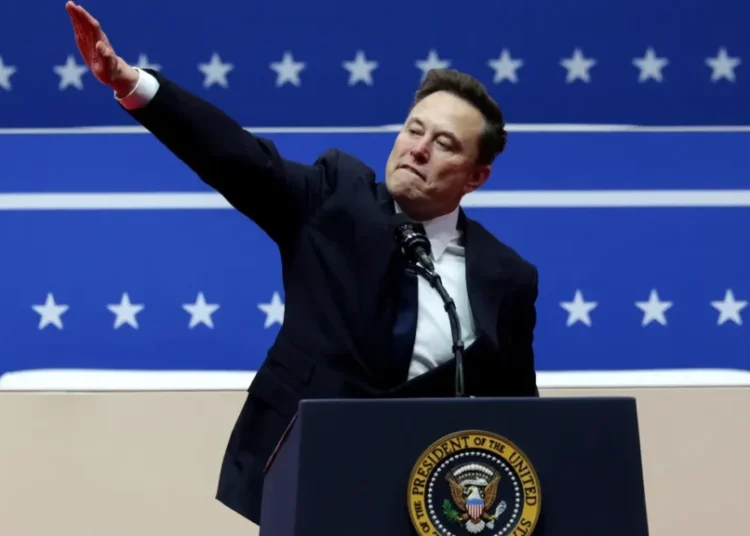
At a campaign stop in Selma, just north of San Antonio, Paxton’s bus idled outside for over an hour as attendees waited in line. Paxton’s campaign manager told The Washington Post that the candidate was on fundraising calls. Earlier in the fall, Elon Musk, the richest man in the world, had spent over $140 million to support Paxton’s reelection (two of Musk’s businesses, SpaceX and Tesla, each have major presences in the state). The South African sometimes-trillionaire’s money has helped Paxton maintain financial supremacy over Talarico.
Besides Musk, Paxton can continue to count on other passionate fans, who show their support in different ways. As Paxton made calls, husband and wife Lane Johnson and Martha Ochoa Johnson waited in line near where the bus idled. There was no shade, and, though it was late October, the sun had decided to have another go at summer. Lane held up a cardboard sign over his wife’s face to give her some shade. On the sign was a photo of the couple’s 25-year-old grandson, Jake Ryan Paez. In 2021, Paez had died after unknowingly taking a pill laced with fentanyl.
The Johnsons had come to thank Paxton in person for his work as Texas’s top cop, which they believe has prevented other Texans from experiencing their loss.
The two wore identical black T-shirts that read “Fentanyl: Distributed by Mexico, killing Americans.” They explained they particularly supported Paxton’s efforts to close the border. Lane said that he was enthusiastically supporting Paxton. “I do not shy away from his baggage; he’s got a huge amount of baggage,” Lane said, explaining he had voted for Cornyn in the primary. But he said he makes the same argument for Paxton that he does for Trump. “He’s not my preacher. He’s a politician, and he’s got his flaws. But I believe he’s going to get things done and for the better.”
Matthew Choi and Molly Hennessy-Fiske contributed to this report.
The post Ken Paxton’s last stand appeared first on Washington Post.