It was before dawn when Amandeep Kaur turned herself in to federal authorities in downtown Los Angeles last Monday. Wrapped in a tasseled shawl, she paced and shivered as she waited outside the courthouse.
At 6:30 a.m., two plainclothes agents rounded the corner, served Ms. Kaur her arrest warrant and walked her to an unmarked vehicle, where they lightly searched her. She would be fingerprinted and taken into custody before appearing in front of a judge that afternoon.
Ms. Kaur, a 30-year-old from India, lives with her two young children, her husband and her in-laws in Rancho Palos Verdes, Calif. She speaks little English and is a legal permanent resident of the United States.
The government says in court documents that Ms. Kaur registered to vote in 2022, voted in the 2024 election — unlawfully, they say, because she is not a U.S. citizen — and then made false statements about that history on her naturalization application.
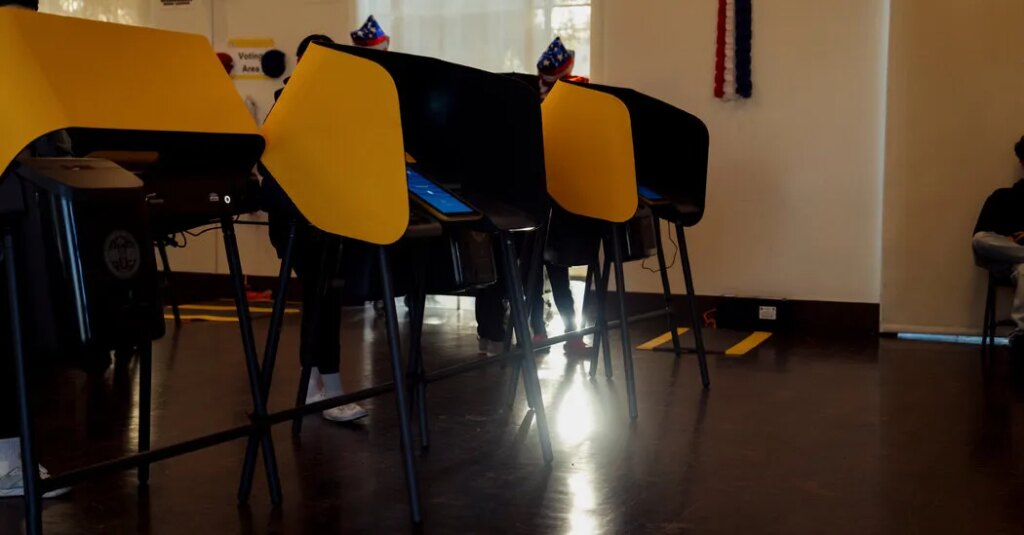
As of Friday, she was among more than 220 people across 28 states charged in connection with voting violations during President Trump’s second term — part of the administration’s far-reaching, monthslong effort to find, arrest and publicize instances of voter fraud.
In the process, people like Ms. Kaur have been caught up in a disorienting and often demeaning experience: Taken by federal agents from their homes, or ordered to turn themselves in. Portrayed as criminals by the country many of them are trying to become citizens of, with their names and faces circulating online. Forced to appear before judges, in some cases in shackles. Some people have been kept in custody for days. At least one man remains in a Texas jail.
Election officials in California and other states have condemned the government’s crackdown, saying its system for identifying suspected violators is severely flawed, based on incomplete information, and has been rife with mistakes, including targeting people who are citizens.
The backdrop to the latest round of charges is the fierce midterm battle in which Democrats are in position to retake the House and possibly the Senate. Mr. Trump has repeatedly made unsubstantiated claims that Democrats have stolen past elections by allowing immigrants to vote illegally. He has called for national measures to prevent fraud that include voter identification, proof of citizenship and restrictions on mail balloting.
State audits and studies have repeatedly found that noncitizen voting is extremely rare, and there have been no instances in which their votes are known to have swayed an election.
The New York Times spent more than a week contacting people whom the administration charged in connection with violating election law. In interviews, some of the defendants and their family members cited language barriers, confusion about the voting process and unexpectedly receiving ballots in the mail as reasons for mistakenly registering or casting a vote.
Others denied the allegations completely. They said they were shocked when the authorities contacted them or showed up at their doors.
The Homeland Security Department did not respond to a request for comment. Nor did the Justice Department. It has described the arrests as part of a coordinated effort “to combat and root out fraud in U.S. elections and protect electoral integrity.”
Trent McCotter, the acting deputy attorney general, has said that “every illegal vote cancels out the vote of a lawful American citizen.”
Ms. Kaur’s husband, Kulwinder Ghotra, said that his wife, who speaks Punjabi, began receiving voter information in the mail after taking a driving test at the Department of Motor Vehicles. Believing she was eligible, he said, she voted in 2024.
“She was confused,” said Mr. Ghotra, 38. “She said there was no translation there at the voting center.”
Ms. Kaur was eventually charged with making false statements on her naturalization application — a felony that carries a maximum sentence of up to five years in federal prison, a fine, or both, and which can result in deportation. She declined to be interviewed about her case while it is pending.
Mr. Ghotra now fears that his wife could be deported. The couple has two children, ages 3 and 5.
Last week, a judge ruled that Ms. Kaur could return home in advance of her hearing this month. A translator relayed this to Ms. Kaur in Punjabi.
She was escorted from the courtroom in shackles and handcuffs.
“I Was Used”
Early on Oct. 19, federal agents banged on the door of Omar Alexander Muñoz, a 72-year-old from Belize, at his home in Commerce, Calif. They threatened to break down the door, Mr. Muñoz said in an interview.
He said the agents pulled his arms behind his back to handcuff him, injuring his shoulder and his neck, both of which he said he had recently had surgery on.
Several police cars, as well as members of the media, were stationed outside his home during the arrest, Mr. Muñoz said.
“They were positioned in a way, waiting,” he said of the reporters. “I was used to make a show of voter fraud.”
The Justice Department, the did not respond to questions about whether or not agents had notified the news media in advance of the arrest, or whether they had used excessive force.
Voting rights experts have called arrests of individuals like Mr. Muñoz performative stunts intended to bolster the government’s legal effort to disqualify California voters.
“This is to serve a political purpose, and that political purpose is to support the civil suit, as well as to support Donald Trump’s claims of a big problem of noncitizen voters,” said Richard Hasen, a law professor and election law expert at the University of California, Los Angeles.
“My first reaction was: These are the best cases they have?” Mr. Hasen said. “Like this guy, Omar Muñoz, like, he’s the perp? Please.”
A legal permanent resident of the United States for more than five decades, Mr. Munoz was charged with illegally registering to vote and making false statements on his citizenship application.
He maintains his innocence. In an interview with CBS News, he said he believed someone else may have used his name.
Agreeing, but Not Understanding
Though President Trump has made a particular example of California, charges of voter fraud have been made across more than two dozen states, including Florida, North Carolina, Pennsylvania and Texas.
Khalwinder Singh Bhengura, of Arlington, Texas, is originally from India and became a permanent legal resident in 2022.
Mr. Bhengura, 70, who speaks Punjabi, had been living in Texas with his wife, according to his brother-in-law Jay Chima. But he had an old habit of nodding along to things he did not understand in order to seem agreeable, Mr. Chima said, and “his English skills are nil.”
In September, Mr. Bhengura was charged with making false statements while registering to vote, and with casting a ballot unlawfully in 2024. He took his case to trial and pleaded not guilty; his lawyers argued that there was not enough evidence to prove that he had voted. They also worried about his ability to comprehend a fast-moving trial.
On Tuesday, a jury found Mr. Bhengura guilty of making false statements of citizenship in order to register to vote, and of voting by an alien in a federal election.
After the verdict was read, Mr. Bhengura was jailed. He remains in custody.
Nicole Knox, a lawyer for Mr. Bhengura, said she found the jailing appalling, and that she worried about what it could mean for other immigrants.
“It creates basically a blank check for further indictments of similarly situated people with innocent intent,” she said.
Jamil Ahmad, 51, of Philadelphia, came to the U.S. from Pakistan about a decade ago and claimed asylum. He is now a United States citizen. But in November 2024, he still had his green card. At the time, he said in an interview, get-out-the-vote campaigners were contacting him by mail, by phone and in person, encouraging him to register.
Mr. Ahmad reasoned that if were not allowed to cast a ballot, then the government would not let him. And he considered it his duty to vote, he said. He helped his wife, Nighat Jamil, a 47-year-old permanent legal resident, to register alongside him.
“I was thinking that, if I’m eligible, then they will accept the form,” he said. “If I’m not eligible, they will send me the form back.”
What came in the mail was not a rejection, but a ballot. Mr. Ahmad voted for President Trump. Ms. Jamil, whose English skills are more limited than her husband’s, said that she trusted him to fill out her ballot.
In September, Mr. Ahmad was charged with voting as an alien in a federal election. The authorities came to his house to question him, he said, which spiked his stress levels. But after a couple of weeks, Mr. Ahmad thought it made sense to take responsibility for what had happened.
“When I read all the things,” he said, “now I understand that this is a crime.”
He pleaded guilty last month and is scheduled to be sentenced in January.
Ms. Jamil was also charged with the same voting misdemeanor. She has a court hearing scheduled for this month and is nervous, she said, because she is not a citizen and could be at risk of deportation.
That makes Mr. Ahmad feel sick with guilt, and concerned for his four children.
“I’m just worried,” he said. “How I can look after them if they deport my wife?”
Kirsten Noyes and Seamus Hughes contributed research. Sameen Amin contributed translation.
The post Accused of Voter Fraud, They Ended Up in Shackles appeared first on New York Times.