A ramen packet with a Korean-language label. A TV show whose leading man speaks Korean. A tea commercial in which the pitchwoman says, “gwenchana,” the Korean word for “it’s OK.”
You could be forgiven for thinking these things were created in Korea, but they actually came from Japan.
One hundred years ago, during the Japanese colonial era, Koreans were pressured to adopt the Japanese language and identity while suppressing their own. Now, thanks to the success and influence of South Korea’s cultural exports — including K-pop, K-dramas and world-renowned beauty products — the Korean language is seeping into Japan’s youth culture.
Moeka Takamatsu, 21, a university student and K-pop fan in Tokyo, said she often mixes Korean words like jinjja (really) and mianhae (sorry) into her daily conversations.
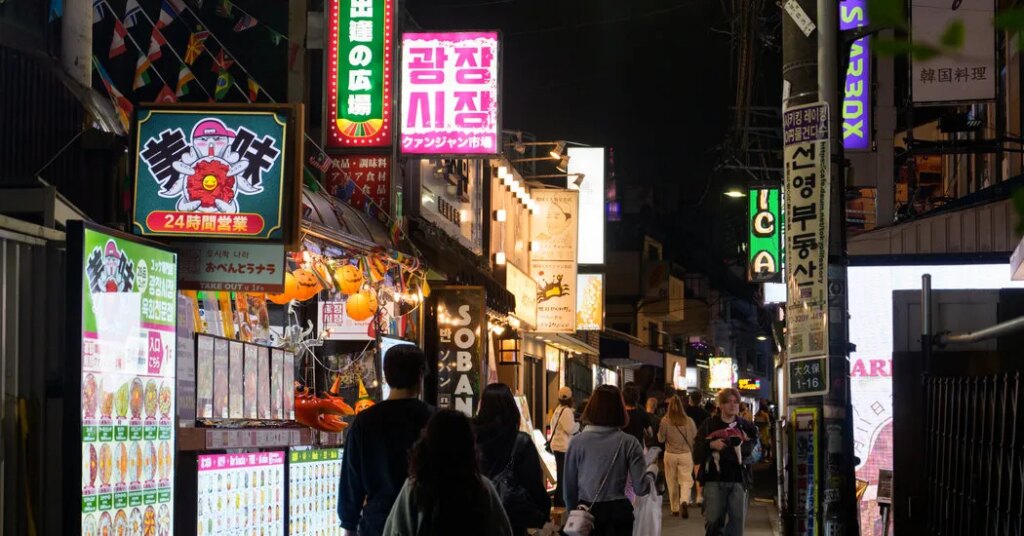
“Even though I don’t know anything about Korea, I find myself saying gwenchana quite often since it’s a trend on social media,” she said on a recent evening on a street in a part of Shinjuku that has many Korean restaurants and cosmetic stores, and that has historically been known as the Koreatown of Tokyo.
The use of Korean words, or slightly altered versions of them, has increased in recent years in popular culture, advertisements and everyday conversation among Japanese Gen Z, experts said. The phenomenon is called “Hanbono,” a portmanteau of the words Hanguko (Korean) and Ilbono (Japanese).
In Japan, especially among K-pop fans, “there’s a trend where people accept Korean words as they are and use them directly,” said Hiroko Sasa, a Japanese-language professor at Cyber Hankuk University of Foreign Studies in South Korea. The practice picked up noticeably in 2018, she said, when the BTS album “Love Yourself: Tear” was released and Blackpink performed in Tokyo and Osaka.
The Korean and Japanese languages’ similar phonetics and the physical proximity of the two countries makes it easier for Japanese people to pick up Korean — and vice versa — than other languages, experts said. Millions of tourists fly back and forth between the countries each year, according to South Korean government data.
Describing the Hanbono phenomenon, Maya Fujisawa, a Tokyo resident who works at a Korean-language school, said, “It’s a strictly informal style of expression used among friends.”
More people in Japan were exposed to K-pop and Korean culture during the coronavirus pandemic, experts said. That is when some Korean words — like hyung, a term of affection used by a man to address an older male, and unni, the female variant of hyung — started being used more widely in Japan. Parallel terms do not exist in Japanese.
“The language became something anyone could easily use, even without Korean heritage,” said Choi Eunkyung, a Korean-language professor at Kansai University in Japan. Using Korean is “a way to express that you like K-pop or culture.”
Japan colonized Korea for about four decades, during which it stripped the Korean language of its official status and required legal documents and school textbooks to be written in Japanese. Korean-language newspapers were closed. In 1942, Japanese colonial authorities arrested scholars of a group that studied and disseminated Korean texts, an episode that became known as the Korean Language Society Persecution.
After the country’s liberation in 1945, Korean scholars established a standardized Korean language to restore native literacy and orthography. In the 2000s, the South Korean government formalized these efforts through the Basic Act on the Korean Language and created language institutions to expand Korean education globally.
Decades later, South Korea has become a cultural powerhouse. The runaway success of its music and film industries has fueled global interest in Korean cuisine and a rapid rise in cosmetic exports. Japan was among the first overseas markets for K-pop in the early 2000s.
While diplomatic relations between South Korea and Japan have improved in recent years, territorial disputes and historical grievances, including over wartime sexual slavery, between the two countries endure. And Hanbono has yet to take hold among the wider population in Japan.
“Korean words were used as a kind of secret slang around the time I was in high school,” said Lee Sang-chul, 64, a man of Korean descent who grew up in Japan, as part of a historically marginalized section of society.
Mr. Lee said that he and his friends used words like dambae (cigarette) or pacchigi (head butt), which later became the title of a film depicting North Korean residents in Japan. “They were just shared between us.”
Now, young people in Japan “judge things on their own merit without drawing lines based on nationality,” said Mr. Lee, a director of the Korean Residents Union in Japan. “Isn’t this a positive trend?”
The post New Slang in Japan Has an Unlikely Source: Korea appeared first on New York Times.