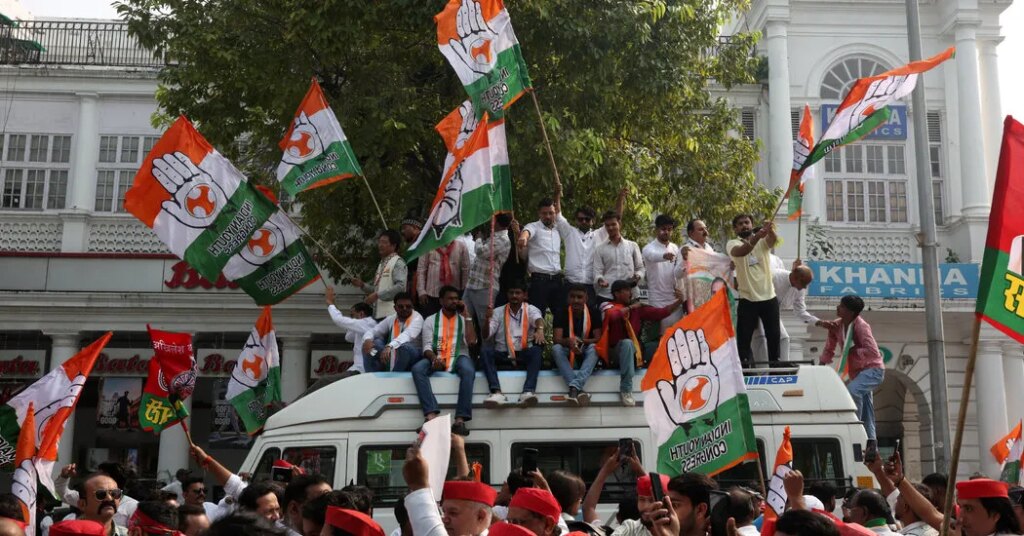
The heart of India’s capital was transformed on Sunday into a sprawling scene of mass resistance to the government of Prime Minister Narendra Modi.
A rally organized by a coalition of India’s centrist and left-wing opposition parties appeared to be among the largest demonstrations against Mr. Modi since he and his nationalist Bharatiya Janata Party took power more than a decade ago, though it proceeded without the violent clashes between protesters and security forces that have marred other recent protests.
Thousands of people lined the streets of central New Delhi in a clamor of banging drums, chants and billowing Indian flags. Inside the gates of the rally venue, a field called Ramlila Ground, tens of thousands more gathered in the height of the afternoon sun as leaders from the opposition denounced the Modi government’s handling of an update to the country’s voter registration lists — a process that has so far resulted in more than 130 million names being expunged.
Rahul Gandhi, the scion of India’s most illustrious political dynasty and leader of the opposition Congress party in Parliament, rebuked Mr. Modi and his government, accusing them of committing “treason” against India’s democracy.
“You have stolen the conscience of India,” Mr. Gandhi said, repeating the demand of the protesters that the chief elections commissioner, whom Mr. Modi appointed, step down.
Gesturing to the crowd, Mr. Gandhi tried to reassure them that their large numbers would make a difference. “You are here to send a message to Narendra Modi,” he said, “and you did it.”
It was the latest outpouring of public dissatisfaction over the voter roll revisions process, which began last summer as a search for duplicates, dead people and other discrepancies.
A string of protests aimed at the Modi government has broken out in New Delhi since July, under different banners and with separate demands, threatening to weaken the prime minister’s iron grip on power. The large numbers who turned out on Sunday were a sign that Mr. Modi’s antagonists believe they have hit on a successful strategy after years of struggling to coalesce.
The protesters have accused Mr. Modi of trying to rig the system, as millions of people have discovered their names are no longer on the books.
Outside the rally on Sunday, Ramakant Sahoo, 42, was helping to hold up a scroll listing some of the deleted names. It stretched the length of a city block and included nine million people, he said. “Our democracy is in bad shape,” said Mr. Sahoo, who runs a small eatery in Dindori, a town in the central Indian state of Madhya Pradesh. “We do not know if what we are doing will make a difference,” he conceded. “But it would be wrong to do nothing.”
Mr. Modi’s allies in the Bharatiya Janata Party, or B.J.P., staged their own rally on Sunday in a state neighboring Delhi. It drew fewer people but was no less hostile.
“Today, whatever is happening at Ramlila Ground in the name of democracy is not to respect the democracy but a well-thoughtout conspiracy to spread anarchy in the name of democracy,” said India’s health minister, Jagat Prakash Nadda.
The B.J.P. has accused its opponents of looking for an excuse to foment unrest. Protests began in force in July under the banner of the Gen Z-led “cockroach” movement. The Cockroach Janta Party — named as a satirical response to a comment from India’s chief justice about “youngsters like cockroaches who don’t get any employment” — first mobilized young people across India to protest the government’s mishandling of important student entrance exams.
More recent protests have focused on the voter rolls and have largely been led not by the cockroach movement, but by the Congress party and Mr. Gandhi. Those recent demonstrations were different from Sunday’s in a crucial respect that contributed to the violence: They were events that did not have official permission.
Security forces and police officers responded to the earlier protests by locking down the heart of New Delhi, detaining protest leaders and rounding up demonstrators by the thousands.
On Sunday, there were few signs of tension between protesters and the police. By noon, the venue and surrounding streets had filled up with people from all over India — including the Himalayas in the north and the southern state of Tamil Nadu. They represented diverse backgrounds, including students, retirees and official party workers. There were Muslim women wearing head scarves and there was a large contingent of flag-waving members of communist parties.
“The country is going backward 30, 35 years,” said Maya Joshi, 60, from Delhi, who said her sister was deleted from the voter rolls. Like many of those who attended, she said she could not be sure whether the government would take any of their demands and concerns seriously. But she believed it was important to attend because, she said, “I wanted my presence to be recorded here.”
The post Large Crowds Protest in New Delhi Over Modi and Voter Roll Changes appeared first on New York Times.