Jan Harayda, a critic and journalist, writes the Substack “Jansplaining,” from which this article was adapted.
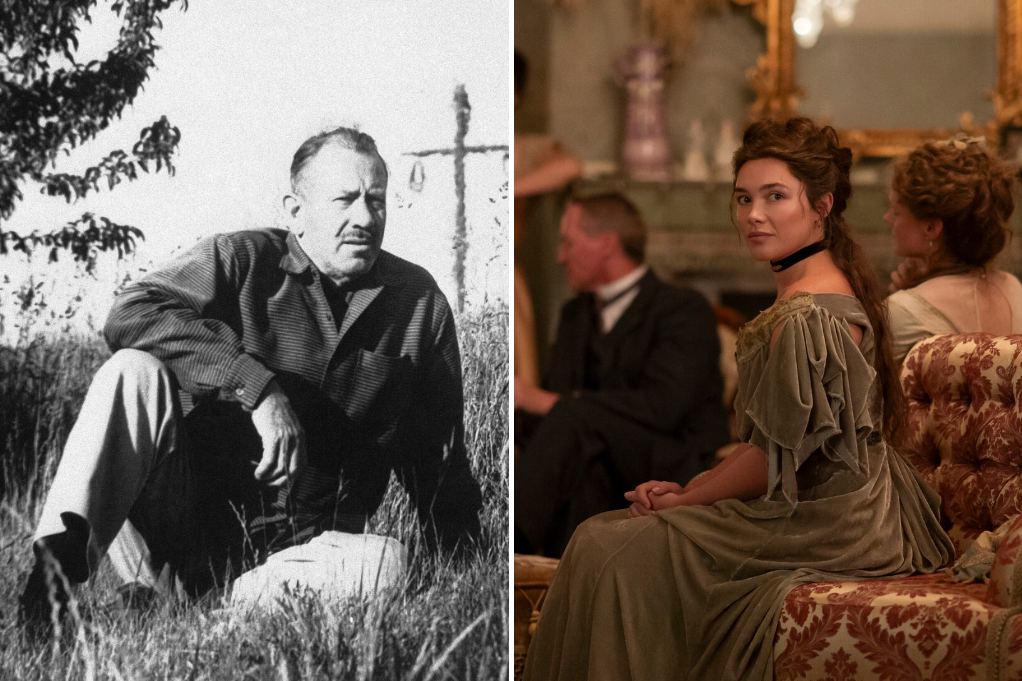
What might book blurbs look like if they told the truth? John Steinbeck summed up a book an unnamed friend had asked him to blurb: “Can’t write, can’t think and has nothing to say.” That comes from “Journal of a Novel: The East of Eden Letters,” a collection of notes Steinbeck sent to his editor while writing the novel. Now “East of Eden” has been made into a seven-part Netflix series. You might find “Journal of a Novel” more rewarding than the TV adaptation of the novel.
Each day while writing “East of Eden,” Steinbeck warmed up by writing to Pascal “Pat” Covici, his editor at the Viking Press. But the subtitle of this collection of those “letters” might be misleading. “Journal of a Novel” consists of his posthumously published notes on his progress in working on “East of Eden,” which transplants the biblical story of Cain and Abel to the Salinas Valley of California by drawing heavily on his family history.
More than a decade after the 1939 publication of his “The Grapes of Wrath,” the daily notes were his way of “getting my mental arm in shape to pitch a good game” in 1951. Covici came by Steinbeck’s Manhattan apartment, usually on Friday, to collect them along with new pages written that week. In the summer, when Steinbeck worked on the book daily while vacationing with his family on Nantucket, he sent the pages to New York by airmail.
Many writers’ letters give frequent updates about their work on a novel. But Steinbeck may be the only author of his stature to send his editor weekly installments of his work along with detailed accounts of its creation, often in vivid and amusing detail.
The remarkable “Journal of a Novel” gathers the “East of Eden” letters in a compact volume full of insights into not just the book but also Steinbeck’s writing rituals, his views of life, and more.
Steinbeck wrote everything in “Journal of a Novel” in pencil on the blue-ruled pages of a large notebook Covici had given him. He used the left-hand pages for notes to his editor and the right-hand ones for the text of the novel, typically filling two pages a day with about 1,500 words, rendered in his minuscule but clear handwriting.
Covici had the manuscripts typed, but before that happened with “East of Eden,” Steinbeck wrote to him, “I want to … take out even the few adjectives I have let slip in.” By such means, he wrote a novel of more than 225,000 words in about nine months. Novelists using a computer with a high-speed processor might find that feat hard to top.
The entries in “Journal of a Novel,” published by Penguin in 1969, show how he did it. Some of their topics are common in writers’ letters: their author’s literary aims, progress and setbacks. Steinbeck also reports on talks with his agent, Elizabeth Otis (whose “icy opinion” he said had never failed him).
It soon becomes clear that Steinbeck aimed to do more than get his “mental arm in shape to pitch” with his notes. He told Covici that his habit of describing his goals in them “keeps the book from wandering.” And there was more to it than that.
“A long time ago I learned a trick — or perhaps it might be called a method for writing,” Steinbeck wrote years later to a friend. “I stopped addressing my work to a faceless reader and addressed one person as though I had only that one to talk to. I gave him a face and a personality.”
Steinbeck told Covici, “It is the duty of the writer to lift up, to extend, to encourage.” But perhaps his best advice to novelists was indirect and involved dialogue. In his own work he believed that “every line of speech must be accurate and full of some kind of meaning which stretches not only forward in the book but stems from before in the book.”
That’s now classic writing-program advice: Every line of dialogue ideally must do double or triple duty: advance the plot, reveal character, say something accurate or true to the novel. And one of Steinbeck’s own lines might inspire writers when they get stuck: “My work does not coagulate,” he wrote to Covici during a week of distractions. “It is as unmanageable as a raw egg on the kitchen floor.”
Whether or not you enjoy reading about writers’ everyday lives, “Journal of a Novel” has useful context for reviews of the Netflix series. (With a writer’s customary disdain for critics, Steinbeck in one note calls them “these curious sucker fish who live with joyous vicariousness on other men’s work and discipline with dreary words the thing which feeds them.”)
In the New York Times, the critic Caroline Darya Framke says series creator Zoe Kazan’s “East of Eden” makes its intentions for the antiheroine Cathy Ames “clearer in one scene than John Steinbeck does over the course of almost 600 pages.” Framke bases this remark on a scene in which an older boy offers candy to the young Cathy, who toddles into the woods after him. This image, Framke says, shows that something “unmistakably sinister” happened to her and presumably warped her life.
That interpretation clashes with what Steinbeck says in “Journal of a Novel.” His notes to Covici don’t give a fashionable pop-psychological gloss to a monster by implying that all of her treacheries might stem from an encounter with a predator.
“Cathy Ames is a monster — don’t think they do not exist,” Steinbeck wrote to his editor. “If one can be born with a twisted or deformed face or body, one can surely also come into the world with a malformed soul. … There is one thing I don’t think any one has ever set down although it is true — to a monster, everyone else is a monster. This I am going into at some length.”
The Times review: “What Kazan’s adaptation proposes is that the simpler explanation is the true one: Cathy is the victim of a crime that scars her for life.”
You might get a similar idea from a Guardian review by its TV critic, Lucy Mangan, who also described Cathy’s behavior in the language of contemporary psychology: “Cathy’s sociopathy or psychopathy was part of the critical rejection of the book — a woman couldn’t possibly! — that feels dated now, but it doesn’t mean it has become much more interesting in the years since.” Mangan comes closer to the view Steinbeck expresses in “Journal of a Novel” when she goes on to say that “East of Eden” is “an excoriation of human nature” and “an examination of how helpless we are before our inborn proclivities.”
Steinbeck downplayed his ambitions for all of this. “I am not putting grappling hooks into immortality. It is just a book — the best I can do with the equipment and training I have.”
He may not have aimed to sink “grappling hooks into immortality.” But in 1962, 11 years after finishing “East of Eden,” he won the closest the world has to it: the Nobel Prize in literature, “for his realistic and imaginative writings, combining as they do sympathetic humor and keen social perception.” That’s not bad for a man who once had called his writing “as unmanageable as a raw egg on the kitchen floor.”
The post John Steinbeck vs. Netflix on ‘East of Eden’ appeared first on Washington Post.