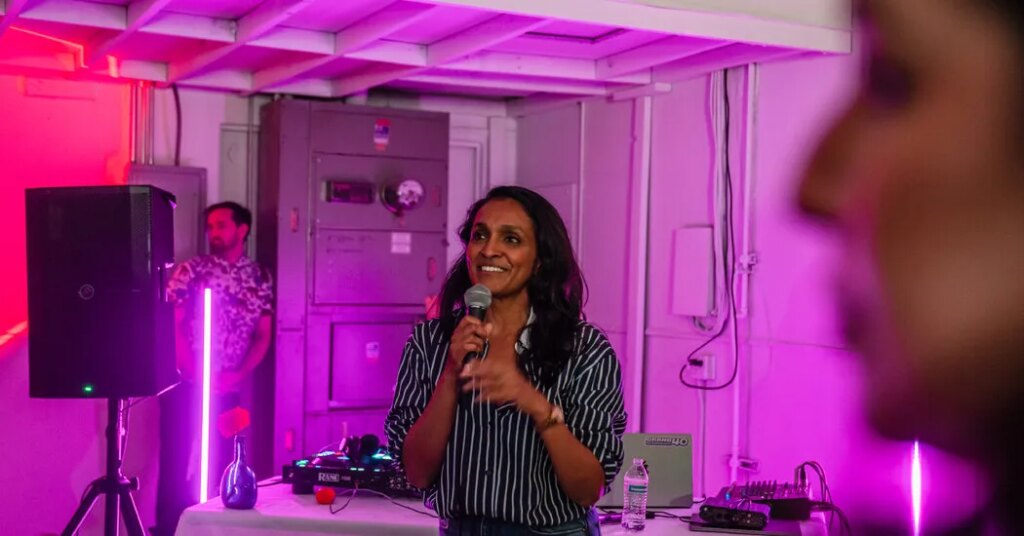
Saturday nights usually aren’t prime time for campaigning in Los Angeles elections. Still, there was Nithya Raman, stumping for mayor at a party at a Hollywood art gallery at 9 p.m. on a recent weekend.
Pink lights glowed. Pop tracks bumped. Gen Z influencers posed in a floral garland for Instagram and TikTok. If anyone in the house was a homeowner over 50, they didn’t look it.
“What is happening in Los Angeles is a generational election,” Ms. Raman, 45, said. In the audience, Sable Minx, a 28-year-old social media creator, applauded.
“I work, I would say, three jobs,” she said, “and I still can’t afford to, you know, live on my own, have my own space.” New leadership? That “resonated,” she said.
Though not with everyone.
The next morning Alton Reed, 80, headed out with his wife and a fistful of fliers to walk precincts for Mayor Karen Bass, the 73-year-old incumbent. “That’s the attitude of all young people, isn’t it,” he said, as he walked with a crowd of supporters. “‘Time for a change.’ Whether it’s warranted or not.”
That tension has underpinned the choice facing Los Angeles voters as they decide whether to keep their mayor or elect a new one. From policy proposals to celebrity endorsements, the most consistent subtext has been the age-based divide that has emerged in the nationally watched campaign.
Polls have consistently shown voters under 40 flocking to Ms. Raman, who has been backed by the democratic socialist movement that helped elect New York’s 35-year-old mayor, Zohran Mamdani. Voters over 65 have mostly stood by Ms. Bass, a former state lawmaker and member of Congress and a veteran Democrat.
The split echoes broader trends: Over the past two years, according to a New York Times/Siena University poll, young voters have swung dramatically to the view that the country is on the wrong track, a determination that, in this election at least, has yanked them leftward.
It has also prompted more young people to run for office. Future Caucus, a nonpartisan nonprofit that works with younger elected officials, reported this month that more than a third of this year’s congressional candidates were millennials or Gen Z, a new high for candidates under 45.
In Los Angeles, the margins have been stark, particularly among younger voters. In a survey conducted earlier this month for The Los Angeles Times by the Institute of Governmental Studies at the University of California, Berkeley, 69 percent of likely voters under 30 favored Ms. Raman, as did 74 percent of voters aged 30 to 39.
“Even more than with Mamdani, this is a campaign about generations,” said Dan Schnur, a former Republican political consultant who now teaches political communications at several universities in California.
On one side, he said, are longtime residents who respect the mayor’s deep experience and consider complaints about the current state of Los Angeles in the context of the chaotic city they once knew — a smog-clouded sprawl of racism, rioting, gang crime and police abuses that changed, in large measure, because of people like Ms. Bass. She’s an adult, they say, and this is no time to elect an untested leader, with two more years of the Trump administration and with the Summer Olympics coming in less than two years.
On the other side are waves of new voters who say they have been failed by the leadership of Ms. Bass and her generation. Many newcomers say the gritty city they’ve found doesn’t live up to its billing, and natives wonder what happened to the Southern California where single-family homes and single-occupancy cars were an affordable birthright.
“Think about what that generation has experienced — 9/11, the Great Recession, the #MeToo movement, Covid,” Mr. Schnur said of young voters. “It’s no wonder they’re searching for dramatic change.”
The schism is directly tied to affordability challenges like home prices and other markers of adulthood, which have increasingly moved out of reach for residents under 40. Young residents shoulder an average rent that, at $2,662, is more than 33 percent higher than the national average, according to Zillow. The average homeowner, according an analysis of census data released last year, is older in Los Angeles than in any other big city in the nation — almost 55.
That calculus already has shifted the city’s conventional political wisdom. Since the early 1970s, when white, Black, Latino and Jewish liberals joined forces to elect the city’s first Black mayor, Tom Bradley, elections in the sprawling city have swung chiefly on the ability to assemble a coalition from socioeconomic and ethnic factions. This year, analysts say, there’s a new cohort.
“This is the first campaign I can recall where age was as significant a factor as racial demography,” said Jim Newton, a former head of the editorial page of The Los Angeles Times and lecturer on public policy at the University of California, Los Angeles.
Michael Rodriguez-Chen, 33, and his wife, Paula Rodriguez-Chen, 32, for example, say they will vote for Ms. Raman. Watching their 3-year-old son dart around a playground in the city’s Eagle Rock neighborhood, they ticked off an assortment of municipal complaints: deteriorating streets, sidewalks turned into mountain ranges by overgrown tree roots.
But what really stood out, Mr. Rodriguez-Chen said, was Ms. Raman’s promise to make housing more affordable by encouraging more apartment construction and establishing tenant protections.
The Rodriguez-Chens work from their two-bedroom, two-bathroom apartment not far from the playground. It’s a little cramped, but at $3,300 per month, it was a good deal. Similar places in their price range would have required them to choose: “Like, do we keep our couch or our table?” recalled Ms. Rodriguez-Chen wryly.
But how long will they stay there? The couple said they didn’t feel they had much choice.
“I don’t know if we’re able to currently move forward,” Mr. Rodriguez-Chen said.
That experience is a far cry from that of Inja Lee, 84, a retiree in the city’s Koreatown district who showed up with scores of Korean American seniors at a recent meet-and-greet with the mayor. Ms. Lee said she appreciated Ms. Bass’s efforts to address homelessness and public safety concerns.
Her experience in Los Angeles dates to the tumultuous 1990s, a decade convulsed by the Los Angeles riots, the Northridge earthquakes and the trial of O.J. Simpson. The proprietor of a greeting card store in nearby Burbank for several decades, she now lives in a Koreatown senior housing complex.
The mayor seemed to understand Los Angeles, she said. “She moved the homeless people to a good place,” Ms. Lee said. “She’s a nice lady. And we know her.”
That split screen extends in ways large and small across the two campaigns. Gen X and millennial stars like Natalie Portman and Poppy Liu dominate Ms. Raman’s list of celebrity supporters. Ms. Bass’s roster reads like a who’s who of silver Angelenos: Jane Fonda, Magic Johnson, Samuel L. Jackson.
Ms. Raman has support from the Los Angeles chapter of the Democratic Socialists of America and most of the transit enthusiasts and lobbies. Ms. Bass has the business establishment, most of the major City Hall unions, the police and every member of the City Council except for Ms. Raman.
Ms. Raman’s campaign has been heavily online, with social media posts featuring influencers and spoofs of microdramas. Ms. Bass’s supporters have papered the city with old-school handouts and door hangers. (The mayor, Mr. Schnur observed with a chuckle, “is running an almost perfect 20th-century campaign.”)
“I’m saddened by it,” Ms. Bass said of the generational divide, pointing to her years as a student activist, her work as a young physician assistant organizing against the 1980s crack epidemic and her mentorship of young Black and Latino leaders at the nonprofit she founded, Community Coalition. If re-elected, she said, her administration will give young people a bigger role.
“But I also understand it, because I was one of those young leaders once,” she said in an interview. “And I was very disgruntled and very dissatisfied and very angry at the status quo.”
The raw numbers would seem to favor Team Raman: almost 57 percent of the city’s electorate is under 50. But turnout is notoriously unpredictable among younger voters. As of Saturday, only 8 percent of Los Angeles voters under 35 had returned their ballots, compared with 31 percent of voters over 65, according to the California-based research firm Political Data Intelligence.
“Now, young people, historically, have not voted in municipal elections,” Ms. Raman called out to her supporters. “Are we going to make our voices heard this time?”
The post In L.A., a Stark Generational Divide May Determine the Mayor’s Race appeared first on New York Times.