Since the Covid-19 pandemic, school board elections around the country, once sleepy affairs, have been convulsed by America’s political and cultural divides. The teaching of racial justice. Gaza and Israel. Transgender rights.
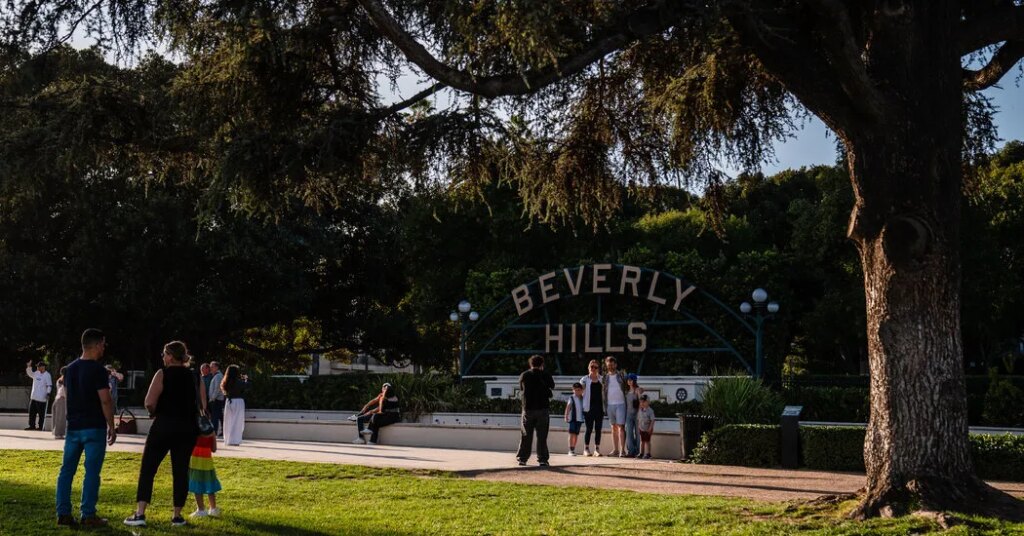
But very few of these battles have had the same mix of wealth, privilege and celebrity as the one that is going on in Beverly Hills, Calif. And this year, the campaign for two seats on the school board has devolved into an all-out political brawl.
“The ugliness of national politics has come to Beverly Hills,” said Gay Abrams, 70, an activist who has lived in the city for decades and recently organized “No Kings” rallies.
Moles have infiltrated group chats. The police have responded to dozens of calls about stolen campaign signs. One of the candidates has a restraining order against an opponent over allegations of doxxing. And in this heavily Jewish community, feelings about Israel and the definition of antisemitism have been at the forefront.
Beverly Hills, while it has always had plenty of Republicans, for decades voted for Democrats for president, save for Ronald Reagan. That changed in 2024, when the city, which has a population of about 30,000, voted for Donald Trump and became a small red dot on the vast blue map of Los Angeles County.
That same year, two new school board members were elected in Beverly Hills, securing a narrow 3-2 conservative majority.
And then controversies began piling up, starting with a pro-Trump rally at Beverly Hills High School after the 2024 election. Minority students said they were bullied, with pro-Trump students yelling, “Deport all Mexicans,” according to a lawsuit filed by a teacher who said she had been fired for a social media post criticizing the rally.
Over time, tensions boiled over arcane issues like when to allow public comment at board meetings and how the bylaws say the board’s vice president should be elected. Then came the political disputes: whether to display the Israeli flag at schools; the inclusion of Charlie Kirk next to notable Americans such as Martin Luther King Jr. at an elementary school exhibit; and the removal of a Maya Angelou book from the same exhibit.
The school board race is nonpartisan, but the rift involves familiar divisions. The conservative board majority has been supportive of Israel and resistant to recognizing ethnic history. Liberals have pushed for celebrating more diversity and said that criticism of Israel does not equate to antisemitism.
On the conservative side of the school board race is Judy Manouchehri, 46, a lawyer and the incumbent president, as well as an ally, David Cienfuegos, 53, a personal injury attorney who grew up in Mexico and California. On the liberal side are two political newcomers: Jackie Kruger, a 47-year-old lawyer and mother; and Kim Lifschitz, 39, a stay-at-home mother.
The four candidates, along with a fifth entrant who has less traction, are competing for two at-large seats that all voters in the school district will choose.
Ms. Manouchehri, who grew up in Beverly Hills after her family fled Iran following the revolution in 1979, considers herself nonpartisan and said she would prefer to focus on the district’s improvements in test scores. (While some data shows gains in test scores, her opponents have pointed to a decline in Beverly Hills High School’s ranking in the U.S. News & World Report.)
She said she was frustrated by the divisiveness within the Beverly Hills Unified School District.
“It’s something that hurts and is disappointing, and I wake up every day and one of my goals is to try to counter the negativity with facts, data and reasons for the Beverly Hills community to be proud of B.H.U.S.D.,” she said in a recent interview.
She said dust-ups over culture war issues are rare, and exaggerated on social media. Still, she apologized for two episodes that have fueled divisions in the city.
In one, she voted against a resolution establishing cultural heritage months, including Black History Month, asking why the city didn’t celebrate a European heritage month. “Looking back, I don’t think I realized the gravity it held for the community,” she said. (The resolution passed on a 3-to-2 vote.)
“I do regret the hurt that my vote on that resolution caused,” she added.
In another, she said it was a mistake for a school club to host the Israeli American influencer Ben Azoulay, who once served jail time after pleading guilty to a sex crime with a minor. She said Mr. Azoulay slipped through the district’s vetting process.
The controversy over Mr. Azoulay was one of the reasons Ms. Kruger decided to run for school board. The incumbents, she said, are “creating chaos and sowing division and demonstrating that they are only here to serve a very small minority.”
Ms. Kruger fled the Soviet Union in 1980, and she said her parents had sacrificed so she could attend Beverly Hills schools.
On a recent evening, residents supporting her and Ms. Lifschitz packed into her modest white cottage on a tree-lined street of multimillion-dollar homes that pass for a middle-class enclave in Beverly Hills and feel far away from the wide lawns and estates on the other side of town.
Over sandwiches and plates of kebab, parents worked the phones, dialing voters.
Ms. Kruger had spent much of the day in court, for a hearing about continuing the restraining order she had secured against Mr. Cienfuegos, whom she has accused of videotaping her home, posting her address on social media and accusing her son of stealing campaign signs.
“This is our opportunity, overnight, to come back to normalcy,” she said of the board election.
Ms. Lifschitz, 39, said she had decided to run to counter what she saw as an extreme, rightward shift of the district.
“It’s really scary to me to see this, honestly, this MAGA infiltration down to this local level,” she said.
During the campaign, Ms. Lifschitz became engulfed in controversy when, in group chats, she appeared to mock both a picture of one school board member at the Western Wall in Jerusalem and the way another board member introduced Holocaust survivors at an event in a “sing-song-y voice like they were pets in a zoo.” Screenshots were leaked online, and Ms. Lifschitz, who is Jewish, was accused of being an antisemite. (“It was just adults venting,” she said.)
Talk to residents long enough about the political upheaval in their city, and they will point to a deeper clash that goes back decades, when Persians, many of them Jews, fled the Iranian Revolution and settled in Beverly Hills. Persian Jews tend to be more conservative — many support the war on Iran, for example — than the old guard of Beverly Hills, who are predominantly Ashkenazi Jews of European descent.
Many liberal Jews in Beverly Hills believe the school board has focused too much on Israel and point to an effort to have schools display the Israeli flag. (After an uproar, the superintendent backed down, citing safety concerns.)
“I’m Jewish and I was raised in this district and I don’t really want my board focusing on a foreign country and an issue that has nothing to do with my classroom,” said Amy Arebalo, who taught in the district for decades and retired last year. “But this has become the board’s priority.”
On a recent afternoon, Russell Stuart, a conservative incumbent not facing re-election, was at his desk at Beverly Hills Guns, an appointment-only gun dealer located on the fifth floor of an office building on Wilshire Boulevard. Mr. Stuart runs a website, the Beverly Hills Standard, that produces articles generated by artificial intelligence that have attacked his opponents.
He framed the split in Beverly Hills as one largely within the Jewish community. The entire five-member school board, including Mr. Stuart, is Jewish.
“I think that in the city of Beverly Hills there’s definitely a divide between the white Jews and the Persian Jews,” said Mr. Stuart.
“It’s absolutely undeniable how well the Persians have done, in this country and this state and this city,” he added. “And I think that there is a resentment, truly a resentment of how well they’ve done.”
Asked about this divide, Ms. Manouchehri said, “It’s starting to feel that way.”
Across the political divide of Beverly Hills, there is a sense of loss — of the civility and decorum people say once defined public life in the city.
“Everyone is just, it’s sad and tiresome,” said David Lucky, 48, a television producer who has a daughter in third grade.
“I don’t know why,” he continued. “I don’t think anyone knows why. And I don’t know what happens after.”
The post Culture War Tensions Roil Beverly Hills School Board Race appeared first on New York Times.