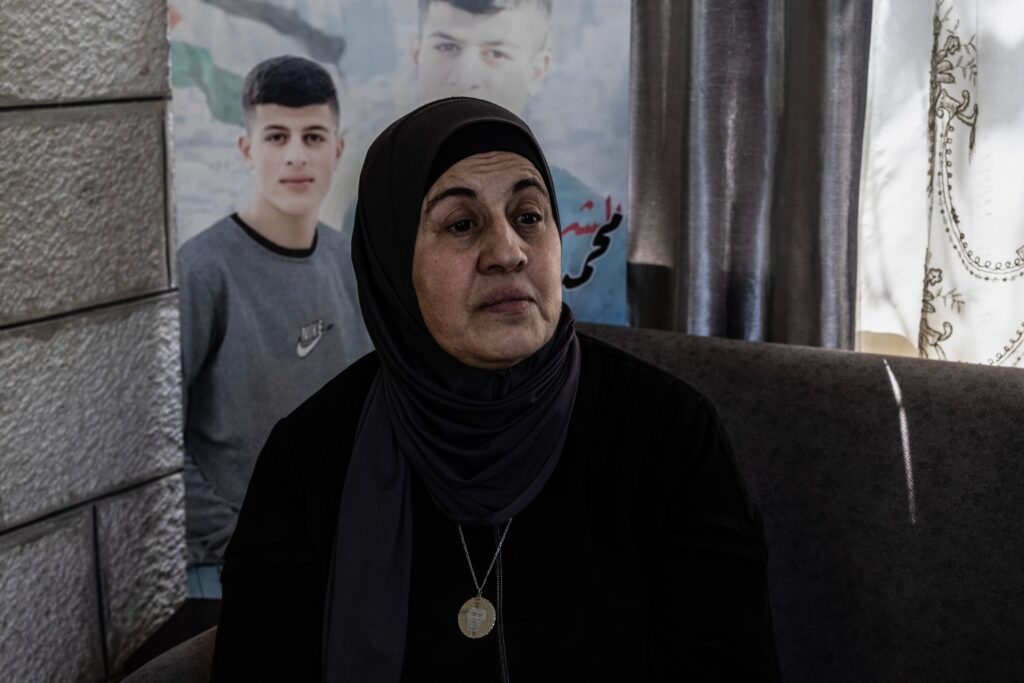
DEIR JARIR, West Bank — Munawar Alawi used to find peace sitting in the sunlight of her front room, drinking coffee, watching olive trees rustle beyond embroidered curtains.
But the pleasure is gone. Whenever Alawi, 55, looks out, she wonders if her son’s killer is looking back at her.
Atop a neighboring hill sits an Israeli settler outpost, home to the person she says shot her 19-year-old son, Mohammad Alawi. It’s close enough that you can see someone wave.
“After the killing of my son, yes, I am sitting here. I keep sitting here,” Munawar said. “I don’t count the hours, but I’m sitting here, especially after the death of my son.”
Mohammad’s death in September 2025 was the first in a run of six killings in her central West Bank town of Deir Jarir in confrontations between settlers and Palestinian residents, which drew in the Israel Defense Forces.
Palestinian residents say settlers from the outpost instigated the events that led to them. In interviews earlier this year, eight people, including victims’ relatives and the town’s mayor at the time, pointed to one man in particular, known by locals as “Nadav.”
They recognized him from a video in which he drives an ATV into a Palestinian man praying on the road outside town, just below the outpost. The IDF said at the time, December of last year, that the settler in the video, a military reservist whose reserve service would be terminated, had opened fire in Deir Jarir that same day. He was detained and released without charges.
“His face is known,” said Fathi Hamdan, the then-head of the Deir Jarir village council.
Last month, Israeli authorities detained Nadav Cohen Tzemach, a settler, and nine others in connection with a weekend of settler violence that included an attack on European diplomats and the severe beating of Washington Post photojournalist Heidi Levine.
Tzemach, implicated in the assault of diplomats and held longer than the other nine, was transferred Monday to serve a week of house arrest, according to his lawyer, Asaf Gonen. As of last month, Tzemach was under investigation but had not been charged with a crime.
Although settler violence and land seizures have been building for years in the West Bank, abetted by Israeli Prime Minister Benjamin Netanyahu’s right-wing government, the recent attacks — in the run-up to Israel’s contentious national election last Tuesday and amid the annual Palestinian olive harvest — prompted rare arrests and international outcry. The direction of West Bank policy is bound up in the election outcome, which remains uncertain.
For many Jewish Israelis, the West Bank is a piece of the Jewish people’s historic homeland. But for the West Bank’s more than 3 million Palestinian residents, and much of the rest of the world, it is seen as a home to Palestinians and part of an aspired Palestinian state.
There was relative stability in Deir Jarir, a town of some 6,000 northeast of Ramallah, residents say, before extremist neighbors moved in and began descending weekly to terrorize the community below, with near-total impunity.
Palestinian locals say the violence has altered the rhythm of daily life. When settlers approach, shops close and streets empty. A settler moves through town grazing his animals, enforcing a curfew, “without there being an official curfew,” said a resident, who like some others in town spoke on the condition of anonymity for fear of reprisal. “The town goes on mute.”
Palestinian mothers gather in a chat on WhatsApp to mourn and warn, sending instant updates when settlers come near. Some days the chat is subdued, other days it simmers with anger and fear.
Munawar now drinks her coffee surrounded by pictures of her son: on a near-life-size poster board, on a gold lighter, on a gold plaque from the Deir Jarir Women’s Association, on a chain around her neck, on a printed photograph haphazardly taped to her front door.
“It’s a moving circle and we don’t know who will be next,” she said, pressing her hand to her heart. “Only God knows.”
An outpost, a new road and growing tension
Residents say the troubles escalated after settlers with bulldozers built a road linking the hilltop outpost to the town. The outpost is illegal under Israeli law, unlike settlements, which are illegal under international law but approved by the Israeli government. Under Netanyahu, tolerance of outposts has grown.
Since the road’s completion in September 2025, violence has tied the town together with a dark thread. The outpost had begun as a single tent the year before and has grown into a sprawl of structures, built adjacent to an IDF military installation. Settlers descend, including on ATVs and with herds of sheep that graze on Palestinian land, and intimidate residents in incidents routinely filmed.
Tension quickly “became heavy,” Munawar said.
Munawar remembers a physical feeling — “something in my heart” — as she sat in her sunroom on Sept. 12, 2025.
That unease prompted her to call her son Mohammad, who was sharing a pizza dinner with friends. He told her he would be home soon.
She waited by the window. Then she heard gunshots.
The WhatsApp group came to life.
Mohammad was bleeding to death some 500 yards from his front door when the IDF arrived and moved his body, his mother says. She alleges a settler shot him, then soldiers shot him again before an ambulance arrived.
The IDF said it identified suspects placing “rocks on roads” while carrying a “device resembling an explosive device,” and that “soldiers responded to the suspects’ actions.” Asked whether such a device was found, the IDF said, “This is all we can respond.”
The next day, anxious texts flooded in.
Mohammad loved horses. In life, he was satisfied with what he had, said his aunt, Masa’ada Alawi. He had just started a job installing marble tiles in homes.
“He was a young man who wanted to live,” his mother said.
Mohammad died in a Ramallah hospital, five days short of his 20th birthday.
“What did he do? What was his guilt? He wanted to eat pizza,” his mother said. “He ate pizza and he never came home.”
The next month, Jihad Ajaj, 26, was shot by settlers at the town’s entrance, the Palestinian Health Ministry said.
The month after, Baraa Maali was killed by the military during clashes between settlers and Palestinians, the military said.
On April 11, Ali Hamadneh, 23, became the fourth young man killed.
Two more men, Ahmad Abu Mokho, 26, and Odeh Farakhneh, 53, were killed in a July raid involving settlers and soldiers, in which the IDF said two security personnel were injured and soldiers “responded with fire.”
In four of the six killings, the military accused Palestinians of “hurling rocks” at Israeli citizens and soldiers.
In the case of Ajaj, the IDF said a sniper fired after soldiers identified suspects putting down a “suspicious object.”
With Hamadneh, the military said a reserve soldier fired in the air, then toward a Palestinian after “violent disturbances.” Israeli rights group B’Tselem published video it says showed a man shooting from a hill at Palestinians who were running away.
Palestinians have killed at least two Israeli settlers and four Israeli soldiers this year, according to the U.N. After Palestinian gunmen killed two Israeli soldiers on Oct. 23, Netanyahu vowed to carry out a sweeping military operation in the West Bank.
Threads connect the Palestinian men killed: Some visited the homes of each other’s grieving mothers, without knowing who would be next. Hamadneh gave a speech at Maali’s funeral. Months later, a woman repeated Hamadneh’s own words as she prayed over his casket.
After Tzemach’s arrest, Munawar said she feared he would soon be released. Settlers from the outpost continued to hang around between the trees outside her house, she said.
“But if Nadav disappeared, there would be other Nadav,” she said.
The faces of the Israeli settlers haunt West Bank residents.
Residents can pull up photos of them, videos of them attacking.
It’s not just the Palestinians who know who the violent settlers are, said Tahani Mustafa, a lecturer at King’s College London. “The Israeli security establishment knows who they are,” she said. “You’re talking about one of the most sophisticated militaries in the world.”
Between 2005 and 2025, Israeli police opened more than 1,600 investigations files into ideological offenses against Palestinians, according to Yesh Din, an Israeli rights group monitoring settler attacks. More than 93 percent were closed without indictments.
This year, the United Nations has documented more than 2,060 settler attacks resulting in Palestinian casualties or property damage, about seven per day.
Netanyahu has downplayed the violence, blaming attacks on “a handful of kids” from “broken homes” engaging in “vigilantism.” His government has simultaneously accelerated the establishment of settlements, including by legalizing some outposts.
The IDF said due to its “presence” around Deir Jarir, soldiers “may encounter violations” by Israeli civilians, including violence against Palestinians. Soldiers are “required to intervene” and, “when necessary, detain or arrest the suspects until the police arrive.” The Israeli police did not respond to request for comment.
During a visit by Post journalists to the outpost in July, an armed man approached and said his family had just visited from the United States. He said the hilltop afforded a view of the whole area.
Settlers associated with the outpost could not otherwise be reached. Asked about the outpost, the Yesha Council, an umbrella organization representing settlements in the West Bank, pointed to social media posts alleging attacks and stone-throwing by Palestinians. “There is no violence in Deir Jarir,” said Yesha Council spokesperson Dorit Ostrovsky-Schechter.
Asked about the violence in Deir Jarir, Asaf Gonen, the lawyer representing Tzemach, said Sunday: “I have no idea. [Tzemach] denies any connection to all of it.”
Tzemach did not respond to messages to his social media accounts, on which he espouses radical settler views, including vlogs of his construction work to “stop the Arab siege.”
On social media, Tzemach takes credit for helping establish two settler outpost farms, Hesed La Avraham in Deir Jarir, and Oranim Farm, near neighboring Taybeh.
Israeli settlers have shot and killed at least 17 Palestinians in the West Bank this year, according to the U.N. humanitarian affairs office, which added that eight more killings have “disputed” perpetrators, typically Israeli forces or settlers. Israeli forces have killed more than 1,000 Palestinians in the West Bank since the Oct. 7, 2023, attacks, according to the U.N.
The IDF said it thoroughly examines incidents when “soldiers fail to act in accordance with orders” and takes disciplinary measures “as necessary.”
A Deir Jarir resident, standing with a group of men at a gas station, repeated the widespread view that there was little hope of recourse or accountability. “We as a people, the young men of the town, we do it ourselves,” one man said.
They carry the bodies of the injured or killed and “manage things ourselves because we know no one is here to support us or to hear us.”
A killing nearby
As Munawar recounted her son’s killing to Post journalists, the peace in her home was again interrupted.
As she scrolled through months-old messages from women grieving her son, her phone buzzed with live news of another killing one neighborhood over.
Al-Mughayyir, a town of 3,000 increasingly encircled by Israeli settlements, is about seven miles from Deir Jarir — the trip can take over an hour due to military checkpoints.
When Post journalists arrived there, the IDF was already in position.
Al-Mughayyir is one of the West Bank’s flash points, the site of fatal flare-ups between settlers and Palestinians and lethal military raids. This year, at least five students of the 470-student al-Mughayyir Boys’ School have been killed by settlers or Israeli forces.
On this overcast April day, outside the gates of the school, a dark slick of blood trailed from the site where, hours earlier, the limp body of a 14-year-old had been carried away. Someone placed a circle of rocks and red poppies atop the still-fresh stain.
A group of Palestinian teenagers approached newly arrived journalists, speaking fast and pointing toward a nearby hill, where they said a settler had fired toward the school. Video sent by the boys showed their friend collapsing as shots rang out. Other young men waved their hands in panic before carrying away the body.
The victims were identified as Jihad Abu Naiem, 35, and Aws Hamdi Naasan, 14.
The IDF said soldiers were dispatched after “rocks had been hurled at an Israeli vehicle” carrying civilians. A reserve soldier exited the vehicle “and opened fire toward the suspects,” the military said, adding that it is “aware of the claim that two Palestinians were killed.”
While Post journalists were at the site, three Israeli military jeeps surrounded their SUV. At least six soldiers and border police emerged, guns pointed, and advanced toward the journalists. “Put your hands on the car! Don’t move!” they yelled in Hebrew, before eventually lowering their weapons.
A familiar routine
Hours after the killing in al-Mughayyir, provisional funerals were held. The women of another WhatsApp group gathered on sofas that hugged the wall of the Naasan family home. They sat in a ring and prayed, rocked back and forth, cried, sang, tried to make sense of what had just happened.
Young Aws’s father had been killed in 2019 by settlers.
Aws’s mother, Nedaa Awad, had been working to bring her children to the U.S., saying the West Bank “is not safe” anymore. Aws had been scheduled for an embassy appointment for interviews and biometrics. He was so close, she said.
She learned he had been killed via WhatsApp message.
Aws’s younger sister Touline, 9, perched on the arm of a sofa where four weeping elderly women sat pressed together. She was walking home from school when she saw video of the attack circulating on the town’s WhatsApp feed.
“It was a boy who was shot in the head, the head is full of blood,” she said. “I knew it was Aws from his sports shoe. I told my grandma, ‘It’s Aws, it’s his shoes.’”
Mothers from nearby towns, including Deir Jarir, whose sons had been killed came to visit Aws’s mother during the three-day mourning period. They “all have the same pain,” she said.
Whenever another man in Deir Jarir is killed, a portrait of his face, marked with the date of his death, is stenciled on surfaces around town: bridges, stone walls and store fronts. They stare at you as you drive past.
“Most of the men killed are my age and my friends,” said one of the men at the local gas station, standing beside a yellow gas tank stenciled with three faces.
He said he has “adjusted” to the settlers. “It became part of our lives, in a very hard way.”
“They come, they shoot, kill, and they leave as if they did nothing.”
The post A mother lives in fear of her son’s killer as settler violence stalks a West Bank town appeared first on Washington Post.