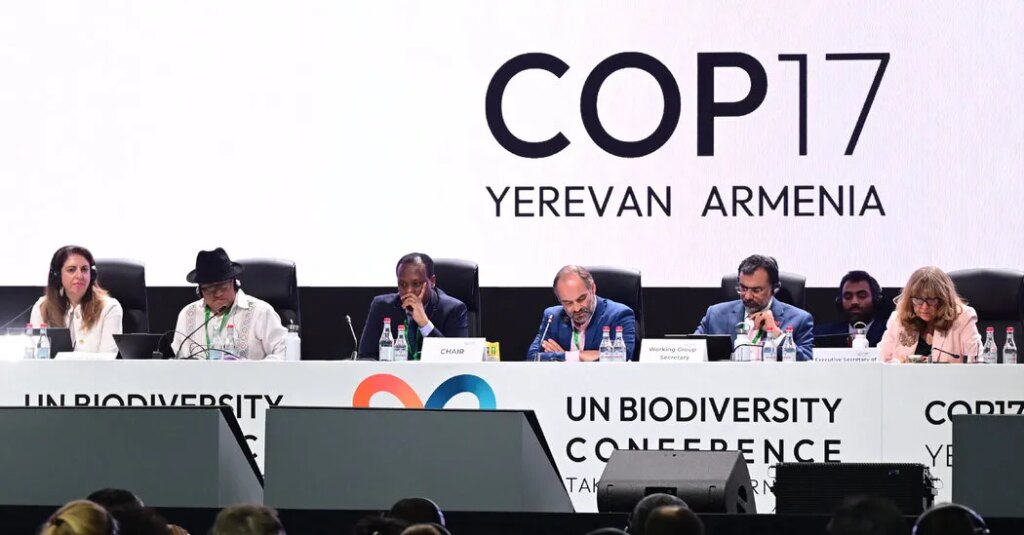
Two weeks of global negotiations to protect the world’s wildlife and ecosystems ended on Saturday in Yerevan, Armenia, with nations reaffirming their pledges to protect nature but still off track to meet an ambitious set of targets by a 2030 deadline.
Biodiversity, the variety of life on the planet, is declining at levels unprecedented in human history, scientists say.
In 2022, in a landmark agreement made under the United Nations biodiversity treaty, nations pledged to reverse those losses by taking action on 23 targets, including protecting 30 percent of the earth’s land and water and reforming industries that drive declines in wildlife.
This year’s meeting marked the halfway point for countries to meet their deadline for those pledges. The United States is the only country, with the exception of the Vatican, that is not party to the treaty, though it attends the meeting and participates from the sidelines.
Just before the talks began, the United Nations issued a review of progress that found that countries were lagging far behind. A major theme was how to get on track with a “Yerevan Pathway” that would help unlock progress.
In the end, delegates reaffirmed their commitments and set priorities, creating pressure for domestic action, but tense questions over how to pay for nature protection, especially in countries that are poor financially but rich in biodiversity, remained unresolved.
Countries pledged almost $2 billion in new financing, conference officials said.
“Within the inevitable limits of the U.N. system, I think that we’ve made some significant progress,” said Steven Guilbeault, a former environment minister of Canada who helped shepherd through the 2022 global biodiversity agreement. He was heartened to see more finance ministers in Yerevan, he said, because action on biodiversity requires their involvement.
A major highlight, he and others said, was a focus on tackling one of the thorniest issues: about $2.4 trillion in public money that flows toward environmentally damaging activities, according to the United Nations.
“Armenia deserves credit for touching the ‘third rail’ of biodiversity negotiations: the agricultural, fisheries and other subsidies that prop up a system leaving biodiversity in global decline,” said Alfred DeGemmis, the director of international policy at the nonprofit Wildlife Conservation Society.
Those harmful subsidies are seen as critical to plugging the yawning gap in funding needed for conservation, estimated at about $1.3 trillion a year by the Paulson Institute, a research organization, and others. Going into the talks, of all the pledges nations made in 2022, subsidy reform has proved one of the most difficult for countries to address.
During the talks in Yerevan, three initiatives were started to help countries make progress on reforming subsidies. One is a coalition led by Colombia and Finland that aims to bring ministerial teams together to share knowledge, experience and strategies.
“We don’t need to spend more to close the biodiversity funding gap, we need to spend better,” Marina Von Weissenberg, a Finnish senior ministerial adviser and co-chair of that effort, said in a news release. “Governments have a real opportunity here to reshape public spending with future generations in mind, but they can’t do it alone. International coordination is key to giving governments the confidence to lead change.”
Another topic of negotiations was one of the major accomplishments from the last global biodiversity talks, in Cali, Colombia, in 2024: a fund through which the pharmaceutical and other industries that rely on biodiversity would contribute to conservation efforts. Since its beginning in 2025, the effort has struggled, raising only about $10,000. Delegates in Yerevan reaffirmed the suggested rate of contribution for large companies: 1 percent of profit. But contributing to the fund is voluntary, and it remains to be seen what will happen.
Throughout the talks, some activists expressed bitter disappointment, raising concerns that the 2022 global agreement would go the way of its predecessor, which failed to fully meet a single global target.
The next such gathering will be held in 2028 in Ecuador.
The post Global Talks on Nature End With Persistent Gaps on Action and Funding appeared first on New York Times.