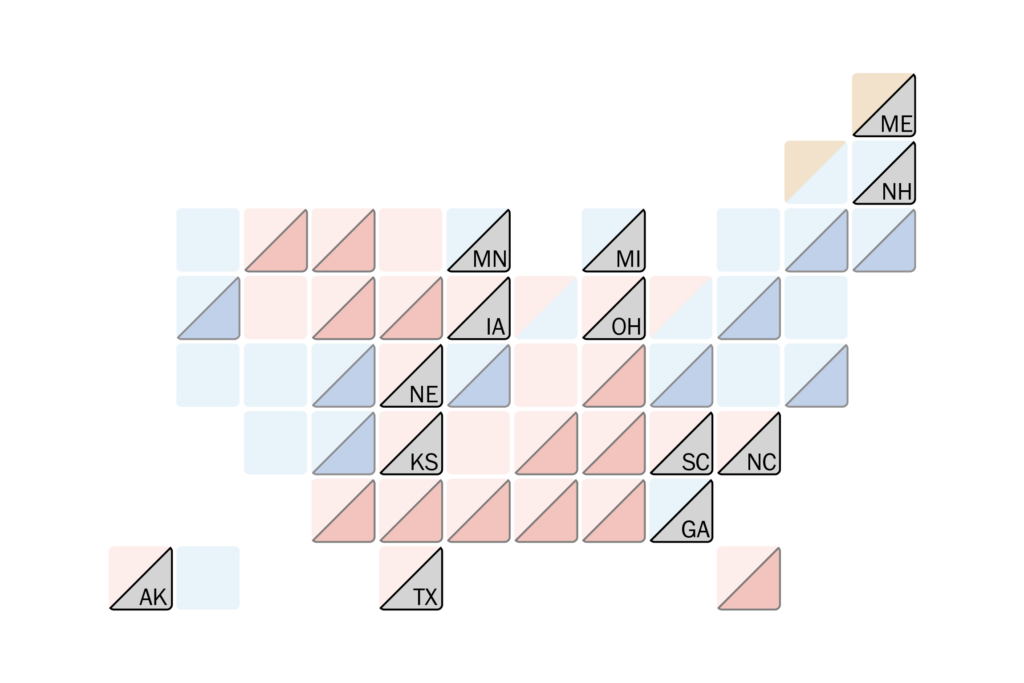
With three days to go until Election Day, Democrats look all but certain to retake the House and, despite their structural disadvantages, seem poised to win the Senate.
But the picture could still change, especially in the Senate. Recent elections haven’t always played out the way pollsters and political analysts thought they would. Republicans outperformed expectations in several recent presidential elections, while Democrats were underestimated in key Senate races in the last midterm cycle, and in Virginia and New Jersey governor’s races last year.
Democrats have a particularly thin margin of error in key Senate races. Their leads in Alaska, Maine and Iowa are within two percentage points. A shift or polling error toward Republicans similar to the ones we saw in the 2016, 2020 and 2024 presidential elections could cost them the majority. Recent midterms offer some reassurance for Democrats: In 2018, the polls overstated Democratic support by just 1.4 points, and in 2022, they actually underestimated it.
This year also has some features that make the polls harder to read. For example, there have been fewer late-cycle polls than usual. Only 66 Senate polls conducted in October had been released as of Oct. 16, compared to an average of 123 at the same point in the last four midterms, according to an analysis by Mary Radcliffe and Cooper Burton of FiftyPlusOne.
The polls we are getting are also unusually similar. In 13 of the 27 races we looked at, including the Senate races in Maine and Texas, there’s less variation among polls than we would normally expect. One possible reason is that pollsters are correcting their samples in similar ways. As it has gotten harder to reach voters who rarely participate in elections, many pollsters now ask people who they voted for in 2024 — then adjust the poll so its mix of Trump and Harris voters looks like the 2024 electorate. That can make polls look alike even if they reached different groups of people.
None of this tells us whether there will be a miss, or in which direction. But it does mean we have less information than usual and that the polls could be slow to pick up changes in the races.
Given the uncertainty, we looked at four ways the elections might unfold — and what would have to happen to produce each outcome.
Scenario 1: The polls are right
The simplest scenario is that the polls are basically right.
Democrats look like the favorite to win the Senate. Jon Ossoff is polling more than nine percentage points ahead of Mike Collins in Georgia, former senator Sherrod Brown leads incumbent Jon Husted by more than three points in Ohio, and even in Texas, Alaska and Kansas — states that have seemed perennially red on the national stage — Democratic candidates were in the lead as of Thursday. Taken at face value — and treating Iowa as a toss-up — the polls put Democrats at a Senate majority.
How does this happen: The president’s party usually loses seats in the midterms, and simply given President Donald Trump’s low approval, we’d expect Democrats to gain seats this year.
The polls also show significant shifts among some groups of voters that helped lift Republicans to victory in 2024. One of the biggest shifts seems to be occurring among Hispanic voters. While Kamala Harris won Hispanic voters by just three percentage points, according to Pew’s validated voter survey, Democrats are currently leading among Hispanics by around 23 points in an average of cross tabs — a 20-point swing.
That helps explain why Texas became competitive. But Democrats are also gaining in states with much smaller Hispanic populations, like Alaska. That’s because White voters have swung about eight percentage points toward Democrats since the 2024 presidential election. Independents now favor Democrats by about 15 percentage points.
Democrats’ gains are particularly concentrated in redder, more rural states. Compared with a swing of nearly 10 points nationally, the polls show Texas swinging 16.4 points toward Democrats since 2024. Alaska shifted 14.3 points, Ohio 14.3 and Iowa 13.5.
Pitfalls: Democrats’ majority rests on exactly the races where the swings are biggest, in rural states where pollsters have long found voters hard to reach. If those swings are overstated, the map looks very different.
Scenario 2: The polls underestimate Republicans
Even a relatively modest polling miss toward the GOP would let Republicans sweep several close Senate races. A one-point swing in Republicans’ favor would give them Iowa, leaving Democrats with 53 seats. A miss of just over two points would put Kansas, Maine and Alaska in the GOP column, leaving Republicans with a 50-50 Senate that they would control through the vice president’s tiebreaking vote. A four-point miss would give Republicans Minnesota, Texas, Ohio and Michigan.
How does this happen: The biggest question is whether polls are overstating GOP weakness in redder, more rural parts of the country. There are a few reasons that could occur. Rural Republicans are famously hard to reach. The Post encountered this problem in a new Kansas poll: Registered Democrats who answered a pollster’s call were more than twice as likely as registered Republicans to complete the survey. Even after extensive efforts to compensate, there were signs the problem persisted — the poll put the Democratic candidate nine points ahead, well beyond his advantage in other recent surveys. If some of the missing Republicans turn out to vote, the poll could be understating GOP support.
There’s also evidence of Trump voters misreporting their 2024 vote, which might be biasing the polls in Democrats’ favor. Conversely, those voters could be unhappy with the current administration and actually planning to stay home.
Republicans are betting heavily that they won’t. The party and its allies are spending a lot of money to motivate people who only vote occasionally to get to the polls this year. There is also a hint inside the polls themselves: In state polls that report results for both registered and likely voters, Republicans do around one point better among likely voters, with an even larger advantage in Texas.
White noncollege voters could also turn out at higher rates than likely voter models assume. Historically, Senate polls have overstated Democrats slightly more in rural states (about 0.6 points for every 10 points of rural share). Maine, the most rural state of the bunch, is the most exposed. Democrats will also be on edge because Maine’s polls have underestimated Republican Sen. Susan Collins before, by eight percentage points in 2014 and 13 in 2020.
The pattern isn’t limited to elections when Trump isn’t on the ballot. Senate polls have overstated Democrats in all four Iowa races since 2014, and in three of four in Texas and Ohio. And Republicans could beat expectations if undecided voters lean toward them. If undecideds break the way their state voted in 2024, Democrats lose between 1 and 1.6 percentage points in red states, which might be enough in some of the closer states.
Pitfalls: There is no hard evidence that a polling miss like this is in the works. If pollsters were systematically missing certain voters, we might expect different polling methods to yield different results. So far, they don’t: There’s no significant gap between phone and online polls in Iowa or Ohio.
Scenario 3: The blue wave turns into a blue tsunami
The polls could also be wrong in the other direction.
It wouldn’t take a miss that large to turn the map bluer. Iowa is essentially a toss-up, and a polling error of about two and a half percentage points would flip the South Carolina Senate race, while around three percentage points would do the same for the Texas governor race. A polling error the size of 2022 would give Democrats 55 seats, and Dan Osborn would win his race in Nebraska.
Further down the line, the possibilities become more dramatic. Next would be Florida, Mississippi and then Louisiana. In all three states, Republicans lead Democrats by between six and seven percentage points, according to Nate Silver’s Silver Bulletin, even though Donald Trump won them by 13, 23 and 22 points, respectively.
How does this happen: For an outcome like this, all the pieces would have to fall into place for Democrats. Hispanic voters would need to return to 2018 levels of support, when, according to the Democratic-leaning election data firm Catalist, Democrats won Hispanics by over 40 points. Young voters would need to turn out at high rates, and young men would need to break Democratic. White noncollege voters would also have to shift meaningfully toward Democrats for the first time since 2016, something that could happen if low-propensity Trump voters decide to stay home.
If this happens, special elections will have been the canary in the coal mine. Democrats have outrun the 2024 presidential margin by a median of 12 points across 136 contested specials since January 2025, according to data collected by Votebeat’s Nathaniel Rakich. That’s roughly a D+10 environment, compared with the D+8 Democrats have in generic-ballot polls.
Pitfalls: Special elections have been a worse predictor of election results in the past than polls. In 2024, Democrats also ran ahead of the polls in special elections, but the polls ended up being significantly closer to the final outcome.
Some pollstershave also argued that recalled-vote weighting might be inflating Republican numbers slightly, since some 2024 Trump voters won’t admit they voted for him and are now supporting Democrats. As a result, weighting to the 2024 result double-counts loyal Trump voters, giving the polls a Republican lean. But that’s not what we’re seeing: Generic-ballot polls that weight to the 2024 recalled vote are, if anything, slightly bluer.
Scenario 4: Democrats perform well, but the story is more complicated
There’s also a scenario where Democrats have a strong election overall but fall short in the Senate because polls overstate their gains with rural, working-class voters.
In one such case, they would hold Georgia, Michigan, New Hampshire and Minnesota, while picking up North Carolina, Ohio and Texas. But they’d fall short in Maine, Iowa and Alaska and, by a slim margin, lose Kansas, leaving Vice President Vance as the tiebreaking Senate vote.
How does this happen: Unlike scenario 2, this wouldn’t require a broad polling miss that favors Republicans. Instead, the polls would be off among non-college-educated White voters, especially those in more rural areas. Maine would be particularly vulnerable in this scenario because 61 percent of its population lives in rural areas. A miss of about four and a half points among rural voters, smaller than the historical pattern, would be enough.
A similar outcome could come from a slightly smaller miss among rural White voters, combined with a 10-point polling error among Hispanic voters, who are notoriously hard to poll. In that case, Republicans would win Iowa, Kansas, Maine, Alaska and Texas, leaving Democrats at 49.
Texas is especially exposed here. Hispanic voters made up nearly a quarter of the state’s electorate in 2024, and polls show Talarico winning them by about 21 points. If polls overstate his margin with Hispanic voters by 12 points, his lead disappears entirely.
Pitfalls: There’s no evidence that a polling miss like this is building, and even if there is a miss, there’s no way to know which party it would favor. The polls show Democrats improving particularly among White rural voters, some of whom have been hit especially hard by the Trump administration’s policies and may have specific reasons to punish it. And even the error among rural voters described above would only make Kansas a toss-up rather than a clear Republican flip.
Scott Clement contributed to this report.
The post 4 ways the polls could be wrong — or right — about who will win the Senate appeared first on Washington Post.