Gissel Figueroa was sitting in class at Harvard Medical School when she received an urgent text from a friend: One of Boston’s most sought-after therapists was on campus.
During a brief break, Figueroa raced to the library, where she found the medical health professional encircled by admirers. Peering into the cozy den where he holds office hours, she caught sight of his bright obsidian eyes, twitching pink nose and spray of whiskers — and exhaled.
“I’ve been waiting two months to meet him,” Figueroa said.
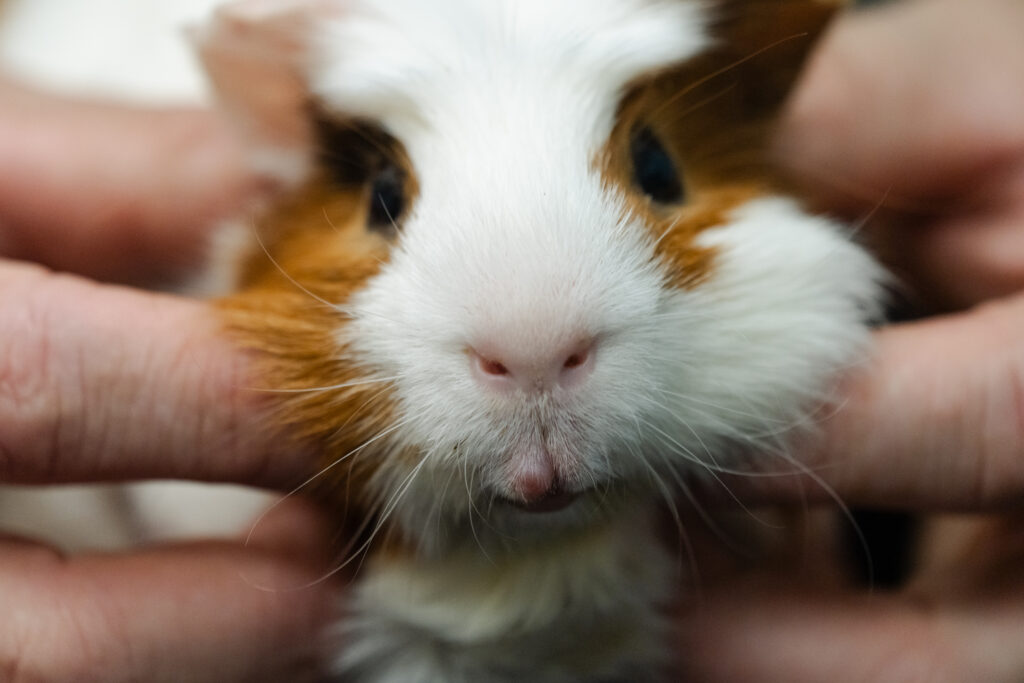
Hermie is not your typical therapist. For one, he’s a guinea pig. Nor is he your standard household pet. Since 2022, he has been a registered therapy guinea pig who regularly visits high-stress or mentally taxing places in the Boston area, such as universities, financial institutions and the Massachusetts State Court of Appeals.
His counseling style is more somatic than Jungian. He perches serenely in laps, projecting calm and cuteness. In his version of talk therapy, he squeaks and munches on crudités while the patient coos and cuddles his Russet potato-shaped body. He accepts head scratches and corn husks in lieu of health insurance.
“When I put Hermie in your lap, you forget what you were thinking about,” said Niki Vettel, Hermie’s caretaker. “That’s mindfulness. You are completely in the moment, not thinking about dinner or exams.”
In the kingdom of therapy animals, dogs reign because of their sociability, trainability and attunement to human emotions. However, the field has expanded from the margins to the mainstream, welcoming new species.
Three years ago, Portland International Airport in Oregon added llamas and alpacas to its animal-assisted therapy program. At Napa State Hospital, rabbits are members of a therapy team run by the California Department of State Hospitals. Also in California, Lockwood Animal Rescue Center pairs rescue parrots with war veterans, the unlikely partners overcoming personal trauma together.
Pet Partners, which created the country’s first standardized program for volunteers and health care professionals working with therapy animals, works with nine animal species. In addition to dogs, cats and horses, the nonprofit also prepares rabbits, domestic rats, birds, mini pigs, llamas/alpacas and guinea pigs for the job of healing helpers. Of the organization’s 7,000 handler-animal teams, 92 percent feature canines. There are 19 guinea pigs, including Hermie.
Since 2011, Vettel, a Boston-based clinical mental health counselor, has trained four therapy guinea pigs. She started with Ralphie, Pet Partners’ first registered guinea pig in Massachusetts.
“Sitting on laps is Hermie’s love language,” Vettel said.
Guinea pigs provide an alternative to more-traditional therapy animals. Folks who are scared of dogs or leery of cats may be quicker to connect with small creatures that, as a prey animals, “encourage people to be more quiet and gentle,” said Claire Berman, who works in marketing for Pet Partners. “People receiving visits from guinea pigs may be more motivated to be present and mindful than with other species of therapy animal.”
With their compact size, they are also built for laps. In fact, as part of Pet Partners’ evaluation process, the guinea pig must sit in three different laps and receive a full-body hug (or, if it’s too petite for a bear wrap, a modified squeeze). To pass, it must accept the embrace.
Deb Gibbs, the program director and coordinator for Tufts Paws for People, a chapter of Pet Partners, said people may also gravitate toward guinea pigs for nostalgic reasons — maybe they grew up with one — or out of curiosity.
“Guinea pigs are more of a novel attraction, and Hermie is very outgoing and social, so people can interact with him and learn about the species,” said Gibbs, who has evaluated Hermie to ensure he has the skills and aptitude for the job. “Maybe they thought hamsters and guinea pigs were equal. They’re not. Hamsters are a bit more shy and tend to bite — pretty frequently and very hard. They are not one of the allowable species.”
‘Hermie has healed us’
At the Harvard Longwood campus, students, faculty and visitors who drop by the library on certain designated days might discover Sophie the golden retriever, Archie the black Labrador or Bartholomew the bunny.
Hermie is typically scheduled for the Countway Library Cuddles Program on the second and fourth Wednesdays of the month. However, sometimes he will make surprise appearances, such as on a recent Thursday afternoon, less than a week before his seventh birthday. (This week, he was diagnosed with kidney stones, so retirement could be imminent.)
“Hellooo!” Vettel called out, searching for signs of Hermie in his sprawling habitat that occupies a corner of her waterside apartment about 10 miles from campus. “We’re going to Harvard to see everybody.”
An elongated snout with nostrils the color of bumble gum emerged from a wood hut. After a few false starts, he bolted up a ramp and leaped into his transport sack with the aplomb of a long-distance jumper.
Once the duo arrived at the library, Vettel quickly set up the designated therapy animal space with the help of Yasmina Kamal, the library’s outreach coordinator. While Kamal scattered Hermie pins and magnets around a sign welcoming people to meet the guest counselor, Vettel lassoed a mandatory leash over his head, apologizing under her breath. She then installed him in a plush hut with an opening wide enough to fit at least one hand, if not two.
From her loaded backpack, she pulled out bags of corn husks, grape tomatoes, wheatgrass and a variety of lettuces and vegetables, payment for his time. Kamal contributed to the bounty with arugula and Swiss chard harvested from her garden.
“He’s so into Swiss chard,” Vettel said.
Simrat Kaur Dhillon approached. Hermie was crunching on a cucumber.
Dhillon, a neurobiology research assistant, sat down at a booth. Vettel placed a mat and then Hermie on her lap. She fed him a cherry tomato, the juice tainting his mouth a light shade of red. She stroked the bald spot on top of his head.
“I wish my lab mice were half as friendly,” Dhillon said.
More visitors started to trickle in. Dhillon ceded Hermie to the next person.
“I feel so grounded and refreshed,” Dhillon said as she headed back to the trenches. “This was so needed.”
After several minutes of nose scratches and cheek rubs, Hermie fell asleep in the warm cradle of Elena Dominguez’s knees. Swiss chard woke him up.
Two waves of students who had just completed midterm exams showed up needing a cuddle.
“It was very hard,” said Tracy Yuan, a first-year PhD student in bioinformatics and integrative genomics, “but Hermie has healed us.”
Typically, a session lasts about an hour, but the demand was so strong, Hermie worked overtime. For more than two hours, he interacted with about 40 people, most of whom said they returned to their labs, classes or textbooks in a calmer, more relaxed, Hermier state of being.
“His job is to make people smile, so he’s obviously doing his job,” said Steve Bella, a dental student preparing for a test the following day. “This has brought me a lot of joy.”
The post Your therapist will see you now. You can pay with veggies and head scratches. appeared first on Washington Post.