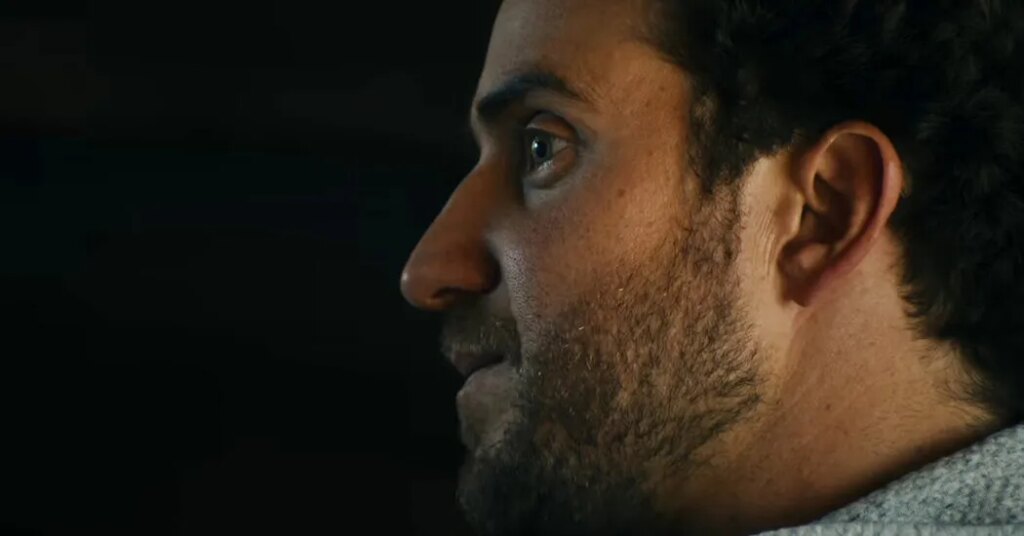
“You Can See Everything,” the hit Nathan Fielder and Lance Oppenheim documentary filmed in the home of the Theranos founder Elizabeth Holmes, leaves viewers with many questions.
Among the less important but still interesting ones: What exactly were those science videos that her partner, Billy Evans, was watching at roughly double speed?
To answer that question, we tracked the videos down. Can you understand them when they’re sped up? Find out for yourself below — and find out how the scientists in the videos would explain them.
At several points in the movie, Mr. Evans watches or listens to YouTube, sometimes while tending to his and Ms. Holmes’s newborn. With the videos playing much faster than originally recorded, the narrators whip through scientific concepts at a breakneck pace.
The videos seem to relate to Mr. Evans’s efforts to create a new blood-testing company, Haemanthus. According to company documents, it plans to use lasers to scan samples for biomarkers and signs of disease, The New York Times reported. The company plans to start by offering tests for pets.
The videos may have been part of Mr. Evans’s earlier research. They cover virology and methods of microscopy, which relies on high-powered cameras and microscopes to examine specimens, as opposed to readings from lasers. (Mr. Evans declined to comment.)
The clips below are what’s heard in the film, sped up to roughly the speed Mr. Evans was watching them. The interviews with scientists that follow have been edited and condensed.
‘Structure of Viruses (Lecture 4)’
Columbia University
Watch the full video (at normal speed) on YouTube.
Vincent Racaniello is the lecturer in the video and a professor of microbiology and immunology at Columbia University.
Have you seen “You Can See Everything”?
I have not seen the movie. Several people have written telling me my lecture is being viewed in it.
What is the video’s content about?
It’s my 2011 Columbia University lecture on virus structure. I’m very disappointed that this is the best that Billy could do. I issue revised lectures every year and they are different.
How complex is the information in this video? What knowledge or training would be prerequisites for understanding it?
Moderately complex. You don’t need any background; you just need to listen and think about it, which seems to be missing these days.
What are some reasons someone may be learning about this subject?
I’ve heard they want to reboot Theranos and include diagnostics for viruses. Good luck with that. He should watch the whole course, if that’s his intent.
Do you think it’s possible to process something like this at 2x speed?
No.
‘MadSTORM for Super Resolution and Highly Multiplexed T Cells’
JoVE (Journal of Visualized Experiments)
Watch the full video (at normal speed) on YouTube.
Jason Yi is the lead researcher who developed the procedure that this video covers, and introduces the procedure earlier in the video.
Have you seen the movie?
I’ve been wanting to. We’ve been trying to, ironically, publish a paper, so we’ve been nonstop writing. My wife’s been trying to get me to go. I’m also a big fan of Nathan Fielder.
What is this video about?
In the paper, there were two things I was pushing on. One was that when you were photographing a cell, all you can photograph is just one type of thing. You’re missing a thousand other details in the picture. [Our method] allows you to cycle through and take all the other parts of the picture.
The other angle has to do with these unique things called nanodiamonds. I had utilized them as a way to track the positions of where cells were, because if I’m collecting images over four days, the microscope case is moving, it’s vibrating — but these diamonds are basically absolutely visible all the time.
How complex is the information in this video?
At minimum, undergraduate level, and likely some degree of graduate training would be needed. Someone with no training at all would have a very hard time understanding the material.
At the same time, if they’re genuinely curious about the topic and have a business need that can be solved by the nanodiamonds or the microscopy technique, the learning curve might be faster.
What are some reasons someone may be learning about this subject?
You would have to be one of three different types of people to get this: if you are interested in immunology, biophysics or chemistry. My gut feeling is Billy is looking into another angle of the paper about nanodiamonds which was more related to super resolution.
Do you think it’s possible to process something like this at 2x speed?
Probably. The speaker is quite slow and very carefully stepping through. I don’t see why one couldn’t watch it at 2x speed for a video like that.
‘Introduction to Super-Resolution Localization Microscopy’
Teledyne Photometrics
Watch the full video (at normal speed) on YouTube.
Daniel Croucher narrated the video and has a Ph.D. in biology. He previously worked as an applications specialist at Teledyne Photometrics.
Have you seen the movie?
I haven’t managed to get out to watch it yet. I want to.
What is this video about?
Super resolution microscopy is effectively a way of seeing things in a higher resolution than would usually be possible with typical microscopy techniques.
Typical microscopy techniques let you see things at the size of the cell, even parts inside the cell, but if we want to go even smaller than that and look at really, really tiny things, you can’t use normal microscopy because there’s a limit. Super resolution microscopy is a bunch of things that are all about breaking that limit and seeing how far we can go to visualize smaller and smaller things using a microscope. That video in particular was primarily around two or three techniques, PALM, STORM and DNA-PAINT.
How complex is the information in this video?
If you were already knowledgeable about microscopy, it was very accessible.
If you were not knowledgeable about microscopy, you would have probably needed to do some background reading to be able to understand it from the beginning. Anyone with a biology degree would have the ability.
What are some reasons someone may be learning about this subject?
The idea was to educate people who were in microscopy, and who were either doing Ph.D.s, or doing postdocs, where they wanted to use this technique. So, they would probably have already been in a lab, under a supervisor who is doing something like that already or has an interest in pursuing it.
Super resolution microscopy is about getting structural information to better understand how cells or other things are built. There’s a lot you can learn just from things that we couldn’t do before, for example, to be able to see the exact structures of a cell.
Do you think it’s possible to process something like this at 2x speed?
I don’t think so. It would be hard to process because when I was making the video, I tried to make it as accessible as I could, but also to keep it concise. So although not impossible to follow if you have a reasonable amount of experience in microscopy, at two or three times speed, it would be hard, and I would expect you would have to rewind.
Additional production by Rumsey Taylor.
The post You Can See Everything That Billy Evans Watched on 2x Speed appeared first on New York Times.