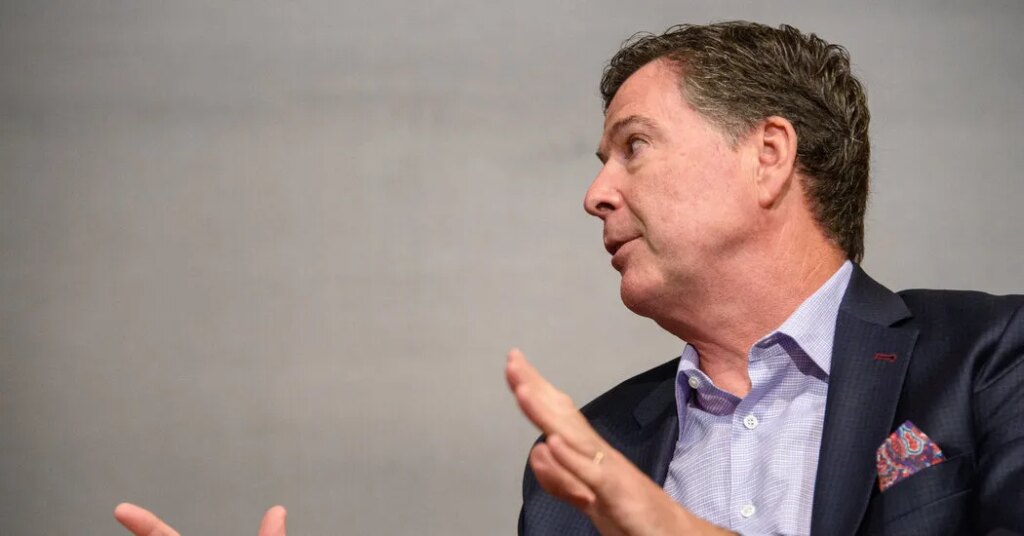
A federal prosecutor suggested on Friday that the Justice Department was pursuing additional charges to a case accusing James B. Comey, the former F.B.I. director, of leaking classified information a decade ago.
The disclosure came during a hearing in Federal District Court in Washington before Judge Trevor N. McFadden, a Trump appointee. Judge McFadden is considering Mr. Comey’s request to throw out charges accusing him of violating the Espionage Act by directing an associate to leak classified information to the news media in October 2016.
Mr. Comey, who has denied wrongdoing, has said that prosecutors brought charges using a legally questionable tactic. Rather than seek a grand jury indictment, prosecutors used a charging document called a “criminal information,” which requires no approval from a judge. Mr. Comey’s lawyers argue that clumsy approach allowed the statute of limitations to expire, and therefore the charges should be dismissed.
The prosecutor, Dustin Farahnak, urged the judge to give investigators more time to finish presenting their case to a grand jury and seek an indictment, which he said would include events from April 2017, shortly before President Trump fired Mr. Comey as F.B.I. director. The president frequently denounces Mr. Comey as a “dirty cop,” and in Mr. Trump’s second term, the Justice Department has pursued him without pause.
“There is additional evidence going to the grand jury,” Mr. Farahnak said. He did not elaborate, citing grand jury secrecy rules. He did not specify whether he meant more prospective charges against Mr. Comey or alleged conspirators, or both.
Still, the judge voiced skepticism about the prosecutor’s rationale for charging Mr. Comey this way — 10 years later, without an indictment.
Judge McFadden also suggested that the Justice Department may struggle to persuade grand jurors to indict Mr. Comey on its evidence, referring to a legal cliché about prosecutors having so much control over grand juries that they can indictment a ham sandwich.
“Turns out ham sandwiches are harder to indict,” the judge said.
Sarah Krissoff, a former federal prosecutor now in private practice at Cozen O’Connor, said she doubted the case against Mr. Comey would survive scrutiny from a judge or jury.
“The fact that they’re spending time on this looks absurd to me,” she said. “And the fact that they couldn’t get their act together until October 2026 is a big red flag.”
The Trump administration has repeatedly sought to bring charges against Mr. Comey. The most recent charges, the third criminal case prosecutors have brought against him, accuse him of directing another F.B.I. official in October 2016 to share classified information with a reporter. That issue was investigated during the first Trump administration and dropped without charges.
Mr. Farahnak said in court that investigators had obtained additional evidence since then.
Prosecutors filed the criminal information just as the statute of limitations on the matter was about to expire. Mr. Comey’s lawyers argue that by failing to secure an indictment, the statute had already passed and no charges could be brought.
In a video posted online, Mr. Comey promised to fight the case.
“I’m still innocent. I’m still not afraid of these people,” he said, adding that the new case against him “would almost be funny if it weren’t such an appalling abuse of the Department of Justice.”
In court papers, prosecutors say the case stems from an article that appeared in The New York Times. The article, citing several people familiar with the matter, described how Yahoo used a system meant to scan emails for child pornography and spam to help satisfy a secret court order that required it to search for messages containing a computer “signature” tied to the communications of a state-sponsored terrorist organization.
According to the article, the Justice Department obtained an individualized order from a judge of the Foreign Intelligence Surveillance Court, and Yahoo was barred from disclosing the matter.
Prosecutors said in legal filings that the Times article came about because Mr. Comey “sought to correct misinformation which had appeared in the press by way of Reuters the day before.” The subsequent investigation, the prosecutors said, “uncovered evidence that Mr. Comey directed staff to speak to” The Times “about specific accuracy concerns related to the Reuters article, and thereby illegally transferred classified information.”
A spokesman for The Times has said the paper does not comment on the sourcing behind its reporting. Cases like this, the spokesman said, were intended to discourage sources from providing journalists with important information that the public needs to know.
In court, Mr. Comey’s lawyer, Ephraim McDowell, pressed the judge to rule quickly that prosecutors had misused the criminal information to buy additional time to which they were not entitled, and therefore the case should be thrown out of court. Until then, he said, Mr. Comey faced the threat of being arrested.
The judge warned prosecutors not to do that as he considers the legal issues, saying he would be “extremely frustrated” if there were some sort of “dawn raid” on Mr. Comey’s home.
“That is not going to happen,” Mr. Farahnak promised.
The post Prosecutors Suggest They May Seek Additional Comey Charges appeared first on New York Times.