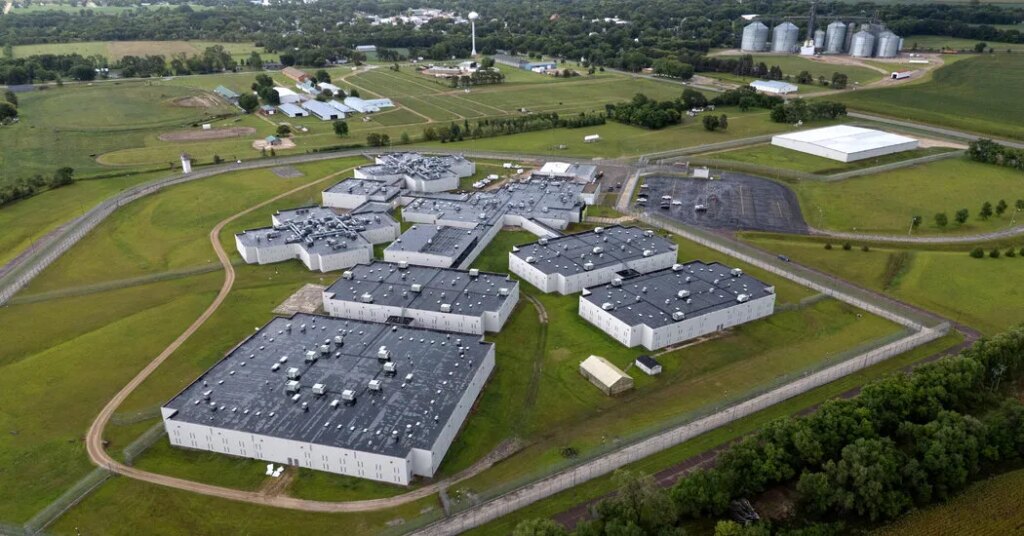
CoreCivic, a private prison company, approached the Minnesota Department of Corrections last year offering to sell a long-shuttered detention facility. The price: $75 million.
State officials passed. They didn’t have the funds to buy the Prairie Correctional Facility in western Minnesota, nor did they need a prison of its size or have the ability to staff it.
Last summer, to their astonishment, the 1,600-bed prison sold for more than $495 million. The buyer: the Department of Homeland Security.
“The price tag is so different than the conversations we were having last year,” said Safia Khan, the deputy commissioner and chief of staff for the Minnesota Department of Corrections. “It was a shock.”
D.H.S. purchased the facility amid a multibillion-dollar spending spree to support the Trump administration’s mass deportation campaign. It plans to use it to expand its immigrant detention capacity, one part of a buildup whose ballooning budget was faulted last month by the Government Accountability Office, a watchdog agency, as a hastily and poorly planned “waste” of millions of taxpayer dollars.
The department is also facing scrutiny over the purchase of 10 used jets for $464 million this year in a no-bid contract. The department said it needed the planes for deportation flights, but most of them have largely sat idle.
Some officials in Minnesota, which the White House has portrayed as an avatar of poor governance and fraud, expressed outrage this week after learning about the amount taxpayers paid CoreCivic. The company donated $500,000 to President Trump’s inauguration committee, and its stock price soared after his 2024 victory.
“Trump scamming taxpayers out of almost half a billion dollars is outrageous, especially at a time when Trump’s tariffs and war in Iran are already raising prices for Minnesotans,” Attorney General Keith Ellison, a Democrat running for re-election, said in a statement.
When it opens, the Prairie Correctional Facility will be the sole dedicated immigration prison in Minnesota.
Lauren Bis, a White House spokeswoman, referred questions about the price the government paid for the Prairie Correctional Facility to D.H.S., which did not respond to an emailed inquiry on Friday.
In a statement, CoreCivic said the federal government bought the facility following an appraisal that established its “fair market value.” It added, “For this specialized property, independent appraisers hired by the federal government used a cost-based methodology grounded in current replacement cost, depreciation, land value and other market-based factors.”
The Prairie Correctional Facility was built in 1992 by the city of Appleton, Minn., population 1,392. In its early years, the medium-security facility housed prisoners from the Puerto Rico Department of Corrections and Rehabilitation. In the mid-1990s, it was acquired and run by CoreCivic, which had contracts with several state corrections agencies, including Minnesota’s.
The prison closed in 2010 as demand for out-of-state detention bed space declined. Over the years, Minnesota officials periodically considered buying or using it again, Ms. Khan said, but it was never a good fit. Its remote location near the South Dakota border made it impractical from a staffing and infrastructure standpoint, she said.
Last year, as Minnesota officials were mulling closing one of the state’s largest prisons near the Twin Cities, state officials met with CoreCivic executives, who were seeking to offload the Prairie Correctional Facility.
In May 2025, Kelly Durham, the company’s director of state partnerships, offered to refurbish and sell the prison to Minnesota for $75 million, according to an email obtained by The New York Times. The news station KARE 11 reported on that offer this week.
During meetings, company officials seemed eager to get rid of the prison, at one point offering to sell it for a fraction of that price, Ms. Khan said. But talks between CoreCivic and the state agency gained little traction.
In August, CoreCivic announced the sale in a statement that said the company intended to use a portion of the proceeds to buy back company stock. Days after the deal was announced, the Department of Homeland Security gave CoreCivic an $18.6 million no-bid contract to run the prison for a year. It’s unclear why the final sale price for the prison jumped so much after last year’s offer.
Treasury Secretary Scott Bessent, who was in Minnesota on Friday to announce developments in the administration’s efforts to root out fraud in safety net programs, said he had not heard about the prison deal. He called questions about the gap between the 2025 price tag and what the government paid “a waste of our time.”
David A. Fahrenthold contributed reporting.
The post Minnesota Declined to Buy a Prison for $75 Million. D.H.S. Paid $495 Million. appeared first on New York Times.