On opening weekend, someone posted on X: “Imagine how weird it would be to watch ‘You Can See Everything’ with Amy Chozick.”
Let me tell you how weird.
It was wild to watch disgraced Theranos founder Elizabeth Holmes and her life partner, Billy Evans, reading the lengthy profile of Ms. Holmes that I wrote for The New York Times on a laptop, seemingly just as it was published. At one point, Mr. Evans reads a quote from Ms. Holmes about her depiction by actors in film and TV — “They’re not playing me. They’re playing a character I created” — and says it doesn’t sound like something she would say. He suggests Ms. Holmes must instead have said, “They’re not playing me. They’re playing a character they created.” She agreed.
I had no idea that a central theme of the film would revolve around this disputed quote, which essentially opens and closes the movie.
The Nathan Fielder and Lance Oppenheim documentary is, as one review put it, “an existential vortex, challenging the concept of truth.” It might not even be, by some overly strict definitions, a documentary.
It is quite funny. I howled laughing at the uncomfortable weirdness of the depictions of the couple that Mr. Fielder and Mr. Oppenheim constructed. Ms. Holmes and Mr. Evans appeared to have let the filmmakers see everything, even showing Mr. Evans taking a shower. But when I saw the film, I kept thinking: Where is the nanny?
She was nowhere to be seen. Without her, the couple comes off as harried multitasking parents, literally rocking the baby with one foot.
I met Vanessa, the Salvadoran woman who was sometimes on hand to help care for their toddler and newborn, because I also spent several days inside the couple’s canary-yellow rental home in Del Mar, Calif. My article was published on May 7, 2023, 23 days before Ms. Holmes went to prison after being found guilty of fraud at her once-hot blood-testing-device company.
We went to the zoo and for tacos and smoothies. They even offered to let me stay with them. I declined. And by the looks of the bed they dusted off for Mr. Fielder, I think I made the right call.
I left in March. Mr. Fielder and his crew arrived in April. I was struck by the film’s opening text that said Ms. Holmes hadn’t spoken publicly in seven years, since my profile was published shortly after Mr. Fielder and his crew arrived.
Ms. Holmes and Mr. Evans seemed convinced that the longer you spend with them, in the cozy kitchen, playing with the kids, walking the dog on the beach, the more you’d be hypnotized, too. How could you not be? For them, access was a conduit to a type of exoneration. They are salespeople. Their humanity is what they now had to sell.
It’s why the couple extended so much access for my Times profile, hoping it would help reshape Ms. Holmes’s image and garner sympathy. Then my story came out.
Half the internet, and many of my former Times colleagues, derided the story as a “puff piece.” I was relentlessly trolled online by people who thought I was too easy on her. Ms. Holmes and Mr. Evans, meanwhile, apparently thought I’d been too hard on them.
So they might as well embrace Mr. Fielder and — as is explored in the documentary — ask for a cut of the film’s profits.
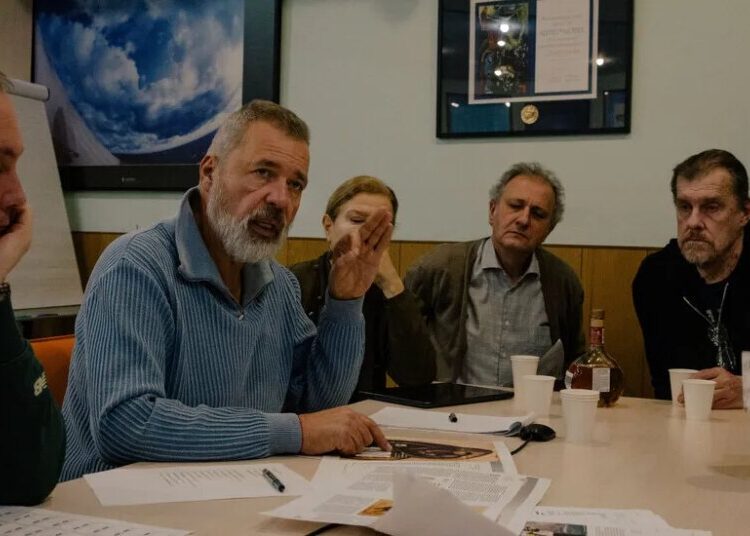
My time in Mr. Fielder’s vortex began in June 2025, when he reached out saying he’d love to “pick your brain” off the record. He’d also spent time with Holmes before she went to prison — we’d just missed each other — and was working on a documentary. I promised not to tell anyone about the project.
We spoke a couple of times, comparing notes about our surreal experiences with Ms. Holmes. We’d so nearly overlapped that she’d worn the same camel sweater. It almost felt like a support group. It’s a pretty small circle of people who understand the dizzying experience of sitting in that canary-yellow house by the Pacific, watching Ms. Holmes nurse her baby days before reporting to prison. We’d both stared into those unblinking eyes. Both offered her Kleenex when she cried. Mr. Evans offered us both breakfast. We both felt ourselves getting swept up by Ms. Holmes’s quiet magnetism.
I’d left the house thinking I had better check my wallet. Mr. Fielder seemed to be similarly conflicted.
I wasn’t particularly familiar with Mr. Fielder’s work, but I wanted to be helpful. I tentatively agreed to appear on camera. Why not? He seems like a mensch! I mentioned this to a friend, a rabid Fielder fan who also happens to work in communications. His advice: “ABORT! ABORT!”
I told Mr. Fielder I actually didn’t feel comfortable being on camera. I apologized and wished him luck. He was disappointed. He laid on the guilt (fair). He’d already rented the camera package and had a crew traveling my way as we speak. He promised he’d make it “very fun and easy.” I felt bad. I wanted to help a nice Canadian man make his documentary. I asked my friend what to do. His response: “LEAVE TOWN!”
I have to admit, I ghosted Mr. Fielder. As it turns out, ghosting Nathan Fielder is hard to do. He is unusually likable, persistent and persuasive — winningly awkward, as he seems to be on camera — and there’s something that makes you want to help him.
Then, in February 2026, Mr. Fielder contacted me again. He wanted help to “clarify a little thing.” Ah, yes, a little thing. Ms. Holmes, he explained, said I’d misquoted her.
In the film, after reading the quote, the couple call their P.R. team. And sure enough, back in 2023, I had heard from one of her publicists who explained that Ms. Holmes’s recollection of our conversation differed from what was published. Would I double-check the quote? At the time, I reviewed my notes with my editors, who stood by the reporting. Mr. Evans sent The Times an 80-second audio clip, but it didn’t contain the disputed exchange. We heard nothing further and considered the matter resolved. (I’ve explained the full backstory here.)
It surprised me, because Ms. Holmes and I had spoken so much about the persona she created at Theranos. When I showed up at their rental house, she looked and sounded like a completely different person from the girl boss people remembered. What was with the James Earl Jones inflection? The Steve Jobs turtlenecks? The red lipstick?
In my profile, Holmes explained that, having founded Theranos at 19, she’d created a public persona to be taken seriously in business.
Now, three years later, Mr. Fielder was asking about that quote. I informed my old editor, who advised that I not reply. Instead, we referred Mr. Fielder’s inquiry to the newspaper’s public-relations department, standard practice when a published article is being challenged.
When the documentary premiered at the Telluride Film Festival, I heard from friends who told me that my Times article was in the movie.
I sent several requests to A24, the film’s studio, asking to see it. It felt like every culture writer and midlevel executive in Hollywood had seen the movie and was asking me about it. I heard about a big screening in L.A. They said it was at capacity. A spokeswoman at a firm helping A24 offered “to assist with a ticket to a local theater” when it opens. (“No spoilers.”)
I texted Mr. Fielder to see if he could help. (Canadian mensch, and all.) He said he’d try, and then reminded me that I never did answer his question about the disputed “character I created” quote (single tear emoji). And somehow I felt guilty all over again. I apologized. I told him I knew it was too late, but to call me if he wanted me to explain.
I finally saw “You Can See Everything” as God and A24 intended at a 4:30 p.m. showing on opening day at the Landmark Theatres Sunset in Los Angeles.
I spit-laughed at the scene of Mr. Fielder sitting on the second floor of Beer Authority across the street from The New York Times building, eating nachos and trying to track me down. I haven’t worked on staff at the paper since 2022. I live in Los Angeles and write screenplays now. But hey, I appreciate a good establishing shot.
The documentary’s closing postscript says Mr. Fielder eventually got in touch with me, that I stood by my story, but didn’t provide evidence supporting the quote. That’s not exactly what happened. I never discussed the disputed quote with Mr. Fielder. I referred his inquiry to The Times, which has stood by the reporting.
I don’t know what Ms. Holmes told Mr. Fielder that didn’t make the cut, but the tone of their conversations on camera is different from my memory of how she and I interacted. With me, our talks felt very much mother-to-mother. After Theranos imploded, Ms. Holmes told me that she finally felt free: “I began my life again.” I remember thinking that she sounded a lot like someone who had finally broken out of a cult and been deprogrammed.
But then I remembered that Ms. Holmes had been running the cult. It was her vortex all along, and thanks to Mr. Fielder and Mr. Oppenheim, we all get to experience it.
Amy Chozick, a former New York Times reporter, is a screenwriter and author based in Los Angeles. Her debut novel, “With Friends Like You,” was published in July.
The Times is committed to publishing a diversity of letters to the editor. We’d like to hear what you think about this or any of our articles. Here are some tips. And here’s our email: [email protected].
Follow the New York Times Opinion section on Facebook, Instagram, TikTok, Bluesky, WhatsApp and Threads.
The post I’m in ‘You Can See Everything.’ Here’s My Side of the Story. appeared first on New York Times.