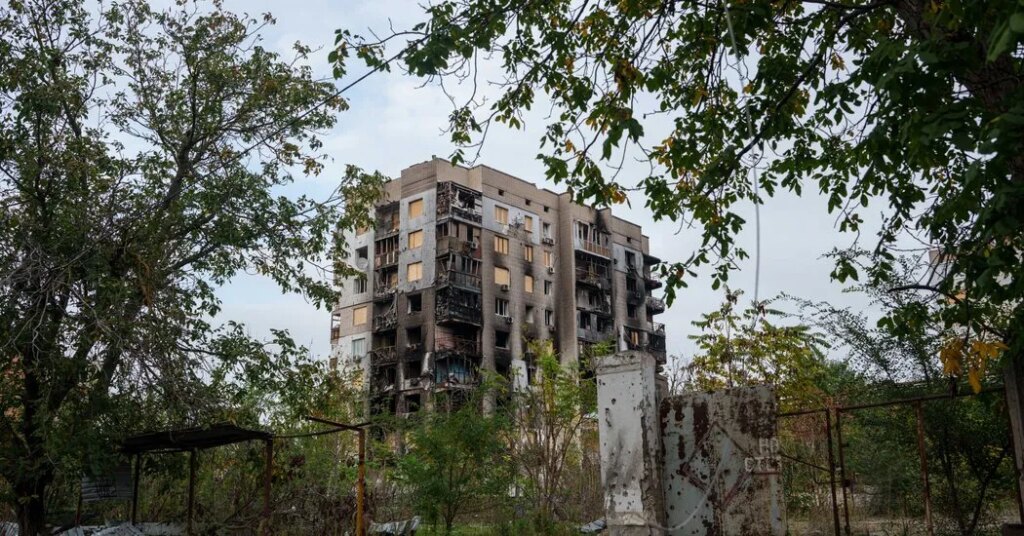
An unusual rescue mission to help up to 2,000 civilians trapped in a frontline city in Ukraine, threatened by starvation and under constant bombardment, was set into motion Friday.
Russian and Ukrainian officials were traveling together to the city of Oleshky to oversee the delivery of assistance and the evacuation of residents in a fleet of buses.
Preparations for the evacuation had been ongoing since May, Yana Lantratova, Russia’s human rights commissioner, wrote on Telegram Thursday as she set out for Oleshky. “Today’s departure is the result of months of negotiations and hard work — without which this mission would not have been possible.”
Dmytro Lubinets, a member of Ukraine’s Parliament and the parliamentary commissioner for human rights, embarked on a long journey overland through neighboring Belarus and Russia to reach the occupied part of southern Ukraine where Oleshky is, to monitor the operation in person. He is the first Ukrainian official to visit Russia since the onset of the war.
“It is important to understand what is happening on the ground and to make every possible effort to ensure that the agreement reached is implemented,” Mr. Lubinets wrote on X. “And if I had to go there to save just one person, I would do it again.”
Why Oleshky has been caught in a vise
Oleshky sits on the southeastern bank of the Dnipro river in southern Ukraine, where the river forms the front between the warring armies. It has been under Russian occupation since the full-scale invasion of 2022.
On the opposite bank of the river is the much larger city of Kherson, which fell to Russia but was later retaken by Ukrainian forces.
About 24,000 people lived in Oleshky at the time of the invasion, but most of them fled early on. Yuri Sobolevsky, deputy chairman of the Kherson regional council, the local Ukrainian governing body, said many of those who remained were older people, a population that dwindled as things worsened.
“It’s hell there,” Mr. Sobolevsky said. “People need to be evacuated from there, one thousand percent. They’re living 24/7 under risk of death.”
The plight of Oleshky has drawn international attention. The American first lady, Melania Trump, announced the local truce last Friday. A week earlier, Pope Leo XIV, just three days after surgery for lung cancer, spoke with President Vladimir V. Putin of Russia and called for a cease-fire to enable an evacuation there.
How conditions there got so bad
With the rising dominance of drones in this war, Oleshky falls squarely in the widening “kill zone” between the two sides, largely abandoned by civilians, where anything that moves on the ground can be seen from above as a target.
This year, that drone warfare has grown markedly more intense. Russian soldiers and drone pilots operate out of ruined buildings in Oleshky, using it as a base to strike Kherson, on the northwest bank. Kherson, where more than 40,000 people live, is hit daily by drones and bombs.
Ukrainian drone pilots, in turn, try to defend Kherson by hitting the Russian military in Oleshky.
“It’s the constant accumulation of drones on both sides,” said Roman Kostenko, a lawmaker and the chairman of the defense and intelligence committee of Ukraine’s Parliament. “The intensity of combat operations has grown due to the fact that there are more drones, more crews and the enemy has set a goal to destroy Kherson.”
“So many apartment buildings in Oleshky are used for positions to strike Kherson,” he said.
“Of course, then it’s a two-way battle,” he added. “Kherson is also under increased attack since the spring. Therefore, in response, our defense forces are also trying to destroy the enemy.”
In addition, most roads in and out of the city have been mined and traffic is targeted by drones. Trucks stopped delivering food and medicine to Oleshky months ago because the drive was too dangerous. Many people have lost electricity, heat and gas service.
How the evacuation is supposed to work
A cease-fire has been in place since Tuesday.
Russian forces, who control the city and surrounding region began demining the access roads and arranging to truck in humanitarian aid, including medicines and food, to the city. Residents of the city were told prepare to leave on buses on Friday.
Both Ms. Lantratova and Mr. Lubinets said on Thursday that the removal on mines on evacuation routes had been completed.
“One cannot even imagine how difficult these negotiations have been,” Mr. Lubinets wrote on X, “and how long they took to get me to where I am now. But we have only made it halfway toward our goal.”
“When there are people — our people — who need help, we must save them. Period.”
Ms. Lantratova said a convoy was ready to transport several dozens of tons of humanitarian aid including foodstuffs and medicines into the city.
“Our primary objective is to deliver humanitarian aid to the people remaining in the city,” she said. “We will also ensure a safe departure for those who wish to leave Oleshky.”
The agreed upon route for the evacuation is through Russian-held territory, so only Russian forces were involved.
Ukrainians have warned that the civilians feared evacuation could lead to arrest or harassment by the Russians, or that Russia would make it difficult for them to return to Ukraine. Reports that Oleshky residents would be transported from Russia to Belarus by plane caused a panic among relatives of evacuees who recalled the crash of a Russian plane that was reportedly carrying Ukrainian prisoners for an exchange in 2024.
The road ahead
Speaking at the Russian-Africa summit, Mr. Putin mentioned the relief operation and added a swipe at the Ukrainians, while also raising a rare hint of hope for a peace settlement.
He blamed Ukraine for “creating virtually a humanitarian catastrophe” in Oleshky but added that the Kremlin was also “dealing with issues regarding a possible peaceful settlement of the Ukrainian crisis itself.”
Mrs. Trump wrote on X, “May this humanitarian mission end the suffering and begin a new chapter of durable peace between Russia and Ukraine.”
But Ukrainian officials have been concerned that Russia will present the rescue as a grand humanitarian gesture by Moscow, and many Ukrainians and others voiced mistrust of Russian intentions.
President Volodymyr Zelensky of Ukraine said in a video statement that Russia had carried out “extremely brutal strikes” against civilians in three cities killing 19 people and injuring dozens in daytime attacks on Thursday. “They are doing this deliberately when everyone is counting on steps toward de-escalation,” he said.
Russia was tidying up Oleshky ahead of the arrival of non-Russians and their video cameras on Friday, Mariam Lambert, a former diplomat who heads the Emile Foundation, a charitable organization working to help children separated by the war, said in a statement on X.
She said an Oleshky resident had told her that Russians were cleaning streets, painting, and “trying to create a pretty picture in the middle of hell.”
Russian troops had arrived in large numbers in the city and were demining the area but also bringing ammunition and supplies to their positions, Ms. Lambert quoted the resident as saying.
Mr. Kostenko, the Ukrainian Parliament member, said there were concerns that a cease-fire would allow the Russian military to resupply and rotate its troops there, including some who have positions on islands in the Dnipro delta.
“We understand the enemy will use this to his advantage,” he said. “I think they will try to do a rotation, bring in more forces, regroup, take better positions. So we will need to watch them.”
Siobhán O’Grady and Liubov Sholudko contributed reporting from Kyiv. Valerie Hopkins contributed reporting from Berlin.
The post A Rare Rescue, Announced by Melania Trump, Begins in a Besieged Ukrainian City appeared first on New York Times.