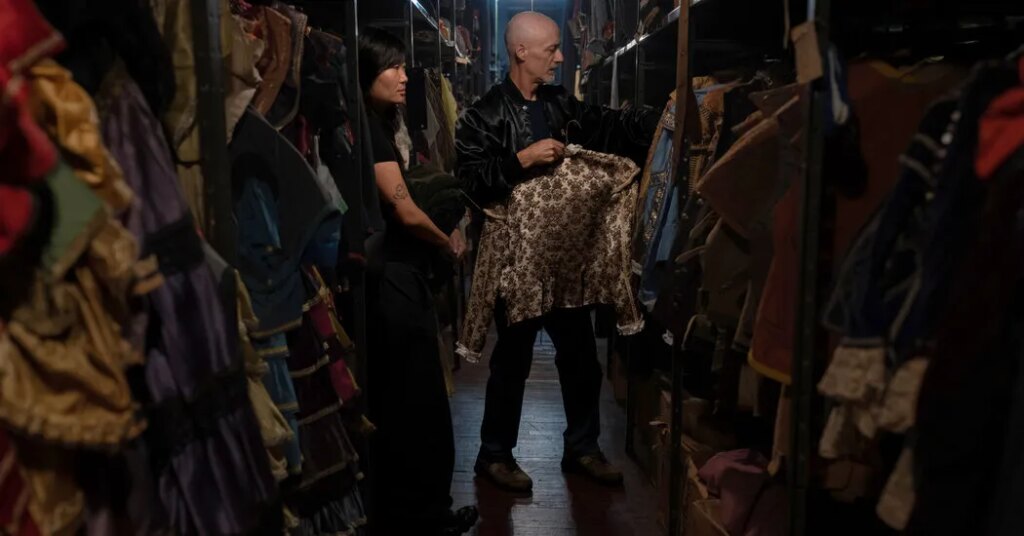
A man dressed up in a full jester outfit did a jig across the slanted hardwood floor. One woman’s blue IKEA bag toppled to the ground and a metal breastplate from a suit of armor rolled out. Another man zipped a brocaded Renaissance costume over his street clothes and paraded through the aisles in search of a mirror.
“It’s a madhouse,” said Robert Stivanello, 68, the owner of the Stivanello Costume Company, as he surveyed the scene at his Queens warehouse on Thursday, two days before Halloween. People crowded the labyrinth of hanging racks in search of hidden gems.
But for Mr. Stivanello, standing among the fray of his going-out-of-business sale, the mood was not one of holiday celebration — he’s closing later this year.
“The opera costume business has changed a lot,” he said. “Covid killed a lot of opera companies.”
The Stivanello Costume Company began in 1924, shepherded first by Mr. Stivanello’s grandfather, then his father and now him. The company has dressed such opera luminaries as Luciano Pavarotti and has provided costumes to companies from Venezuela to Canada, including local operas in dozens of American cities.
But after the Covid-19 pandemic turned operas dark for the better part of two years, the business turned to cost-cutting measures — and handmade costumes were one of the casualties.
“There’s so many costume houses around the country that are shutting down,” said Rachel Stillman, 26, a vintage clothing dealer who drove from the Philadelphia area for the closing sale. “And it’s just like, what’s the alternative?”
Mr. Stivanello said that many operas had transitioned to styling their performances so that the characters appear in modern dress, which is cheaper because they don’t have to rent costumes. That, and buying costumes from Amazon.
“I learned from my father how it should be done right, which is not the way they do it anymore,” Mr. Stivanello said.
Ms. Stillman said that she and several costume designers at the sale would repurpose Mr. Stivanello’s costumes so that they could have a second life.
Lara Donnelly, 36, an executive assistant from West Harlem, said she was looking to get into costume design. She is in the midst of an apprenticeship with Atelier Abene, the costume designer behind shows like “Sleep No More” that are known for what Ms. Donnelly described as “weird, romantic, clunky, immersive stuff.”
Despite being at the sale for work, Ms. Donnelly could not resist the treasures around her. She said she had “taken Halloween seriously since I was a small child.”
“I did find on the return rack, perfectly placed for me to see it, this bright purple frock coat, and it fit perfectly,” she added. “So then I’m like, do I need a bright purple frock coat for my daily wear? Very likely.”
Amid the professionals were those who happened upon the sale in the lead-up to Halloween. Simon Lieber, 24, had wandered up from Flatbush on the recommendation of a friend and had not realized Stivanello’s was closing.
“This is clearly a gem of a place,” he said. “All of these really high-quality costumes and everything, and the way it’s run makes you feel like you’re in a 1970s New York establishment.”
Mr. Lieber had entered the warehouse with designs on a St. Sebastian costume, before second-guessing how revealing such an outfit might be. (The saint is often depicted tied to a tree, wearing only a loincloth.) Instead, he was embracing the magic of Stivanello’s and seeking “divine inspiration.”
“I’m looking at what the guys who run the place are seeming to call ‘pumpkin pants,’” he said, looking to pair Renaissance-style poofy shorts with a toreador’s jacket. What would he call such a look? “A strange costume,” he said, “but a great one.”
As customers double-parked outside to load trunks full of bulging bags, Mr. Stivanello clambered up and down ladders inside as a radio chirped from his belt clip while he plundered his precious supply to hunt down accessories that would complement ambitious outfits.
He sped past simple paper signs denoting, for example, Aisle 19 as “Dancers, Slaves, Meister; Egyptian, Otello, Biblical” and Aisle 7 as “Early Peasants; Hoop Dresses, Mixed Capes.”
One wall was lined with swords stacked in a row, ranging from the “Princess Bride” variety to a more King Arthur style and selling from $40 to upward of $75. The opposite wall was hats — top hats, felt hats, helmets, even the kind with metal grates, like the one Shrek wore to rescue Fiona.
Mr. Stivanello joked that his father tricked him into following his forebears into the family business, but he took to it quickly. He said he worked harder learning operas than he ever worked in school, and even got into directing.
As he gazed around the warehouse, he said, sadly, that his future would contain less heavy lifting, even as he stooped to pick a hefty, fur-lined robe off the floor. He fought to get the store to 100 years, Mr. Stivanello said, and in the end he made it to 102.
“I hope my ancestors are resting in peace,” he said.
The post A Century-Old Queens Costumer Says Goodbye appeared first on New York Times.