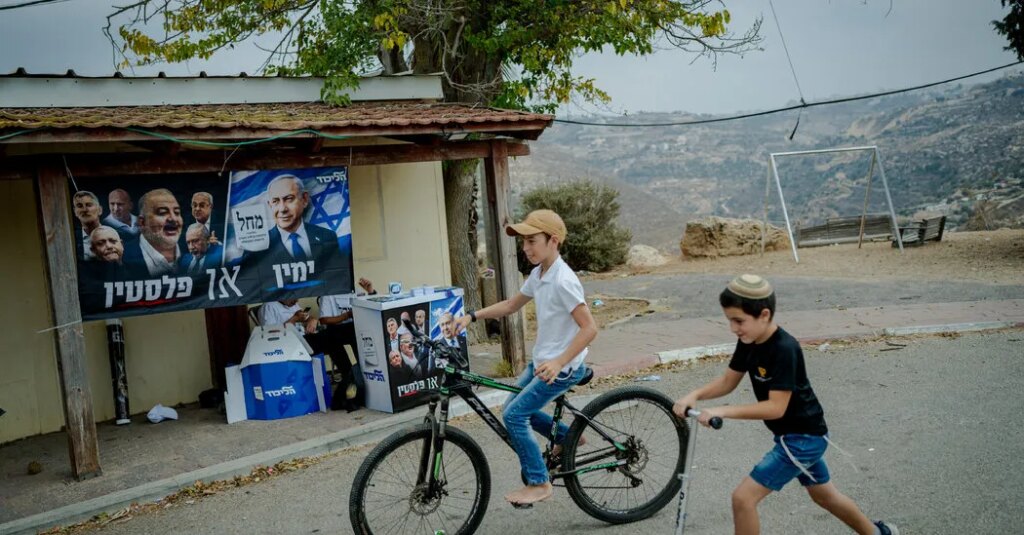
Israel’s election on Tuesday was the country’s first referendum on its leadership, in particular Prime Minister Benjamin Netanyahu, after years of war, growing international isolation and domestic upheaval, including over a proposed judicial overhaul.
A close look at election data finalized on Thursday offers insights into how this turbulent period may have influenced voting behavior.
With the counting of more than five million ballots complete, here are four takeaways.
Some war-struck communities stood by Netanyahu
Prewar voting patterns largely held up in communities along Israel’s borders with Gaza and Lebanon, including some that suffered heavy damage during and after the Hamas-led attack on Oct. 7, 2023, and repeated rounds of fighting with the Lebanese militia Hezbollah.
The two largest cities in those areas — Kiryat Shmona near Lebanon and Sderot near Gaza — maintained their traditional support for Mr. Netanyahu’s Likud party.
Likud also dominated the vote in several smaller villages along the border with Lebanon, where residents spent many months under evacuation. The same was true in Ashkelon and Ofakim, longtime Likud strongholds close to Gaza that were hit hard by Hamas.
Support for Netanyahu fell in the wealthiest towns
Israel’s highest-income towns and cities — all predominantly secular Jewish communities, many around Tel Aviv — have long been strongholds for center-left parties.
Mr. Netanyahu and his allies in 2022 won about 30 percent of the vote, and that share shrunk further on Tuesday.
In seven towns and cities at the top of a socioeconomic ranking by Israel’s Central Bureau of Statistics, based on metrics such as income and level of education, support for parties in Mr. Netanyahu’s governing coalition declined sharply.
In six of those cities, it shrank by more than ten percentage points. In Givatayim, a Tel Aviv suburb, it was cut by about half to about 16 percent from about 30 percent.
Turnout surged among Arab citizens
In five of Israel’s largest predominantly Arab cities, turnout increased sharply compared with the previous election’s four years ago.
In Umm al-Fahm, the third-largest of these cities, turnout doubled, to about 76 percent from 38 percent in 2022.
The Joint List, an alliance of three Arab parties, dominated the vote in those cities. It was followed by the United Arab List, or Raam for short, whose leader, Mansour Abbas, took the bold step of recruiting a Jewish former top police official as the No. 2 on the party’s candidate list.
Turnout by groups allied with Netanyahu was strong
Turnout has historically run high among ultra-Orthodox Jews, who overwhelmingly support two religious parties allied with Mr. Netanyahu — United Torah Judaism and Shas.
In five of the largest ultra-Orthodox-majority cities, turnout on Tuesday was on par with, or slightly higher than, the turnout in 2022. A central issue in the campaign was the status of a longstanding exemption from military service granted to ultra-Orthodox citizens.
More than 500,000 Jewish Israelis live in settlements in the occupied West Bank, according to official figures. On Tuesday, turnout in major settlements surpassed that in the previous election and, in many cases, the overall national rate.
Religious Zionism dominated the vote in many of the largest settlements. The party is led by Bezalel Smotrich, the far-right finance minister and an ally of Mr. Netanyahu’s. Mr. Netanyahu’s Likud party, though still prominent, lost some ground there.
The post What Israeli Election Results Reveal About the Electorate appeared first on New York Times.