This summer, Lucien Smith, accompanied by the gallerist Tripoli Patterson and a trickle of friends and observers, laid a 40-foot tarp on a baseball field at Camp Hero State Park in Montauk, N.Y. He aimed a modified air compressor filled with acrylic paint at a few canvases propped up on ladders, spraying in a soft arc.
The process was only slightly different from the one Smith developed in his early 20s to create the “Rain Paintings,” the body of work that brought him fame and also disillusionment, and eventually spurred a retreat from both New York City and the art world.
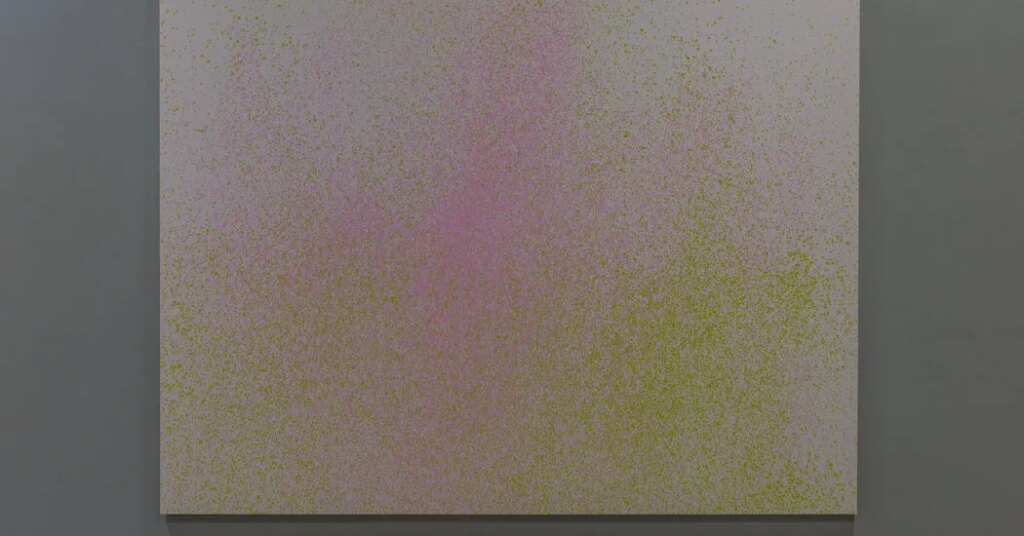
The resulting pictures, four 90-by-120-inch paintings of speckled bubble-gum pink and acid lime, ended up being his last. Smith died on Sept. 7, at age 37, five days before they were scheduled to be displayed. On Sunday, all four paintings went on view at Tripoli Gallery in Wainscott, N.Y., 18 miles up the road from Montauk, where Smith had lived since 2015.
The show’s title, “Delay of Game,” refers to a rain delay in baseball, usually a few minutes to an hour. The delay in Smith’s case was more psychic, and lengthier — 15 years — from the time he made his first “Rain Painting” to this summer, when, seemingly, he managed to purge the cynicism that reshaped his practice.
In 2011, shortly after graduating from Cooper Union, Smith began filling empty fire extinguishers with thinned paint. He was taken with the spray effect’s atmospheric mimicry of weather, even if his droplets fell in unnatural shades of yellows and blues. They felt new and familiar at the same time, retoolings of Pollock lashing house-paint-dipped sticks at canvas and Hans Hartung’s late-career use of a garden sprayer. The “Rain Paintings” prized process over style — beautiful but aloof, expressionistic but made without direct touch.
They dazzled collectors and rankled critics, and Smith became the poster child for a mode of art making that the artist and writer Walter Robinson called “zombie formalism” — the kind of process-obsessive abstraction that warmed up midcentury leftovers.
Smith arrived at a cultural moment driven by a post-recession market flooded with money and juiced by overheated auction prices. And while the true targets of Robinson’s complaint were the speculative pump-and-dumpers who flipped work at auction, the label and its associations influenced the trajectory of contemporary painting.
Other critics piled on, alarmingly willing to dismiss a cohort of young artists vaguely interested in a similar aesthetic. The stigma led to a fallow decade of technically precise but inert figurative painting from which we’re only now climbing out.
“Zombie” was an irresistible knock, but it missed the point, at least as applied to Smith. To detractors, the style — or lack of one — smacked hollow, a canny pose by someone trying to engineer an art career. Smith himself was open about his ambition. But calculated doesn’t mean without value.
Smith was born in California but had a New Yorker’s restlessness, a quality evident in his output. After the spectacle of the “Rain Paintings,” of which he made some 200, he bounced between approaches and mediums: pie tins filled with paint and hurled at a canvas, like a Chaplin slapstick bit absent the laughs; fuzzy airbrushed headshots of celebrities, à la Warhol society portraits, skewed with Richteresque blur. Smith’s work could be droll or deadpan, but it wasn’t arbitrary. He thought about his historical forebears clearly, and his work revealed an artist who understood he operated on a continuum.
Smith never wrote graffiti, but he was cognizant of its lessons and strategies; around 2007, the artist KATSU popularized the fire extinguisher to cover more surface area quicker, throwing up jittery, drippy 10 to 20-foot tags in seconds versus the hours it would take with a standard spray can. Smith’s persona was wrapped up in the downtown demimonde of graffiti kids, skaters and Supreme ambassadors. Its scuzzy, druggie nihilism still inspires, even if the downtown scene has largely cleaned up and embraced corporate ambition.
In many ways, Smith was last in a lineage of early-aughts downtown artists. He worked as a studio assistant to Dan Colen, who with Dash Snow heralded a feral and self-destructive version of art making, one informed by Snow’s tagging career and association with IRAK, the collective that gleefully straddled art and vandalism. Smith’s 2013 exhibition, “A Clean Sweep,” a wistful and taxonomic accounting of New York signifiers — mesh waste cans and stickered lampposts — filled the same Grand Street space where Snow and Colen built their festering “hamster nest” six years earlier.
Yet Smith’s work never approached the paranoiac chaos of Snow’s, or the syncopated radiance of Jean-Michel Basquiat’s, the other artist to whom he was most often compared. In Smith’s unremitting interest in material experimentation and healthy disrespect toward single-disciplinary focus, a better antecedent would be Julian Schnabel.
What was Smith’s first solo show in New York — electric guitar bodies painted, stickered and bedazzled with bottle caps — if not also a kind of painting, Schnabel’s smashed crockery swapped out for worked-upon tonewood? They looked like junk sculptures, an ode to the congealed flotsam of city street life, but for Smith they achieved what all artists try to achieve: to find a new channel of communication.
Most of Smith’s work, and especially the “Rain Paintings,” was antiheroic. Antagonists griped at the work’s perceived slacker affect, and by doing so ignored its palpable freedom. The “Rain Paintings,” given over to the whims of accident, acknowledged a fundamental truth: that the limits of our control are much closer than we like to believe. They sidestepped the muscly ego of the midcentury Abstract Expressionists and 1980s Neo-Expressionism’s macho posturing, an achievement which for a 21-year-old kid struck some as unearned.
But Smith was perhaps more equipped than most. He had spoken openly about his unsettled childhood, and the rift between him and his father. His art was pain-streaked but adept at hiding the hurt. As if uncomfortable with the prettiness of the “Rain Paintings,” he gave them the incongruous titles of rom-coms: “Mystic Pizza,” “My Best Friend’s Wedding” — the way we sometimes cope with trauma by cracking jokes.
The paintings in “Delay of Game,” as in their earlier iterations, can feel like a scrim hiding an image you realize you can’t make out. Paint accumulates as a fine mist near the edges of the canvas, becoming denser at the bottom, layers overlapping and clotting toward their middles and evanescing toward their tops. There’s a lightness to them, as if the whole surface were floating.
Each wall is hung with a single painting, and the tightness of the show is also its tension — a resistance against making salable inventory. Smith must certainly have understood the draw of making them — the equivalent of playing the hits long sworn off.
The new works’ titles are cloyingly sweet: “Love is a trusting creature,” “Love and cough cannot be hidden.” In a bit of spooky action at a distance, they recall the titles of Agnes Martin’s last paintings, which came out of her practice of Zen Buddhism. But Smith’s are taken from the messages tucked into Baci chocolates, a last poke in self-seriousness’s ribs.
Taken on their surface, the paintings in “Delay of Game” don’t upend anything. But their creation, now, forms a subtly affecting meditation on reclamation and acceptance.
Notably, the exhibition is billed as the remnants of a live performance. A better word is “exorcism.” In videos the gallery posted, Smith is seen crouched on the tarp holding the compressor nozzle in a loose grip. He grins the wide grin of re-enchantment, ghosts and bad spirits being pressure blasted into something approaching grace.
Lucien Smith: Delay of Game
Through Nov. 23, Tripoli Gallery, 26 Ardsley Road, Wainscott, N.Y.; 631-377-3715, tripoligallery.com.
The post Lucien Smith’s Last Paintings Reclaim His Dazzling First Act appeared first on New York Times.