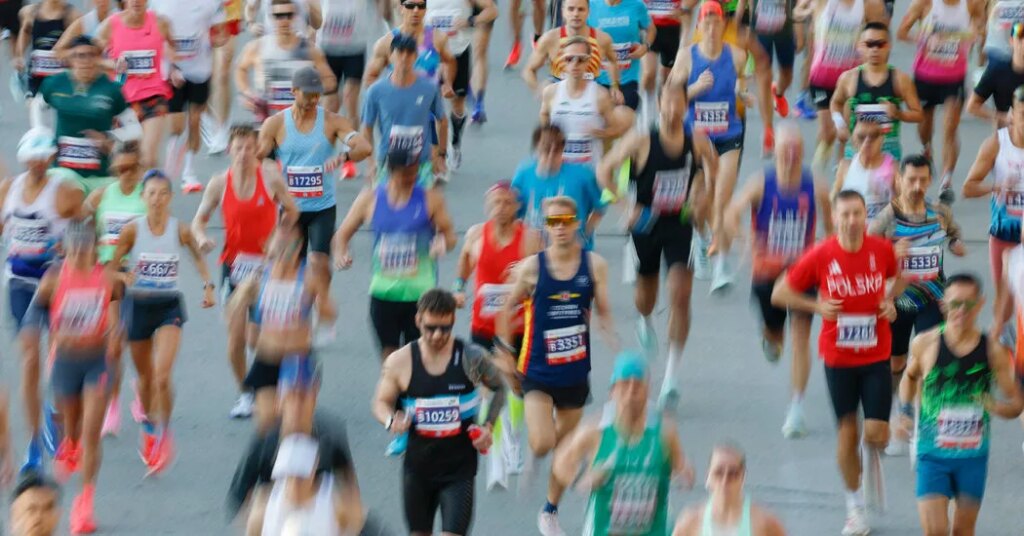
When the New York City Marathon begins on Sunday morning, temperatures are expected to be in the low 50s Fahrenheit.
Runners, consider yourselves lucky.
The relatively mild forecast is an increasingly rare luxury in the world of running, with hotter temperatures and extreme weather worldwide disrupting training and scrambling races.
In March, temperatures soared past 80 degrees Fahrenheit, or roughly 27 Celsius, during the Los Angeles Marathon. With runners wilting as the day went on, organizers decided to hand out finisher medals to anyone wishing to stop at the 18-mile mark.
A full marathon is 26.2 miles, or 42.2 kilometers, and many in the running world were outraged. But organizers said it was a necessary move in the name of public safety.
On the first October weekend of 2023, the Twin Cities Marathon, from Minneapolis to Saint Paul, Minn., was canceled at the last minute as temperatures were predicted to climb past 90 degrees, the area’s hottest-ever October day. Starting next year, the race will be held later in the month, making it the largest U.S. marathon so far to make a climate-related scheduling change.
“We all feel like our probabilities of getting those ideal crisp fall temperatures is just much higher,” said Dean Orton, president of Twin Cities in Motion, which organizes the race.
And many major races have been disrupted by heat in recent years. Across Europe this summer, a heat wave led to canceled marathons in France and Wales.
Climate Central, a nonprofit organization that studies global warming, conducted an analysis of 221 marathons globally and found that the odds of racing in cool, optimal temperatures are already slim, just 27 percent on average, and are quite likely to shrink in the years ahead.
“The trends are not moving in a good direction,” said Andrew Pershing, chief program officer at Climate Central.
Running on empty in Chicago
Three weeks ago, I learned firsthand just how punishing it can be to run a marathon in the heat.
On Oct. 11, I joined 55,000 or so other runners for the Chicago Marathon, a famously flat and fast course where conditions are often ideal.
Headed into race day, I knew the heat would be a factor. Temperatures were projected to be in the 70s, much warmer than it usually is in Chicago at that time of the year.
Nevertheless, I thought I was ready. I had trained through a hot, humid summer on the East Coast, logging several 18-mile runs on sweltering days in New York City, and putting in 20 miles on a muggy morning in Richmond, Va. I was hydrated, relatively well rested and I’d been taking electrolytes all week.
When race day arrived, it was pleasant enough at the start line, and for the first half of the marathon, I was cruising. All those miles of training had paid off, the crowds were joyous and the city looked spectacular.
Then, somewhere around Mile 15, the shade from the buildings fell away, the sun began to feel more intense and my legs began to get tight. Over the next few miles, I slowed down. Then, somewhere around Mile 18, my calves seized up with cramps.
The next eight miles were agony. I shuffled across the concrete as the sun got higher in the sky, cursing the weather. I stopped at a medical station and had my legs rubbed down with a topical pain reliever. I jogged when I was able to ignore the pain, but mostly stumbled, crushed that all my training had been for naught. And when I finally crossed the finish line, I nearly collapsed.
I was hardly alone. Many runners struggled in the heat, and I was among thousands who were walking during the final miles.
I’m still proud that I finished, but thanks in part to climate change — and the fact that, well, I’m getting old — it was hardly the race I had hoped for.
All kinds of extreme weather
It’s not only the heat that is disrupting race days.
Floods, fires and storms, all of which are being made more intense because of human-caused global warming, are also wreaking havoc on organized runs.
This fall, runners in a half-marathon in Paramus, N.J., found themselves wading through waist-deep water as a flash flood inundated the course.
Near Moab, Utah, this month, a 240-mile footrace was called off after the forecast called for severe storms. About 70 runners and race volunteers had to be rescued from the desert, according to local news reports.
This year, wildfires prompted cancellations of races across the American West and Canada, including the Fat Dog 120 in British Columbia, the Elkhorn Crest 50 in Oregon and the Silver Rush 50 in Colorado.
And the list goes on.
In September, the Kuching Marathon in Malaysia was canceled because of haze from wildfires. An Ironman event near Barcelona was canceled in early October because of concerns over severe weather. The Kauai Marathon in Hawaii, scheduled for Sept. 6, was called off because of Hurricane Lowell.
More disruptions are inevitable.
“This is the coolest summer for the rest of our lives,” Dr. Pershing said, speaking as the hottest and most humid summer on record was coming to a scorching close.
Related: Nazaneen Ghaffar from the Times weather team has an article on how race-day weather can make or break your marathon performance. And Hiroko Tabuchi and Brad Plumer from the climate team explain how pollution can also be a big factor.
Hotter Halloweens: October nights are warming in 93 percent of major U.S. cities, according to a new report from Climate Central. The hotter, longer fall is leading to more heat-related illness, wildfires, allergies and more.
Over the past 55 years, October nighttime temperatures have warmed in 228 of the 246 U.S. cities analyzed, with an average rise of 3.4 degrees Fahrenheit.
Overall, the Northeast has experienced the most warming, while some of the sharpest individual increases have come in the Southwest. Temperatures in Reno, Nev., have jumped 11.9 degrees Fahrenheit; El Paso has jumped 10.1 degrees; and Las Vegas has risen 9.5 degrees.
Alexander Nazaryan contributed reporting.
Handle with caution: 4,000 degree batteries
Nestled in the cornfields of eastern South Dakota, a new type of battery is running, and some companies are betting the idea could transform the global energy system.
Most big batteries store electricity. But this array, built over the past year by a start-up called Antora Energy, stores large amounts of blistering heat.
To charge up, Antora draws surplus electricity from nearby wind farms that would otherwise go to waste, using it to heat carbon blocks to as much as 4,352 degrees Fahrenheit, or about 2,400 Celsius. The blocks stay hot for days, releasing heat on demand to produce steam for a nearby biofuel refinery, replacing the need to burn natural gas and coal.
Only a smattering of these large heat batteries exist today. But experts say the technology, also known as thermal storage, has the potential to unlock vast amounts of low-cost clean energy. — Brad Plumer
Your guide to understanding El Niño
El Niño is the planet’s naturally recurring chaos agent, scrambling weather patterns, spiking global temperatures and typically reaching full strength by December. This year’s is predicted to be the strongest ever recorded, and its effects will be global. So what could this mean for you? Read this F.A.Q. to find out.
More climate news from around the web:
-
Warming waters around Europe are attracting unwanted marine life, according to Inside Climate News.
-
From Mongabay: Rising seas are erasing an important migratory bird habitat in Nigeria.
-
Climate change is triggering previously unknown “permafrost landslides” in Canada, LiveScience reports.
Read past editions of the newsletter here.
If you’re enjoying what you’re reading, please consider recommending it to others. They can sign up here.
Follow The New York Times on Instagram, Threads, Facebook and TikTok at @nytimes.
Reach us at [email protected]. We read every message, and reply to many!
The post A marathon runner’s hard lesson appeared first on New York Times.