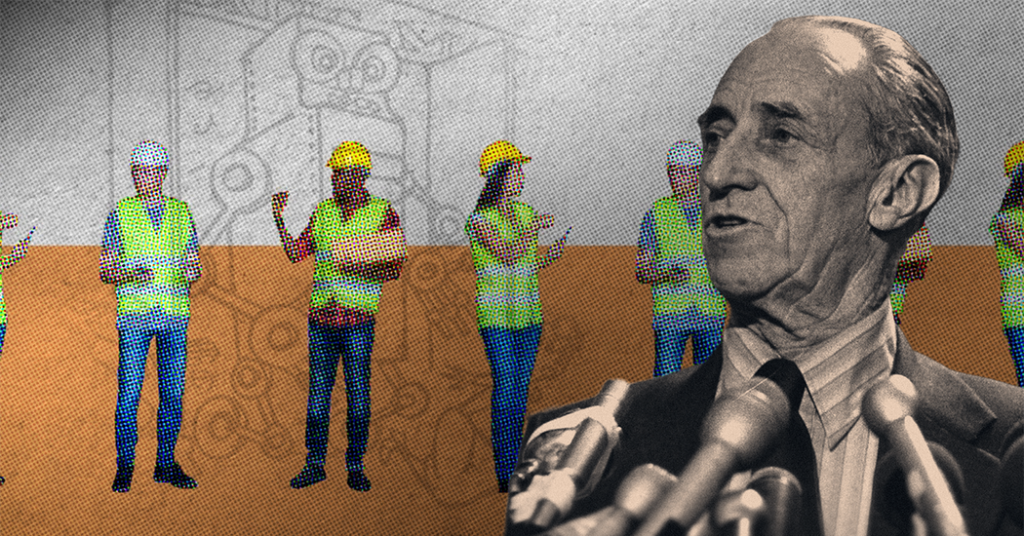
Workers are increasingly worried that artificial intelligence will take their jobs. Back in the late 1950s, on the San Francisco docks just down the street from what’s now Anthropic’s headquarters, a longshore labor leader named Harry Bridges faced a similar fear: that a new technology would make jobs disappear. The Opinion video above details the story of how Bridges fought to make technological change work for his longshoremen — and how workers today can use his playbook.
Below is an edited transcript of this video. We recommend watching it in its original form for the full effect. You can do so using the video player above.
Jillian Weinberger: Are you worried about A.I. taking your job? Yeah, us too.
Maybe older workers might be able to retire. And maybe younger workers could pivot. But what about the rest of us? Are we screwed? Well, this guy might just have a solution. His name is Harry Bridges.
He actually worked in San Francisco, down the street from what’s now Anthropic, OpenAI and Perplexity. He’s long dead, but he also lived through a technological revolution. And for him, that piece of technology was — the box.
OK, so this box. It was actually a container. And it revolutionized Harry’s world.
You see, Harry was a longshoreman, those guys who used to move lots of stuff from the ships to the docks. It was the 1950s, and the box threatened his way of life. It was about to put a lot of the longshoremen out of work.
Archival documentary clip: Salt-resistant aluminum alloy containers are automatically loaded and unloaded by a specially designed crane, with minimum use of manpower.
With the box, all the bosses needed was a man in a booth, rather than a gang of longshoremen on every pier. For Harry, the container was the A.I. of the 1950s. He was a union leader.
Archival clip of Harry Bridges: I know that every half penny or penny that they grant to the union workers in increased wages, that’s that much less profit. That brings about a conflict of interest. And that is generally known as the class struggle.
He wanted to protect workers. But Harry realized that he couldn’t stop the technological revolution in front of him. The containers were coming. There was too much money to be made. So Harry wanted a piece of that profit for the workers.
And he did have some leverage. The shipping companies still needed some workers to transition to the box. So Harry negotiated with the bosses. His men agreed — they wouldn’t fight the box. And the companies agreed to keep the current workers on until they retired, even if they didn’t have much work to do.
Most of the union was all for it. But some of the men were upset with Harry. The box would completely change the industry and a way of life on the waterfront. And they were right.
Today’s waterfront looks and feels totally different. But history shows that if the longshoremen had tried to resist, they would have lost. So Harry proactively made a deal. And just maybe, you should be thinking along the same lines.
Harry got what he did, in part, because he represented all of the longshoremen on the West Coast. And he negotiated with all of the shipping companies at once.
Today, that’s nearly impossible. Look around: Most Americans aren’t in unions. But there is a solution. It’s fun. It’s sexy. It’s — sectoral bargaining. OK, it’s an insanely wonky name for a really smart idea.
Here’s what it would look like: Take all the fast-food workers in the country — Wendy’s, Burger King, McDonald’s — it doesn’t really matter who they work for, they all work in a single sector. And their representative negotiates a deal with all the fast-food companies — kind of like our old pal Harry. Think it can’t work? Meet Dennis Dacke.
Labor organizer Dennis Dacke: [Waving] Hello!
Weinberger: He represents service workers in Germany — Lufthansa flight attendants, H&M retail workers, even Hamburg longshoremen. He negotiates sectoral bargains that require employers to use A.I. to help workers do their jobs — not replace them.
If they can’t do that, they need to train workers for other jobs. And any workers they still need to eliminate get a pile of money as they walk out the door. And all of that is possible because the deal binds the whole sector. It sets a minimum standard for everyone. Sounds great, right? But here’s the problem: In the United States, for most workers, sectoral bargaining is illegal. Until that changes, states should follow the example of Massachusetts.
The federal labor law prohibiting sectoral bargaining doesn’t apply to contractors. And in 2024, Massachusetts voted to allow it for ride-share drivers. Those workers now have a better chance to negotiate with companies like Uber and Lyft, and to fight for their share of the profits A.I. will likely bring in. We think Harry would approve.
Archival clip of Bridges: What’s good for the workers, I think, will have a beneficial effect on all other people in the country.
This video was produced by Jillian Weinberger. It was edited by Steph Khoury. The senior producer was Binyamin Appelbaum. Cinematography by Marina King and Kyle I. Kelley. Archival research by Rebecca Shaid and Tara Jayaram. Fact-checking by Julie Beer. Graphics by Emma Kumer. Audio mixing by Efim Shapiro. Audio recording by Isaac Jones. Original music by Carole Sabouraud. The postproduction manager is Mike Puretz. Audience strategy by Kristina Samulewski. The executive producer of Opinion Video is Erica Berenstein. The director of Opinion Video is Jonah M. Kessel. The director of audio engineering is Isaac Jones. The deputy director of Opinion Shows is Alison Bruzek. The director of Opinion Shows is Annie-Rose Strasser. The head of Times Opinion is Kathleen Kingsbury. Special thanks to Bill Saporito.
Opinion Video combines original reporting with creative storytelling to produce visually transformative commentary. Pitch a video guest essay here.
The Times is committed to publishing a diversity of letters to the editor. We’d like to hear what you think about this or any of our articles. Here are some tips. And here’s our email: [email protected].
Follow the New York Times Opinion section on Facebook, Instagram, TikTok, Bluesky, WhatsApp and Threads.
The post You Can’t Stop A.I. But You Can Bargain With It. appeared first on New York Times.