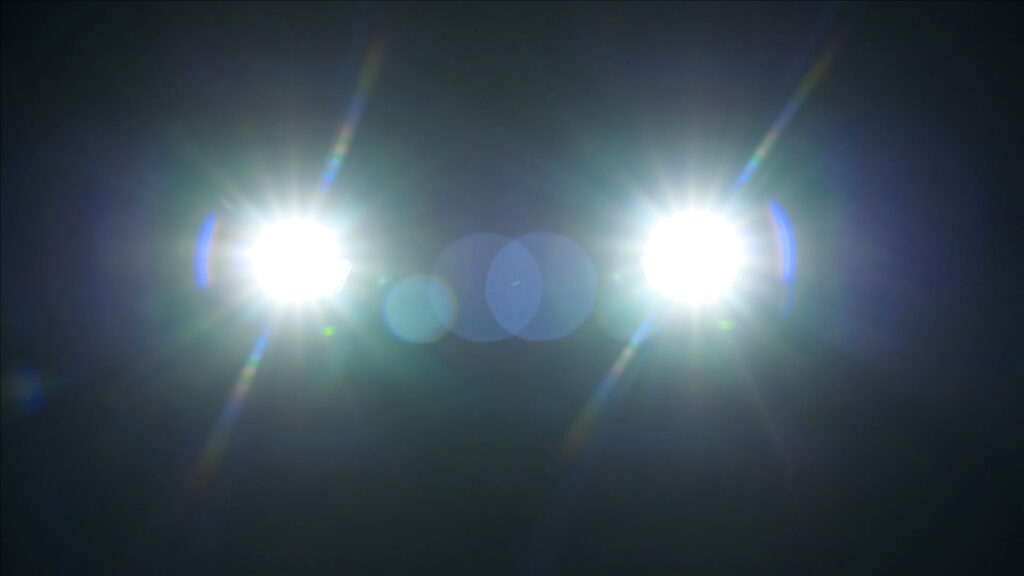
Matthew Brumbelow, like anyone else, gets annoyed when he’s blinded by oncoming headlights at night.
But it also gets him thinking.
He’s among the nation’s top headlight experts, having spent a decade investigating how automakers struggle to illuminate the road without forcing other drivers to squint and wince. Brumbelow wants to know what’s behind those irritating starbursts of lights. Headlights too powerful? Mounted too high? Aimed in the wrong direction? Maybe it’s the high beams.
“I’m just trying to understand what the source of the glare is,” said Brumbelow, principal research engineer at the Insurance Institute for Highway Safety (IIHS).
Headlights have unquestionably gotten brighter in the past two decades, driven in part by the tiny but powerful LEDs that have mostly replaced halogen bulbs. The whiter and bluer light of LEDs feels harsher. And the soaring popularity of trucks and SUVs means headlights are more likely to be mounted higher off the ground, putting the offending light right at driver-eye level.
“It’s one of the most hotly contested areas of vehicle design,” Brumbelow said.
It forces automakers to balance conflicting safety goals — giving drivers enough light to see without blinding others. Vehicles that get it wrong face potential consequences on two fronts: IIHS can ding them in its safety ratings, while regulators can order them to dial it back.
But pretty much everyone seems to think it’s a problem. When the National Highway Traffic Safety Administration (NHTSA) first solicited public input about headlamp glare back in 2001, it was flooded with more comments than it had ever received on any other safety concern to that point. Earlier this year, a AAA survey reported 6 in 10 drivers described glare after dark as a problem, with almost three-quarters of them saying it’d worsened over the past decade.
Now, NHTSA is promising to take a fresh look. The agency said this month that it wants to modernize the “outdated vehicle lighting standards” by again asking for public comments and creating an expert panel to examine headlight glare.
“Underlying all the public angst is that the regulations need to be looked at again,” said John Bullough, a program director at the Mount Sinai Light and Health Research Center in Albany, New York.
Experts say previous analysis failed to capture the extent of the problem because of how headlights are tested in the United States.
NHTSA evaluates the power and intensity of headlamps in a lab setting instead of on a finished vehicle. The rules don’t account for how headlights are aimed or mounted in the real world.
“I think that’s where a lot of the issues are coming into play,” Brumbelow said.
LEDs have introduced another challenge, “since the standards were written at a time when the only realistic lamps were incandescent,” Bullough said.
The bluer light of LEDs causes more “discomfort glare,” he said. “The color is more annoying and bothersome.”
Experts also want to see the U.S. rules take advantage of “adaptive driving beam” technology that uses cameras and sensors to automatically dim or shade headlights. ADB headlights preemptively avoid most glare problems. The systems are already found on many modern cars in Europe and other parts of the world.
The U.S. market is far behind. NHTSA changed its rules in 2022 to allow some ADBs, Brumbelow said, “but it was shoehorned in and has a lot of limitations.”
While the federal rules fall short, IIHS’s testing has encouraged automakers to change their ways.
The nonprofit group judges headlights in real-world situations. It wants to see headlights that can cast enough light for drivers to see at least 325 feet down a straight road, defined as an intensity that’s about five times as bright as moonlight on a cloudless night measured 10 inches above the roadway. But if the headlights cast too much light at a higher point — at 3 feet, 7 inches off ground — that’s considered glare.
A “poor” vehicle rating reflects a lack of adequate roadway illumination or too much glare.
Brumbelow said IIHS testing has found that things are improving. Just 5 percent of vehicles were cited for excessive glare with the 2026 model year, down from 21 percent in model year 2017.
Some of that improvement is due to automakers adopting a two-tier lighting design for their SUVs and trucks. Some, such as Kia, Hyundai and General Motors, have placed small running lights in traditional headlight spots and the true, powerful headlamps closer to the road on many models.
“Kia’s approach to headlight design aims to provide clear visibility for drivers while limiting glare for other road users,” said James Bell, a Kia spokesperson.
Brumbelow noticed the change.
“It just makes the balance between visibility and glare easier to accomplish,” he said. “The higher the headlight, the harder it will be to pass our test.”
And when automakers go too far, NHTSA tries to reel them in.
GM ran into trouble in 2022 when regulators discovered several model years of its GMC Terrain SUVs had headlights at least three times brighter than allowed by law. The automaker argued the problem was inconsequential. NHTSA disagreed and ordered GM to recall about 740,000 trucks to tone down the lights.
Subaru was forced to recall about 190,000 Imprezas that same year for a glare problem.
In August, Tesla recalled 21,000 Model 3 and Model Y vehicles for too-bright headlights.
Mark Baker has spent years fighting blinding headlights.
He first noticed the lights about a decade ago when he was a middle school math teacher in California.
“The blue-rich lights of the headlights — it was just crushing me,” Baker said. “I couldn’t take it anymore.”
In 2021, he started a group called the Soft Lights Foundation, which argues that people are being hurt by LEDs in cars and beyond. His group has sued and petitioned federal agencies to strictly regulate the use of LED bulbs.
“Blue is the worst possible choice for headlights,” Baker said.
The widespread use of LEDs, along with a chorus of headlight complaints, led Brumbelow to try to determine if glare was causing more accidents.
He examined police crash records from 11 states from 2015 to 2023 and found glare was cited as a contributing factor in 1 to 2 nighttime accidents per 1,000 — a rate that stayed pretty constant over time.
It was curious, Brumbelow said. Glare seemed to be a persistent problem, even as headlight technology improved.
He also found that most crashes attributed to glare hadn’t occurred at night at all, when headlights might have been a factor.
Most of them took place during the day, when the sun was close to the horizon.
The sun was like a giant headlight in the sky.
The post Why headlights seem more blinding than ever appeared first on Washington Post.