A high-speed passenger train rear-ended another on Wednesday near Toledo, Spain, killing at least 68 people and injuring dozens, according to local emergency officials.
It was one of the deadliest train crashes in the country’s history.
The collision comes months after another deadly train crash in southern Spain that involved the same carriers, killing 46 people in January.
The accident on Wednesday was the third fatal train crash in Spain this year, adding to deep concern about the safety of the country’s extensive rail system.
What happened?
Around 9 a.m., a train belonging to the private rail operator Iryo was stopped on the tracks near Toledo when a train operated by Spain’s national rail company, Renfe, barreled into it. Both trains were covering the route between Madrid, the capital, and the southern city of Seville.
Óscar Puente, Spain’s transportation minister, said in a news conference that the crash appeared to result from what he called an “inexplicable” decision by traffic control operators to tell the Renfe train to continue its journey when the other train was stopped farther along the tracks.
Passengers involved in the crash told local news outlets that the impact tossed people around cabins. Some crawled out of windows and lay in a nearby field, where local workers, who had heard the crash, rushed to help them.
Video filmed inside one of the train cars and verified by The New York Times showed smoke rising from a charred, mangled carriage on the slope by the rail line.
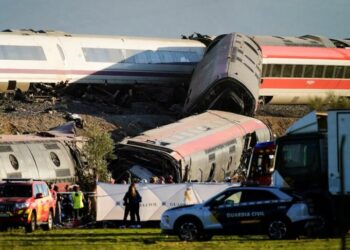
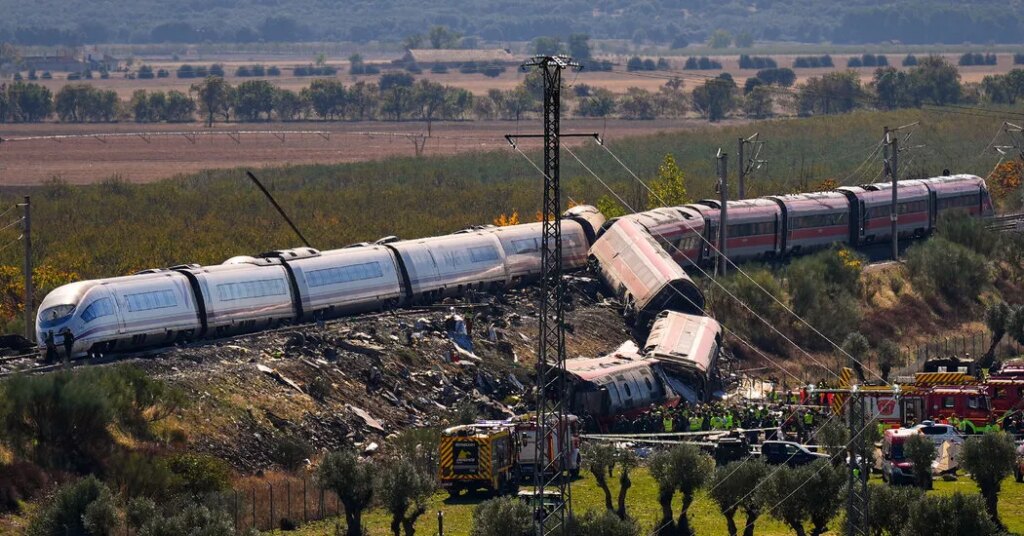
On Wednesday afternoon, the trains were surrounded by ambulances, police cars and fire trucks, with helicopters flying low overhead. Dozens of Civil Guard officers, some wearing white protective suits, were inspecting the scene.
Both trains appeared to have sustained substantial damage, according to images from the scene. The nose of the Renfe train, which was traveling to Seville, appeared destroyed. Three rear carriages of the Iryo train appeared to have been derailed, two of them overturned.
More than 50 people were injured in the crash, according to local officials. Some 397 passengers were aboard the Renfe train and about 150 aboard the Iryo train, local news outlets reported.
How are officials responding?
Prime Minister Pedro Sánchez traveled to the scene of the crash on Wednesday.
“It’s not possible for a country like Spain to suffer two high-speed train accidents in one year,” he said, adding that while Wednesday’s accident and a fatal January crash on the same line seemed unrelated, Spanish rail’s security systems clearly needed to be reinforced.
With national elections set for the end of November, the crash has the potential to become an issue in an already bitter campaign, in which opponents have attacked the competence of the left-wing government of Mr. Sánchez.
“I am very concerned about the information we are receiving regarding another train accident,” the conservative opposition leader, Alberto Núñez Feijóo, wrote on social media. “The priority now is to assist the victims and support their families. My full support goes to the emergency teams working on the ground.”
What is Spain’s history with train collisions?
The collision on Wednesday came months after a deadly collision involving the same carriers that killed 46 people.
In that accident, in January, a train belonging to Iryo derailed near the town of Adamuz as it traveled north toward Madrid from Málaga. Two of its rear cars fell onto the opposite track and were struck by a southbound train operated by Renfe.
An official report on what caused that accident is not yet completed, but preliminary investigations pointed to a broken rail as the likely cause.
In 2013, 80 people were killed when a high-speed train carrying more than 200 passengers derailed near Santiago de Compostela in northwest Spain and slammed into a concrete wall. The driver of the train admitted to speeding before the accident and was also on a call with a railway official before the crash.
The accident on Wednesday was the third fatal crash in Spain this year. Days after the accident in January, a commuter train near Barcelona struck a collapsed retaining wall and derailed, killing one person.
Reporting was contributed by José Bautista from the scene near Toledo, Jason Horowitz from Madrid, James McManagan from London and Carlos Barragán from New York.
The post What We Know About the Deadly Train Crash in Spain appeared first on New York Times.